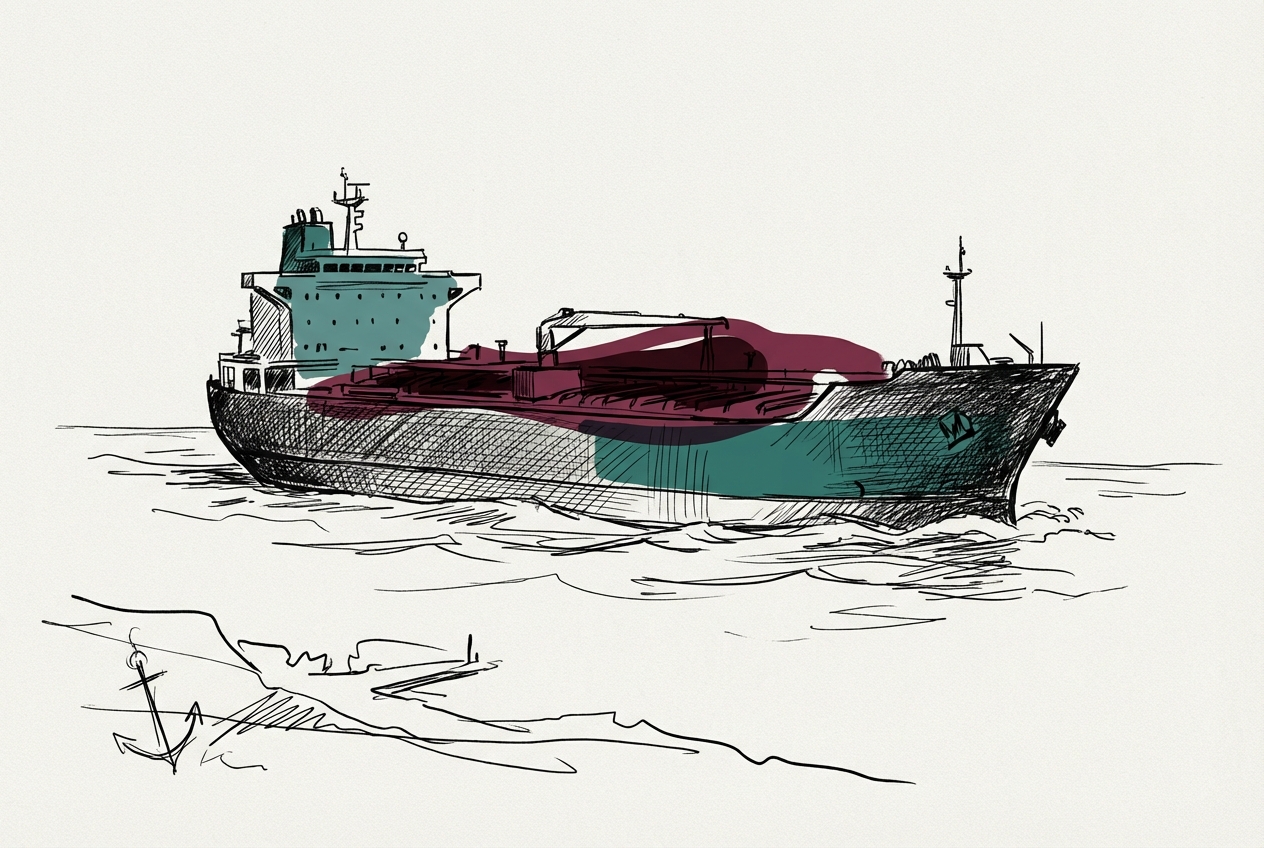
PING SHUN
Sanctioned Aframax tanker that proved Iranian crude can reach India, then China.
Last refreshed: 19 April 2026 · Appears in 1 active topic
Why did the Ping Shun divert from India to China overnight?
Timeline for PING SHUN
Mentioned in: Beijing backs Hormuz passage, names no Chinese hull
Iran Conflict 2026Diverted from Vadinar in India to Dongying in China ahead of GL-U lapse
Iran Conflict 2026: Ping Shun diverted from Vadinar to DongyingSanctioned Aframax tanker delivering Iranian crude to India
Iran Conflict 2026: First Iranian Crude Reaches India Since 2019Mentioned in: General License U Sets a Hidden Deadline
Iran Conflict 2026Background
The PING SHUN was diverted mid-transit from Vadinar (India) to Dongying (China) on 18-19 April 2026, as General License U lapsed at 00:01 EDT with no renewal. Indian state refiners, facing secondary-sanctions exposure for the first time since March, withdrew before the cliff. The diversion confirmed that Indian buyers were pulling away from GL-U-covered cargoes before the deadline, while Chinese Shandong independents remained undeterred.
The vessel is a sanctioned Aframax crude tanker (roughly 80,000-120,000 deadweight tonnes), having delivered 600,000 barrels of Iranian crude from Kharg Island to Vadinar in late March 2026, the first Iranian oil to reach India since May 2019. That delivery was executed under GL-U while Reliance Industries maintained rupee-based settlement mechanisms from pre-sanctions trade. The PING SHUN transited the strait of Hormuz under the IRGC toll system both inbound and outbound.
The PING SHUN diversion is the clearest single-vessel illustration of the Russia-Iran sanctions asymmetry: on the same day GL-U lapsed, Treasury extended Russia's seaborne-oil license GL-134B to 16 May 2026. Sanctioned Iranian tonnage pivoting from India to China's dark-fleet-adjacent Shandong ports is now the dominant pattern. 128 million barrels remain stranded in floating storage across the wider fleet; the PING SHUN's reroute is the proof of concept that the China pivot functions within 24 hours of a sanctions cliff.
Why was the Ping Shun diverted from India to China?
What is the Ping Shun tanker and why is it sanctioned?
How does the Ping Shun diversion show the Russia-Iran sanctions gap?



Written with AI from Lowdown's published reporting. Not individually reviewed by an editor. Updated 19 April 2026. Editorial standards.