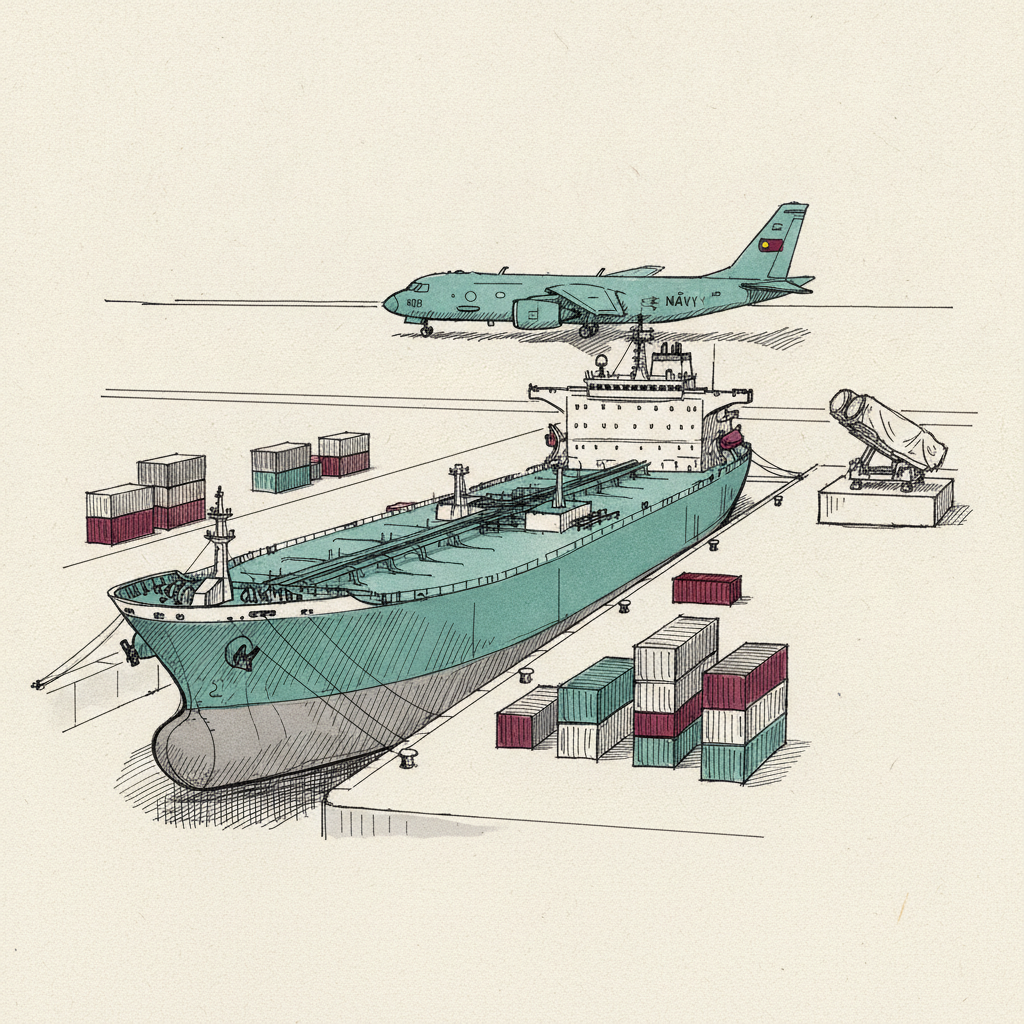
MT Settebello
Palau-flagged crude tanker struck by US forces in the Gulf of Oman on 11-12 June 2026, killing three Indian crew members.
Last refreshed: 15 July 2026 · Appears in 1 active topic
Who were the three Indian sailors killed when CENTCOM struck the MT Settebello, and what happened next?
Timeline for MT Settebello
Mentioned in: First sailors die in the tanker war
Iran Conflict 2026India brings the last dead sailor home
Iran Conflict 2026India brings its sailors home, with no apology
Iran Conflict 2026Mentioned in: Modi raised dead sailors; Trump gave nil
Iran Conflict 2026India takes Settebello deaths to G7
Iran Conflict 2026Background
MT Settebello is a Palau-flagged oil tanker that became the most politically consequential vessel casualty of the US naval enforcement operation in the Gulf of Oman during the 2026 Iran conflict.
On 11 June 2026, CENTCOM fired munitions into the tanker's engine room after it repeatedly failed to comply with US naval instructions. Three Indian nationals died in the strike: Aditya Sharma, Shivanand Chaurasiya and Patnala Suresh. Twenty-one of the remaining twenty-four crew were rescued. The vessel was one of at least three tankers disabled by US forces that week as part of the enforcement of what Washington described as a maritime exclusion zone around Iran.
India's response was unusually sharp by the standards of New Delhi's diplomatic register. The Ministry of External Affairs summoned the US Deputy Chief of Mission and lodged a formal protest; Shipping Minister Sarbananda Sonowal called the deaths 'deeply unfortunate'. The strike placed India (with some 300,000 seafarers at sea at any given time, the second largest seafarer workforce globally) in direct diplomatic confrontation with its strategic partner the United States. The vessel appeared in Iranian drone attack reports the following days as US forces continued operations in the strait and its approaches.
The human cost carried by the MT Settebello's crew crystallised the broader toll of the naval blockade on third-country nationals and neutral shipping. India's Prime Minister Modi placed the three sailors' deaths on the agenda of his bilateral with President Trump at the G7 summit in Evian on 17 June 2026, the first time the blockade's civilian cost was formally raised between a US ally and Trump at leader level. The incident added an Indo-Pacific dimension to what had been framed primarily as a US-Iranian and US-European affair, and set a precedent for how third-country governments might structure their opposition to similar enforcement operations.
What happened to the MT Settebello?
Who were the Indian sailors killed on the MT Settebello?
Why did US forces strike the MT Settebello?
How did India respond to the killing of its sailors by US forces?

