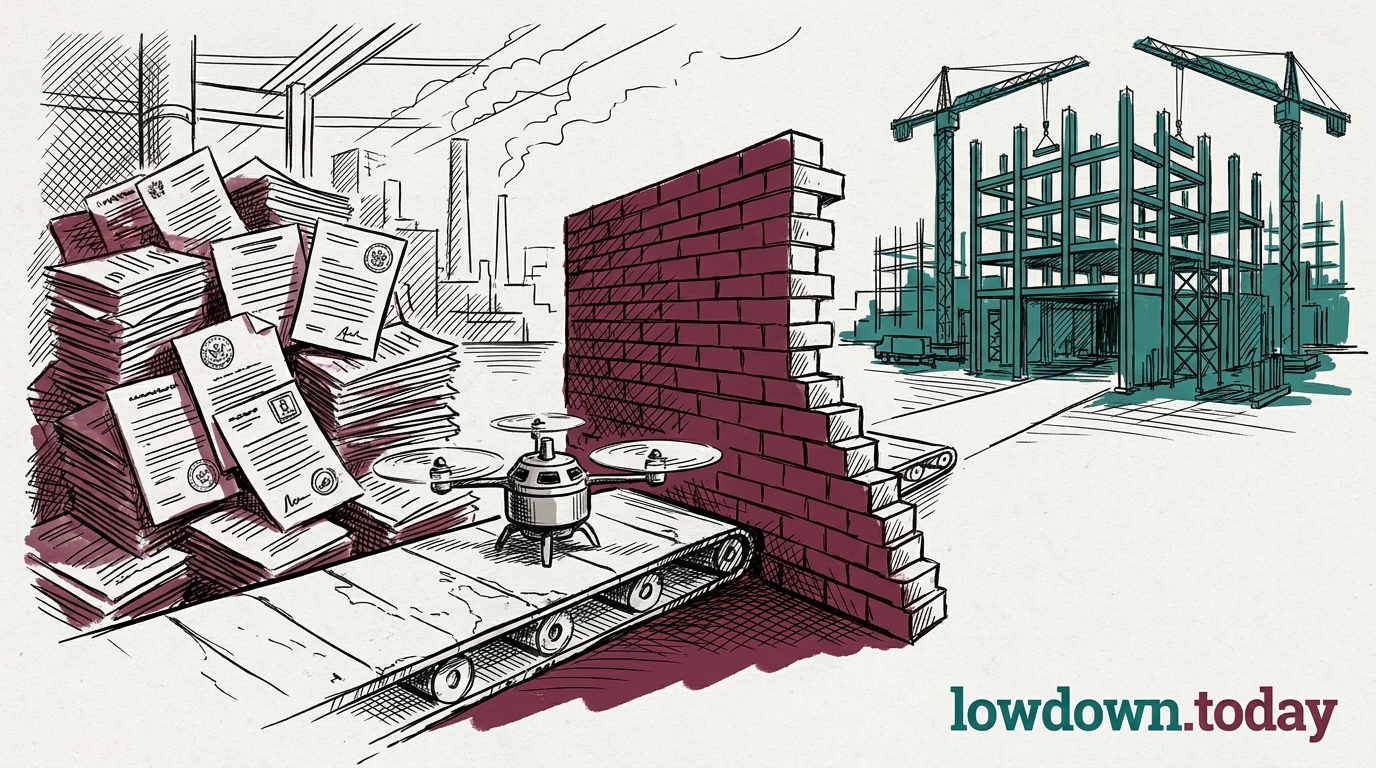
Shenzhen's Longhua District reported on 13 August that it had opened 145 low-altitude flight routes by July, 84 of them for logistics, and flown nearly 200,000 logistics drone sorties in the first half of the year, up about 60 per cent1. The district counts nearly 450 low-altitude companies, 225 take-off and landing pads, 1,267 5G-A base stations, meaning fifth-generation advanced cellular, and 88 weather stations resolving conditions down to 1.46 kilometres. First-quarter civil drone output rose 1,061.2 per cent against the same quarter of 2025, from a base of roughly 26,000 units, so that percentage measures a standing start rather than industrial scale. The sortie count is the durable number, because repeat flying is what generates the reliability record that unlocks the next permission.
Hunan province published in the same week, and its figures describe demand rather than manufacture2. The provincial industry department counted nearly 700 low-altitude applications and more than 250 logistics routes. Agricultural spraying reached 13.6 million mu, roughly 9,000 square kilometres, against water inspection across 469 square kilometres and more than 7,000 kilometres of transport-infrastructure inspection. Farming alone therefore accounts for close to twenty times the area of every water survey the province flew. Two low-altitude and BeiDou projects, BeiDou being China's satellite navigation system, have gone to the National Development and Reform Commission with provincial special funds behind them.
Same state, same fortnight, opposite directions. Beijing adds licensing friction to what leaves the country while two of its provinces publish route counts, pad counts and flight-hour growth for what stays. A Shenzhen manufacturer that loses an American customer still has 84 logistics routes at home to sell into, which is precisely the cushion that makes an export restriction bearable to the firms living under it.
The permission layer opened elsewhere too, in smaller increments. Singapore's Civil Aviation Authority of Singapore took sanctioned flying sites from two to six under a six-month trial from 3 August3. Australia's Civil Aviation Safety Authority proposed a single national beyond visual line of sight (BVLOS) examination and discretionary flight notices, consulting to 3 September4. The UK Civil Aviation Authority's Atypical Air Environments policy opened routine BVLOS inspection flights around pylons, turbines and secured sites5, the rule the FAA has yet to deliver against a Part 108 deadline it already missed in June. India's SVAMITVA cadastral programme has drone-surveyed 330,000 villages and issued 27.2 million property cards6, and its Ministry of Defence sought information on 2,715 logistic drones across three altitude bands reaching 20,000 feet7. A regulator can open a route or publish an exam syllabus inside a season, while a factory takes years, so the permissions move first and the industrial capacity follows them.




