Skip to content
Briefings are running a touch slower this week while we rebuild the foundations.See roadmap
Russia-Ukraine War 2026
1JUN

Day 1559: Oreshnik doubles as Russia's front collapses

4 min read
10:39UTC

Russia fired two Oreshnik intermediate-range ballistic missiles at Ukraine on 24 May, the first dual launch of the war, then Lavrov told Rubio to evacuate Kyiv. The weapons escalation came as ISW data showed Russia losing 100 square miles in four weeks at triple the attrition cost of 2025. Istanbul Round 2 agreed a 1,200-prisoner exchange but no ceasefire.

Key takeaway

Russia's front line collapsed while its weapons escalated; the dual Oreshnik launch substitutes strategic theatre for ground results.

This briefing mapped
Loading map…
Military
Diplomatic
Humanitarian
Economic

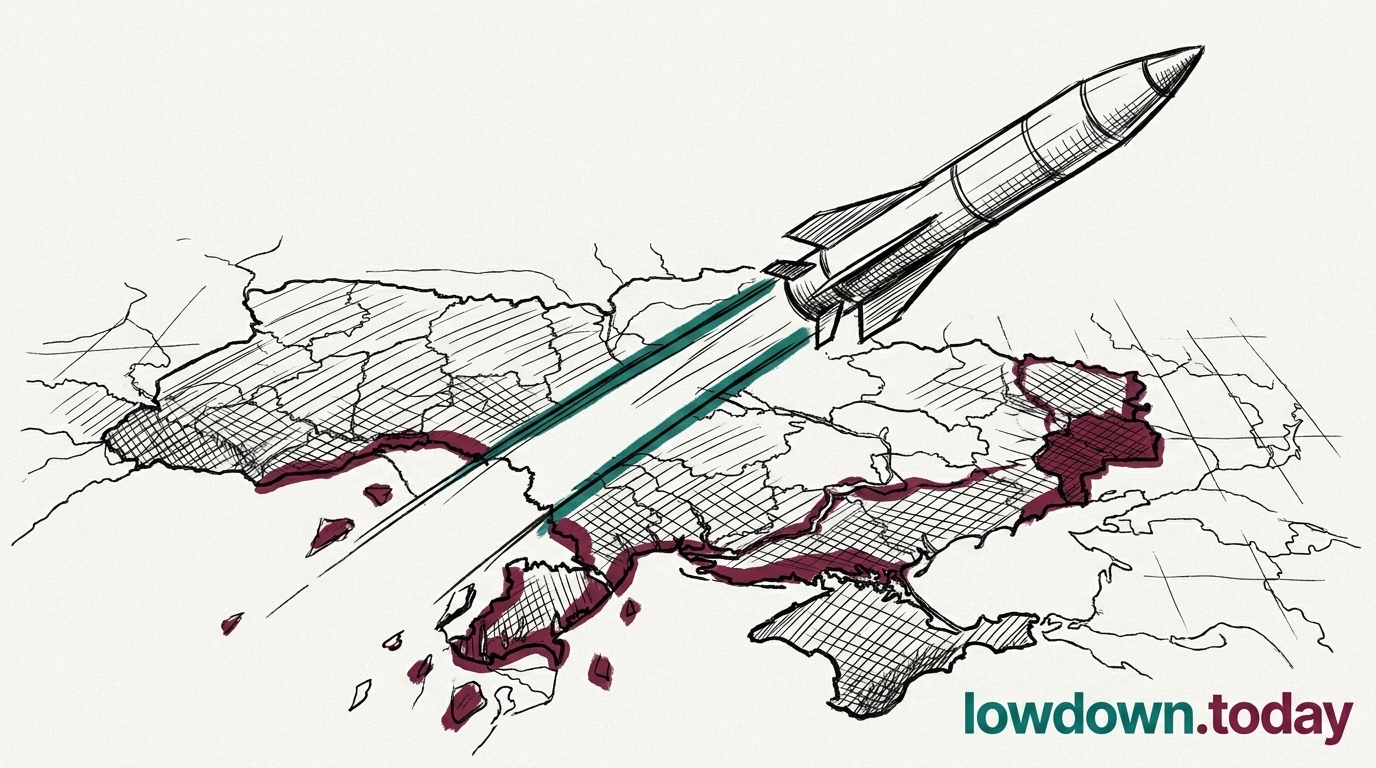
Russia launched two Oreshnik nuclear-capable missiles simultaneously on 24 May, anchoring a 690-weapon barrage that damaged 300 sites across every Kyiv district and killed four people. No air defence system Ukraine currently operates can intercept the Oreshnik.

Sources profile:This story draws on centre-left-leaning sources from Ukraine, United States and 1 more
UkraineUnited StatesFrance

Russia fired two nuclear-capable Oreshnik missiles at Ukraine simultaneously on 24 May, the first dual launch of the war, as part of a 690-weapon barrage that damaged 300 sites across Kyiv and killed four people. No Ukrainian air defence can intercept the Oreshnik.

Firing two at once signals Russia has moved from using the weapon as a one-off demonstration to deploying it as a regular strike tool. Poland scrambled jets. Zelenskyy wrote to Trump demanding urgent Patriot resupply. 

Briefing analysis

The Oreshnik belongs to a class of weapon that did not exist in operational European use for 36 years. The Intermediate-Range Nuclear Forces Treaty (INF), signed by Reagan and Gorbachev in 1987, eliminated all ground-launched ballistic and cruise missiles with ranges between 500 and 5,500 km from both US and Soviet arsenals. The treaty held until 2 August 2019, when the Trump administration withdrew, citing Russian violations (the SSC-8/9M729 cruise missile programme).

Russia's deployment of the Oreshnik in Ukraine is the first operational firing of a ground-launched IRBM in a European theatre since the Soviet SS-20 (RSD-10 Pioneer), which was withdrawn and destroyed under the INF by 1991. The SS-20 carried three independently targetable nuclear warheads to 5,000 km; NATO's response, the 1979 dual-track decision, deployed Pershing II and ground-launched cruise missiles in Western Europe while simultaneously negotiating.

The dual-track precedent is instructive. NATO's political response to the SS-20 took two years to formulate and eight years to resolve in treaty form. Russia's current Oreshnik use is more provocative in one respect: the SS-20 was never fired in anger. The Oreshnik has now been fired three times at Ukrainian targets, twice in a single salvo.
Sergei Lavrov called Marco Rubio on 25 May to warn that Russia would launch systematic strikes on Kyiv's decision-making centres and demanded the evacuation of US diplomatic staff and American citizens. It was the first such demand of the full-scale war; the US did not comply.

Sources profile:This story draws on centre-left-leaning sources from Qatar and United States
QatarUnited States

Sergei Lavrov called Marco Rubio on 25 May to formally warn that Russia would launch systematic strikes on Kyiv's government buildings and demanded the evacuation of US diplomats and citizens. It was the first such demand of the full-scale war. The US did not comply, nor did any EU embassy.

By issuing a formal pre-strike warning, Russia creates a legal record it can cite if Western personnel are later harmed. The Lavrov-Rubio call was the first direct contact between them since 5 May, a 20-day gap spanning both Istanbul Round 1 and the Oreshnik barrage. 

Ukraine's Unmanned Systems Forces destroyed a 2,484 sq m drone training compound in Russian-occupied Snizhne on 20-21 May, killing 65 Sever-Akhmat cadets and one instructor. Russia cited a follow-up strike on Starobilsk as its formal justification for the 24 May Oreshnik barrage.

Sources profile:This story draws on neutral-leaning sources from United States
United States
LeftRight

Ukraine's Unmanned Systems Forces destroyed a 2,484 sq m drone training compound in Russian-occupied Snizhne on 20-21 May, killing 65 Sever-Akhmat cadets and one instructor using 11 drones. Russia cited a follow-up strike on a second facility in Starobilsk as its formal justification for the 24 May Oreshnik barrage.

The operation targeted the training pipeline rather than frontline units. The proportionality gap is stark: 11 Ukrainian drones against a military school; 690 Russian weapons including nuclear-capable missiles against Kyiv

ISW data compiled by Russia Matters shows Russia net-lost 38 square miles in the week of 19-26 May, its largest single-week reversal of 2026, and 100 square miles over four weeks. Russia's net advance rate for January-May 2026 is 94% below the same period in 2025.

Sources profile:This story draws on neutral-leaning sources from United States
United States
LeftRight

ISW data from Russia Matters shows Russia net-lost 38 square miles in the week of 19-26 May, its worst single-week reversal of 2026, and 100 square miles over four consecutive weeks. Russia's net advance rate for January-May 2026 stands at 94% below the same period in 2025.

The territorial collapse is the direct context for the dual Oreshnik launch: Moscow is substituting a strategic-weapons narrative for operational results it cannot achieve on the ground. 

Marco Rubio confirmed on 22 May that US-led peace mediation had stagnated and that no talks were occurring, three days before Lavrov's evacuation demand. The withdrawal leaves Turkey's Istanbul bilateral channel as the sole active diplomatic format.

Sources profile:This story draws on centre-left-leaning sources from Ukraine
Ukraine

Marco Rubio confirmed on 22 May that US-led peace mediation had stagnated and no talks were occurring, three days before Lavrov used that same channel to warn him about further strikes on Kyiv. Russia and Ukraine now meet only through Turkey's Istanbul bilateral format, with no American participation.

The US withdrawal removes the last potential American de-escalation route. The GL 134C sanctions waiver, expiring 17 June, becomes Washington's primary remaining pressure instrument by default. 

Mykhailo Fedorov calculated that Russian forces were suffering 179 losses per square kilometre of advance in 2026, nearly three times the 67 per sq km in 2025. Mediazona's running database recorded verified dates of death for 202,000 Russian soldiers as of 22 May.

Sources profile:This story draws on mixed-leaning sources from Qatar
Qatar

Mykhailo Fedorov calculated that Russian forces suffered 179 losses per square kilometre of advance in 2026, nearly three times the 67 per sq km rate of 2025. Mediazona's database recorded verified dates of death for 202,000 Russian soldiers as of 22 May.

At that attrition rate, Russia's defence budget is funding operations at roughly three times the per-kilometre human cost it planned for. The National Wealth Fund's remaining liquid assets cover only about six months of deficit financing at current overshoot rates. 

Russia and Ukraine met for a second time at Istanbul's Ciragan Palace on 2 June and agreed to exchange up to 1,200 prisoners per side, including journalists and political prisoners; Russia pledged to return 6,000 bodies. Ukraine's proposed 30-day ceasefire was rejected; a third round was set for 20-30 June.

Sources profile:This story draws on mixed-leaning sources from United States
United States
LeftRight

Russia and Ukraine met at Istanbul's Ciragan Palace on 2 June and agreed to swap up to 1,200 prisoners per side, including journalists and political prisoners, with Russia also pledging to return 6,000 fallen Ukrainian soldiers' bodies. Ukraine's proposed 30-day Ceasefire was rejected; Russia countered with a 2-3 day partial pause that Zelenskyy called shortsighted.

The Istanbul mechanism now has two rounds and no Ceasefire. The ceiling is visible: prisoner exchanges work because they avoid territorial questions; a Ceasefire cannot work for exactly the same reason. 

The 1,000-for-1,000 exchange agreed at Istanbul Round 1 completed approximately 23-25 May, the largest single prisoner swap of the full-scale war. Ukraine has now repatriated over 5,000 prisoners since March 2022.

Sources profile:This story draws on centre-left-leaning sources from Ukraine
Ukraine

The 1,000-for-1,000 prisoner exchange agreed at Istanbul Round 1 was completed approximately 23-25 May, the largest single swap of the full-scale war . Ukraine has now repatriated over 5,000 prisoners since March 2022.

Completion in roughly 10 days from agreement to finish shows both sides pre-positioned the logistics before the Istanbul session ended. The swap ran concurrently with Russia's largest missile strike on Kyiv, confirming that humanitarian and military tracks operate independently. 

A drone struck the turbine building adjacent to reactor 6 at Zaporizhzhia Nuclear Power Plant on 30-31 May, the first confirmed impact on a reactor-adjacent structure. IAEA inspectors confirmed debris and a damaged hatch; radiation levels remained normal. The plant also lost all communications for 12 hours on 27 May.

Sources profile:This story draws on neutral-leaning sources from Austria
Austria

A drone struck the turbine building adjacent to reactor 6 at Zaporizhzhia Nuclear Power Plant on 30-31 May, the first confirmed hit on a reactor-adjacent structure. IAEA inspectors confirmed debris and a damaged hatch; radiation levels remained normal. The plant also lost all communications for 12 hours on 27 May.

The plant has been on a single backup power line for over 70 days. If that line fails, ZNPP would depend on diesel generators with reserve levels not publicly reported. No repair Ceasefire for the main 750 kV line has been agreed despite IAEA Director General Grossi's continuing negotiations

Ukraine's drone strike on the Syzran refinery on 21 May forced the facility to shut down on 25 May, the 11th Russian refinery hit in May 2026. The Syzran plant supplies fuel to the Russian Air Force.

Sources profile:This story draws on centre-left-leaning sources from Ukraine
Ukraine

Ukraine's 21 May drone strike forced the Syzran refinery in Samara Oblast to shut down on 25 May, the 11th Russian refinery hit in May 2026. The plant supplies fuel to the Russian Air Force.

Eleven refineries in a single month is Ukraine's most intensive refinery campaign of the war. With Russian gasoline output already down 30% and diesel down 25% before Syzran closed, the shutdown adds sustained pressure to Russian aviation fuel supply at the source. 

Ukraine's Verkhovna Rada approved the EUR 90 billion EU loan agreement on 28 May; the first tranche of EUR 9.1 billion, covering EUR 5.9 billion in defence spending and EUR 3.2 billion in macro-financial support, is expected to arrive mid-June.

Sources profile:This story draws on neutral-leaning sources

Ukraine's Verkhovna Rada approved the EUR 90 billion EU loan on 28 May. The first tranche of EUR 9.1 billion, split EUR 5.9 billion for defence and EUR 3.2 billion for macro-financial support, is expected mid-June.

The disbursement converges in the same week as the GL 134C sanctions cliff on 17 June and Istanbul Round 3 proposed for 20-30 June. Three major financial and diplomatic events in one window make mid-June the most concentrated decision point of 2026. 

Closing comments

Upward, with a mid-June inflection decision. The dual Oreshnik launch and Lavrov's evacuation demand together create an architecture for continued strikes on Kyiv's government district that did not exist before 24 May. The specific mechanism that would tip escalation further is whether Russia fires a third Oreshnik within 30 days of the dual launch: a single pair can still be framed as a coercive signal; a confirmed pattern of paired launches establishes an operational doctrine with no INF-era legal ceiling. The GL 134C decision on 17 June is the parallel inflection: if Treasury renews the waiver, Russia's oil revenue stream remains partially intact and the fiscal pressure that is currently degrading its offensive capacity eases. If it expires, the compounding fiscal and operational pressure on Russia intensifies through summer 2026.

Different Perspectives
Russia
Russia
The Kremlin framed the dual Oreshnik launch and Lavrov's evacuation demand as a proportionate response to Ukrainian strikes on Luhansk Oblast, which Russia treats as annexed territory. Moscow's position is that systematic strikes on Kyiv's decision-making infrastructure will continue as long as Ukraine targets Russian-held land.
Ukraine
Ukraine
Zelenskyy called Russia's 2-3 day ceasefire counter-offer at Istanbul Round 2 "shortsighted" and submitted a full peace memorandum covering EU membership, international guarantees, phased sanctions relief and frozen-asset reparations. Kyiv's position is that a partial ceasefire freeze aids Russian reconstitution; only an all-domain 30-day pause is acceptable.
United States
United States
Rubio declared US mediation stagnated on 22 May and confirmed no talks were occurring, then received Lavrov's evacuation demand three days later without ordering embassy drawdown. Washington's leverage now runs through the GL 134C sanctions cliff on 17 June rather than any active diplomatic channel.
European Union
European Union
EU Ambassador Mathernova answered Lavrov's evacuation demand with "We stay in Kyiv. We stay with Ukraine." The Verkhovna Rada approved the EUR 90bn EU loan on 28 May; the EUR 9.1bn first tranche, the EU's first explicit defence-procurement financing, arrives mid-June.
Turkey
Turkey
Ankara hosted Istanbul Round 2 at Ciragan Palace on 2 June and secured a 1,200-for-1,200 prisoner exchange, consolidating Turkey as the war's sole diplomatic venue after Rubio confirmed US mediation has ended. Erdogan's leverage over both parties grows with each round.
IAEA
IAEA
Director General Grossi condemned the ZNPP reactor-6 turbine building strike and stated "there should be no attack of any kind from or against the plant." The agency confirmed normal radiation levels but has not resolved attribution; Rosatom CEO Likachev warned the region is "one step closer to an incident."

