Skip to content
Briefings are running a touch slower this week while we rebuild the foundations.See roadmap
Russia-Ukraine War 2026
22MAY

Day 1549: Istanbul talks, refineries dark, deficit overruns

4 min read
10:57UTC

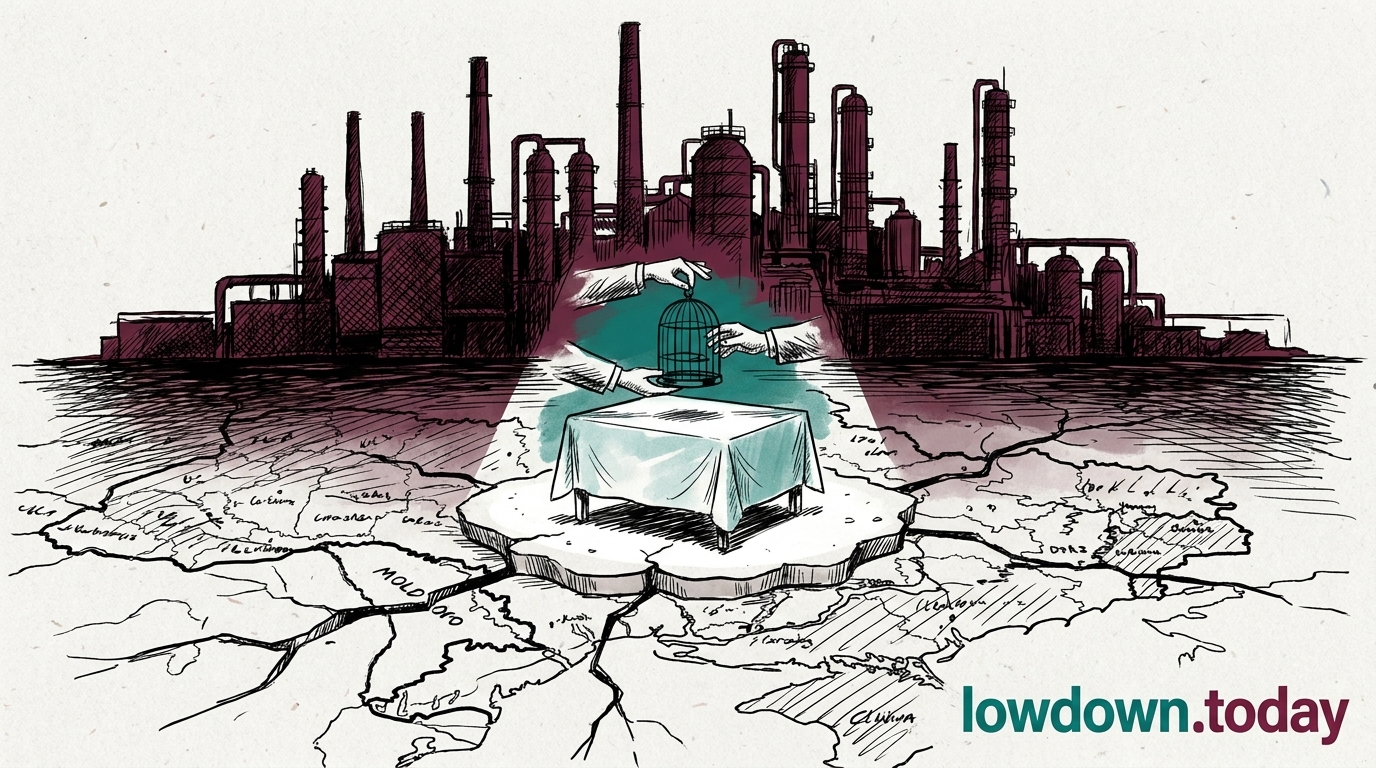
Russia and Ukraine met in Istanbul on Saturday 16 May for the first direct talks since 2022. One hour, a 1,000-prisoner deal, and zero movement on territory. Behind the cameras, Ukraine has halted roughly a quarter of Russia's refining capacity, Treasury has rolled the crude waiver for a third 30-day window, and Russia's Q1 deficit has already blown past its full-year target.

Key takeaway

Russia accepted Istanbul because the format is the only venue where engagement costs nothing on territory.

This briefing mapped
Loading map…
Diplomatic
Military
Economic
Regulatory
Infrastructure
Humanitarian

Russia and Ukraine met face to face for the first time since March 2022 on Saturday 16 May, agreed a 1,000-prisoner deal at Dolmabahce Palace, and closed inside the hour with Moscow's territorial demand untouched.

Sources profile:This story draws on mixed-leaning sources from United States
United States

Russia and Ukraine held direct talks in Istanbul on 16 May 2026, the first face-to-face contact since the March 2022 collapse, producing a 1,000-for-1,000 prisoner exchange agreement but no movement on Russia's precondition that Ukraine withdraw from all four annexed regions before any ceasefire.

First direct Russia-Ukraine contact in three years produced one humanitarian deliverable and zero movement on the four-region withdrawal Moscow has demanded since 2022, handing Putin a peace-talk news cycle at no concession cost. 

Ukrainian drones struck the Syzran refinery overnight Wednesday 20 to Thursday 21 May, more than 800 km from the front, the latest in a wave Reuters reported has halted around a quarter of Russia's refining capacity.

Sources profile:This story draws on mixed-leaning sources from United Kingdom and United States
United KingdomUnited States
LeftRight

Ukrainian drones struck the Syzran refinery in Samara Oblast on 20-21 May 2026, more than 800 km from the front, killing two and igniting fires. Reuters reported on 20 May that Ukrainian strikes have now halted or reduced operations at nearly all major central Russian refineries — Kirishi, Moscow, Ryazan, Yaroslavl, Syzran and Kstovo — affecting 83 million tonnes/yr of capacity (approximately 25% of Russian total refining), with gasoline output down 30% and diesel down 25%.

Ukraine has shifted the strike map from revenue-erosion targeting to direct hits on the fuel supply for the Russian Air Force and military logistics, changing what cumulative damage means for the war's tempo. 

Russia's Q1 2026 budget deficit reached 4.6 trillion rubles against a 3.8 trillion full-year target, per Meduza's 7 May analysis, while GDP contracted 0.3 per cent year on year against a 1.3 per cent government forecast.

Sources profile:This story draws on centre-left-leaning sources from Ukraine
Ukraine

Russia's Q1 2026 budget deficit reached 4.6 trillion rubles, exceeding the government's full-year target of 3.8 trillion rubles. Q1 GDP contracted 0.3% year on year against the government's own 1.3% forecast. April oil and gas revenues fell to 855.6 billion rubles, down 21.2% year on year, extending the 38.3% year-on-year drop for January to April. The liquid share of the National Wealth Fund fell to 3.89 trillion rubles, down 60% from 9.74 trillion at the invasion's start. Enterprise overdue debt reached 8 trillion rubles, 3.8% of GDP.

Moscow has burned the entire 2026 deficit ceiling in three months while the economy slips into technical contraction, narrowing the room to finance the war and the social peace simultaneously. 

OFAC issued General License 134C on Monday 18 May after a 48-hour enforcement gap, extending the Russian-crude waiver another 30 days while explicitly excluding Cuba from coverage from 17 June.

Sources profile:This story draws on neutral-leaning sources from Austria
Austria

Treasury removed Cuba from its Russian-crude waiver coverage on 18 May 2026, issuing GL 134C with explicit Cuban exclusion two days after GL 134B lapsed. The 48-hour enforcement gap is the second consecutive cliff; the rolling 30-day bridge pattern (GL 134A April, 134B mid-May, 134C now) confirms Treasury is managing the waiver in monthly windows rather than terminating it. Bessent justified the extension as helping 'the most vulnerable nations'; Cienfuegos refinery loses US sanctions cover for incoming Russian cargoes on 17 June.

A third consecutive 30-day rolling licence confirms Treasury is running the Russian-crude waiver as a managed permanent instrument, and the Cuba exclusion turns that instrument into a country-specific foreign-policy lever. 

Sources:IAEA

Rosatom chief Alexey Likhachev accused the IAEA Secretariat on Sunday 17 May of ignoring Ukrainian strikes on Zaporizhzhia, just as the plant approached 60 days running on its single remaining backup external power line.

Sources profile:This story draws on mixed-leaning sources from United States
United States

Rosatom chief Alexey Likhachev publicly accused the IAEA Secretariat on 17 May 2026 of ignoring Ukrainian strikes on Zaporizhzhia, marking the first Russian-state attack on the watchdog's credibility since the occupation began. The intervention coincided with the plant passing 60 days on single backup feed by 23 May. Grossi has been unable to broker a sixth repair ceasefire; the Rosatom posture degrades the mediation track.

A Russian state attack on the only multilateral safety track at Europe's largest nuclear plant degrades the credibility Grossi needs to broker a sixth repair ceasefire, with the disconnection clock now past two months. 

Sources:Mediazona·NPR

Ukraine launched more than a thousand drones at Russian targets on Sunday 17 May, the largest single-day Ukrainian barrage of the war, killing four people in the Moscow region including an Indian worker at a refinery construction site.

Sources profile:This story draws on neutral-leaning sources from Austria
Austria

Ukraine launched more than 1,000 drones at Russian targets on 17 May 2026, the largest single-day Ukrainian barrage of the war. Four were killed and twelve wounded in the Moscow region. An Indian national working at an oil-refinery construction site was among the dead; three other Indian workers were hospitalised. The Indian Embassy in Moscow confirmed the casualty.

The single-day volume reset what 'mass barrage' means in this war, and a foreign-national fatality at a Russian energy site introduces a third-country pressure point Moscow has avoided so far. 

ISW assessed Russia net-lost 12 sq mi between 5 and 12 May and a further 29 sq mi between 12 and 19 May, extending the April territorial-loss pattern as Moscow extended its gasoline export ban through 31 July.

Sources profile:This story draws on neutral-leaning sources

Russia's Q1 2026 budget data, synthesised by Meduza on 7 May, showed the full-year deficit target blown in one quarter and GDP in contraction. ISW assessed Russia net-lost 12 sq mi (5-12 May) and 29 sq mi (12-19 May), the second and third consecutive net-loss weeks extending the April territorial-loss pattern. Russia imposed a gasoline export ban through 31 July 2026 in response to refinery damage.

Two more weeks of net-negative Russian advance, paired with a fuel-export ban extension, suggest the front line and the home fuel market are tightening on the same timeline. 

Ukraine and Russia exchanged 205 prisoners each side on 15-16 May, executing the first tranche of the Istanbul deal eight days after Putin had publicly blocked it by denying Kyiv submitted a list.

Sources profile:This story draws on mixed-leaning sources from United States
United States

The 205-for-205 first tranche of the 1,000-prisoner deal was executed on 15-16 May 2026. Putin had denied Ukraine submitted a list when blocking the deal on 12 May; eight days later, 205 prisoners each side walked free. 795 each side remain in subsequent tranches.

Two hundred and five families on each side received returned soldiers in the only deliverable the new diplomatic format has so far produced, with 795 each side still owed under the agreement. 

Closing comments

Vertical: Ukraine's 2026 refinery campaign has shifted from Baltic export terminals to Syzran, which the General Staff says supplies the Russian Air Force; the six-refinery outage accounts for roughly 25% of national refining capacity. Nuclear: ZNPP enters day 60 on the single Ferosplavna-1 line on 23 May 2026; three prior total power-loss events stayed inside 90-minute diesel windows; a fourth without diesel would cross into uncharted territory. Diplomatic: the absence of a round-two Istanbul date by mid-June is the earliest measurable signal the format has collapsed.

Different Perspectives
Volodymyr Zelenskyy, Ukrainian President
Zelenskyy declined to attend Istanbul personally, dispatching Defence Minister Umerov, and banked the 205-prisoner tranche as the only deliverable the format could produce without ceding diplomatic ground. Kyiv's position is that no ceasefire is available while Russia holds the four-region withdrawal precondition, and the 1,000-drone barrage on 17 May signals Kyiv is maintaining military pressure in parallel with talks.
Vladimir Putin, Russian President
Putin authorised the Istanbul session without updating Medinsky's 2022 brief, securing a peace-engagement headline while the four-region withdrawal precondition remained publicly intact. Moscow's 48-hour delay in issuing written ceasefire proposals preserves the scheduling ambiguity Russia has used since the Peskov precondition statement on 9 May.
Donald Trump / US Treasury
Treasury issued GL 134C with a 48-hour gap after GL 134B expired, confirming the waiver series functions as permanent monthly management rather than a wind-down instrument. Washington was absent from the Istanbul room; Treasury Secretary Bessent framed the Cuba carve-out as protecting 'most vulnerable nations', maintaining the fiction that the 30-day bridge has a humanitarian rationale.
European Council / Commission
The Commission is preparing a three-document disbursement package for the 9.1-billion euro first tranche of the EU loan to Ukraine, targeting first-half June, but delivery depends on the Magyar cabinet, which formed on 12 May, not blocking the mechanism. The 20th sanctions package remains in force against Russia.
Viktor Orban / Hungarian Government
Budapest's new cabinet, formed 12 May, holds the institutional veto point on the EU tranche disbursement ahead of the first-half June window. Hungary has previously leveraged EU loan tranches to extract bilateral concessions; the combination of a fresh cabinet and a tight disbursement timeline makes Budapest the single highest-leverage actor in the EU track this fortnight.
Recep Tayyip Erdogan, Turkish President
Erdogan met Zelenskyy in Ankara for nearly three hours on 15 May before the Istanbul session, recovering Turkey's 2022 mediator role and reducing Trump's leverage by hosting bilateral talks without Washington in the room. Turkey hosts the NATO Ankara summit on 7-8 July; the Istanbul format gives Erdogan standing at both tables simultaneously.