Skip to content
Briefings are running a touch slower this week while we rebuild the foundations.See roadmap
Russia-Ukraine War 2026
1JUN

Russia loses 100 sq miles in four weeks

3 min read
10:39UTC

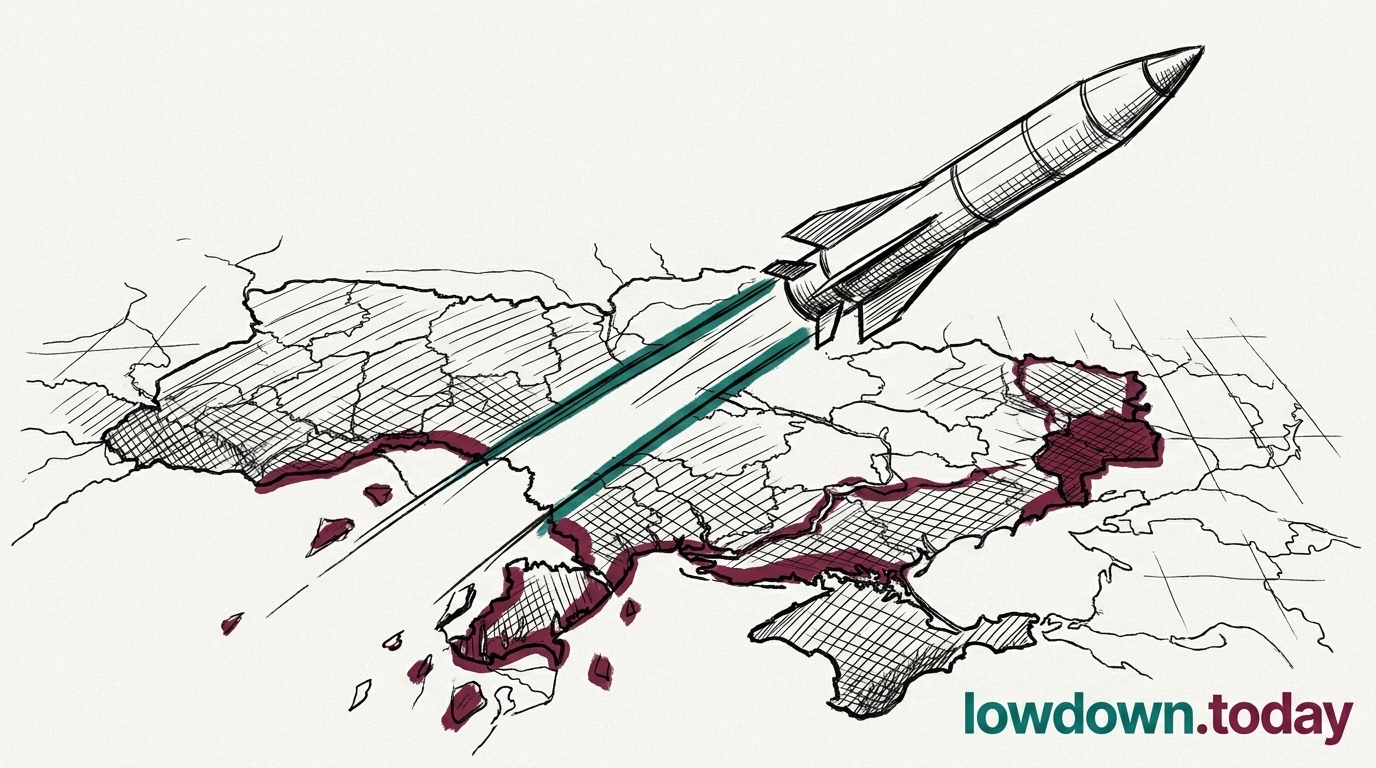
ISW data compiled by Russia Matters shows Russia net-lost 38 square miles in the week of 19-26 May, its largest single-week reversal of 2026, and 100 square miles over four weeks. Russia's net advance rate for January-May 2026 is 94% below the same period in 2025.

ConflictDeveloping
Key takeaway

Russia's net advance rate collapsed 94% year-on-year as it net-lost 100 sq mi in four consecutive weeks.

Russia net-lost 100 square miles of Ukrainian territory over four weeks (28 April to 26 May), including 38 sq mi in the week of 19-26 May, according to ISW data compiled by Russia Matters at Harvard's Belfer Center. Russia's operational pattern since the full-scale invasion has been incremental advance punctuated by Kursk-style reversals; a four-week sustained net-loss run is something else.

The net advance rate collapsed 94% year-on-year, from 1,619 sq km in January-May 2025 to 104 sq km in the same window of 2026. Seasonal factors cannot account for that. It tracks the period of Ukraine's most intensive drone campaign against Russian logistics and training infrastructure.

For Russia's defence establishment, the data bites. The 2026 defence budget of 13.5 trillion rubles was calibrated on higher advance rates. At current attrition and territorial costs, each ruble buys less than a fifth of the territory it bought in 2025.

NATO Secretary General Mark Rutte said on 21 May that Ukraine's defences are "stabilising the frontline," the closest the Alliance has come to acknowledging a Ukrainian operational advantage. ISW recorded Russia's first net monthly loss since the August 2024 Kursk incursion , then 12 sq mi lost in 5-12 May and 29 sq mi in 12-19 May ; the four-week figure extends that reversal to its deepest point.

Deep Analysis

In plain English

Russia is losing ground in Ukraine at the fastest rate since 2024. Over four weeks from late April to late May, it gave back roughly 100 square miles of territory it had taken earlier in the war. To put that in perspective: in the first five months of 2025, Russia gained around 1,000 square miles. In the same period of 2026, it has gained only about 40 square miles total, and is now losing ground. This military failure is directly connected to Russia's missile escalation: the Kremlin is using its most powerful weapons to create the appearance of military dominance while its troops retreat on the ground.

Deep Analysis
Root Causes

Ukraine's drone campaign against Russian logistics, training infrastructure, and refinery supply has degraded the support chain that sustains frontline Russian units. Destroying fuel supply (11 refineries struck in May) and training pipelines (Snizhne and Starobilsk) simultaneously reduces both the operational reach and replacement rate of frontline Russian forces.

Russia's 2026 defence budget was calibrated on the 2025 advance rate of 9.76 sq km per day. At the actual 2026 rate of 2.9 sq km per day during January-April, followed by net losses in May, the budget is funding operations at a cost-per-kilometre roughly five times higher than planned. That fiscal mismatch becomes unsustainable as the National Wealth Fund approaches the floor at which it can no longer cover deficit financing.

What could happen next?
  • Consequence

    Russia's spring-summer offensive plans are operationally bankrupt at current attrition rates; the Kremlin must accept a defensive posture or commit reserves the 2026 budget cannot fund.

  • Opportunity

    Ukraine's demonstrated counterattack capacity strengthens Kyiv's negotiating position in any future ceasefire format by establishing a favourable baseline front line.

First Reported In

Update #18 · Oreshnik doubles as Russia's front collapses

ISW / Critical Threats· 1 Jun 2026
Read original
Causes and effects
This Event
Russia loses 100 sq miles in four weeks
Four consecutive weeks of Russian territorial retreat, culminating in its worst position since August 2024, is the military context in which the dual Oreshnik launch occurred; the weapons escalation and the front-line collapse are directly correlated.
Different Perspectives
China
China
Beijing has not publicly commented on the dual Oreshnik launch. China's declared position of urging restraint and dialogue sits awkwardly alongside its continued economic ties with Russia; the weapons escalation tests whether Beijing's neutrality framing can survive a European IRBM normalisation event.
IAEA
IAEA
Director General Grossi condemned the ZNPP reactor-6 turbine building strike and stated "there should be no attack of any kind from or against the plant." The agency confirmed normal radiation levels but has not resolved attribution; Rosatom CEO Likachev warned the region is "one step closer to an incident."
Turkey
Turkey
Ankara hosted Istanbul Round 2 at Ciragan Palace on 2 June and secured a 1,200-for-1,200 prisoner exchange, consolidating Turkey as the war's sole diplomatic venue after Rubio confirmed US mediation has ended. Erdogan's leverage over both parties grows with each round.
European Union
European Union
EU Ambassador Mathernova answered Lavrov's evacuation demand with "We stay in Kyiv. We stay with Ukraine." The Verkhovna Rada approved the EUR 90bn EU loan on 28 May; the EUR 9.1bn first tranche, the EU's first explicit defence-procurement financing, arrives mid-June.
United States
United States
Rubio declared US mediation stagnated on 22 May and confirmed no talks were occurring, then received Lavrov's evacuation demand three days later without ordering embassy drawdown. Washington's leverage now runs through the GL 134C sanctions cliff on 17 June rather than any active diplomatic channel.
Ukraine
Ukraine
Zelenskyy called Russia's 2-3 day ceasefire counter-offer at Istanbul Round 2 "shortsighted" and submitted a full peace memorandum covering EU membership, international guarantees, phased sanctions relief and frozen-asset reparations. Kyiv's position is that a partial ceasefire freeze aids Russian reconstitution; only an all-domain 30-day pause is acceptable.
