Skip to content
Briefings are running a touch slower this week while we rebuild the foundations.See roadmap
Russia-Ukraine War 2026
5APR

Day 1502: Russia Sells Less Oil but Earns More

5 min read
19:51UTC

Ukraine's Baltic port strikes cut Russian crude exports by 43%, but the Iran war pushed Urals crude from $54 to $121 per barrel, handing Moscow a net revenue windfall. Explosives were found at the TurkStream pipeline one week before Hungary's election, an RFI investigation revealed Ukrainian military bases in Libya, and the Kremlin's Telegram ban triggered harsher domestic backlash than expected.

Key takeaway

The Iran war temporarily reversed Ukraine's Baltic campaign economics; Libya opens a new front with no collective defence framework.

This briefing mapped
Loading map…
Economic
Infrastructure
Military
Domestic
Diplomatic
Humanitarian

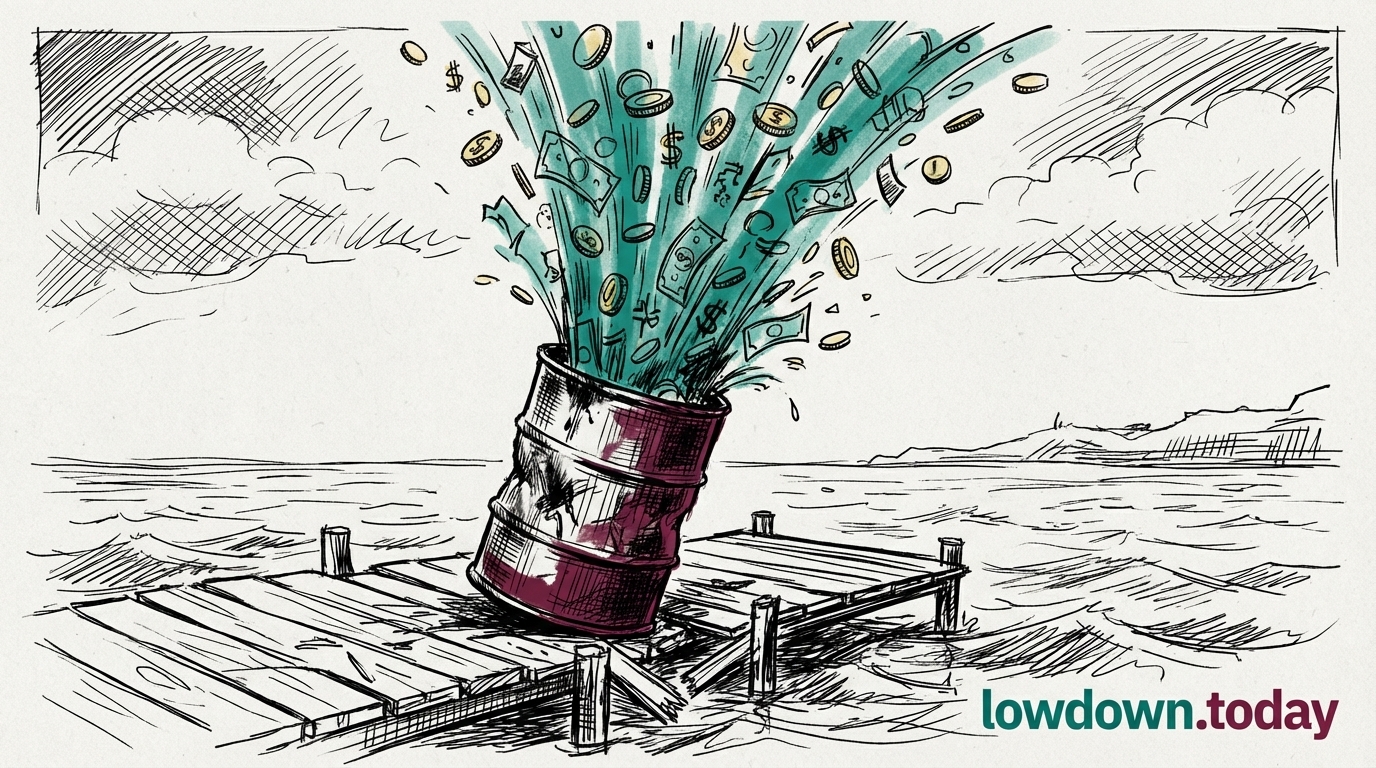
Ukraine's Baltic port strikes cut Russian crude exports by 43%, but the Iran war more than doubled the per-barrel price, projecting a 70% April revenue jump over March.

Sources profile:This story draws on mixed-leaning sources from United Arab Emirates and United States
United StatesUnited Arab Emirates

Urals crude reached $123.45 per barrel on 3 April 2026, more than double Russia's $59 budget assumption, driven by the Iran war disrupting Gulf supplies. Despite a 43% Baltic export volume collapse, Russia's oil and gas revenues are projected to jump 70% in April versus March, generating roughly $150 million per day in additional revenue.

Russia's war finances are temporarily strengthened rather than weakened by the convergence of Baltic port damage and Iran-war price surge, complicating Ukraine's infrastructure-strike strategy. 

Briefing analysis

The paradox Ukraine faces has a direct precedent. During the Iran-Iraq tanker war (1984 to 1988), both belligerents attacked each other's oil export infrastructure and neutral shipping in the Persian Gulf. The attacks reduced volumes for both sides, but supply anxiety pushed global prices upward, partially offsetting the damage.

The difference in 2026 is that Ukraine is not attacking its own exports. It is a third party striking Russian terminals while a separate conflict drives the price surge. The combination produces a perverse outcome: Ukraine's most effective strikes coincide with Russia's largest revenue windfall.

Historically, oil infrastructure campaigns succeed only when sustained long enough to force production cuts, not just export disruption. Iraq's attacks on Kharg Island required repeated strikes over years before Iran was forced to develop alternative terminals at Larak and Sirri. The question for Ukraine is identical: can it maintain Baltic strike tempo through the repair cycle, or will Russia restore capacity before storage saturation forces shutdowns?

Serbian authorities found explosives at the TurkStream pipeline one week before Hungary's election, prompting Orban to convene an emergency Defence Council and deploy military units.

Sources profile:This story draws on neutral-leaning sources

Explosives were found in two backpacks hundreds of metres from the TurkStream pipeline near the Serbia-Hungary border on 5 April 2026. Serbia classified the incident as attempted sabotage by 'a foreigner.' Hungarian Prime Minister Viktor Orban convened an emergency Defence Council within hours and deployed military units to the pipeline. Ukraine denied involvement. Russia's foreign ministry spokeswoman Maria Zakharova called it 'an attempt to strip Hungary of sovereignty.'

The incident, one week before Hungary's 12 April election, gives Orban a security-narrative campaign advantage regardless of perpetrator identity, and could delay EU loan disbursement to Ukraine

An RFI investigation confirmed 200 or more Ukrainian troops at two Libyan bases, establishing that the 4 March strike on a Russian LNG carrier in the Mediterranean was launched from Libyan soil.

Sources profile:This story draws on mixed-leaning sources from France
France
LeftRight

An RFI investigation published 4 April revealed that 200 or more Ukrainian officers and specialists have been stationed at two sites in Libya: the Misrata Air Force Academy, shared with Turkish, Italian, US AFRICOM, and British intelligence personnel; and a drone launch facility at Ezzawiya port, 50 km north of Tripoli. A Magura V5 autonomous surface drone launched from Ezzawiya disabled the Russian LNG carrier Arktik Metagaz in the Mediterranean on 4 March, carrying 60,000 tonnes of LNG toward Egypt. The agreement was brokered by Ukrainian military attache General Andriy Bayuk and includes long-term arms deliveries and Ukrainian investment in Libya's oil sector.

Ukraine has extended its anti-shipping campaign more than 2,000 km beyond the Black Sea into the Mediterranean via a third-country base, creating a new operational theatre outside NATO's Article 5 coverage. 

Both Ust-Luga and Primorsk remained closed for petroleum products into a second week, with Primorsk's 40% storage loss confirming lasting physical damage as Russia attempts Arctic rerouting.

Sources profile:This story draws on centre-leaning sources from United Kingdom and Norway
United KingdomNorway
LeftRight

Russia's Baltic terminals at Ust-Luga and Primorsk remained offline for petroleum product shipments for a second consecutive week as of 3 April. Planet Labs satellite imagery from 1 April showed Ust-Luga's crude terminal structurally intact but fuel terminals bearing fire traces. Primorsk lost 40% of storage capacity from eight damaged 50,000-cubic-metre reservoirs. Rerouting through Murmansk is underway but Arctic routes require ice-class vessels and 15-20 day transits versus 8-10 days from the Baltic.

Partial physical recovery is underway but Arctic rerouting constraints mean full restoration will take weeks, creating a window for Ukraine to sustain the production squeeze if strike tempo continues. 

A Ukrainian operator destroyed two Shahed drones simultaneously from 500 km using STING and HORNET VISION Ctrl technology, a 15-20 times multiplication of previous engagement range.

Sources profile:This story draws on mixed-leaning sources from Ukraine
Ukraine

On 4 April 2026, operator Hulk of Ukraine's Bulava unit destroyed two Shahed-type drones simultaneously from 500 km using STING interceptor drones equipped with HORNET VISION Ctrl technology developed by Wild Hornets. Previous operational range was 20-30 km. This is the first documented remote interception at this distance and against two simultaneous targets. Mass deployment is underway.

If mass-deployed as claimed, HORNET VISION Ctrl transforms Ukrainian air defence from point coverage to a theatre-wide interception grid, with operators protected 400-500 km behind the front line. 

The 1,500th day of full-scale war passed with Russian cumulative losses at 1.3 million and daily engagements declining from 163 to 120 as the spring offensive stalls.

Sources profile:This story draws on neutral-leaning sources

3 April marked the 1,500th day of Russia's full-scale war against Ukraine. Cumulative Russian personnel losses reached 1,303,550 by 5 April per the Ukrainian General Staff, with Russia sustaining 1,100 to 1,230 casualties per day. On 3 April alone, 230 combat engagements were recorded. Russia gained 17 square miles in the week of 24 to 31 March despite multi-sector pressure, with daily engagements declining from 163 to 120.

Russia's attrition rate — roughly one division equivalent every 10-12 days — makes sustained offensive pressure structurally self-defeating at the territorial gain rate of 17 square miles per week. 

Russia's 1 April block of Telegram prompted stronger domestic backlash than the Kremlin expected, with pro-war bloggers publicly questioning whether Ukraine can ever be captured.

Sources profile:This story draws on neutral-leaning sources

Russia blocked Telegram on 1 April 2026, forcing users toward the state-controlled platform Max. ISW assessed on 4 April that the crackdown produced harsher backlash than Moscow likely expected. Russian war bloggers, previously tolerated as pro-war morale builders, publicly stated that capturing Ukraine could take 100 years at the current pace. ISW linked the censorship directly to the stalled spring offensive, with daily engagements falling from 163 to 120.

The censorship crackdown is repressing the very voices the Kremlin built to maintain domestic war support, narrowing Russia's information management window precisely as the offensive stalls. 

Witkoff and Kushner are expected to make their first-ever Kyiv visit after Orthodox Easter on 12 April, with Senator Graham, as stalled peace talks await a reboot.

Sources profile:This story draws on mixed-leaning sources from United Kingdom
United Kingdom
LeftRight

US envoys Steve Witkoff and Jared Kushner are expected to make their first visit to Kyiv after Orthodox Easter on 12 April, joined by Senator Lindsey Graham. No date is confirmed. Talks stalled following US-Israeli strikes on Iran in mid-March. Russia demands Ukrainian withdrawal from approximately one-fifth of Donetsk.

The visit, if confirmed, would be the first direct US diplomatic engagement in Kyiv since talks collapsed following US-Israeli strikes on Iran, signalling renewed American interest in a negotiated timeline. 

Russia is shipping Geran-2 drones and satellite intelligence to Iran per an FT investigation, a direct technology transfer that Israel targeted with strikes on Iran's Bandar Anzali naval base in March.

Sources profile:This story draws on neutral-leaning sources from United Kingdom
United Kingdom
LeftRight

Russia is shipping Geran-2 drones (upgraded Shahed-136 variants), food, medicine, and satellite intelligence to Iran, the Financial Times reported. Israel struck Iran's Bandar Anzali naval base on 18-19 March, targeting supply routes. The Kremlin denied the drone transfers while confirming 'ongoing dialogue' with Tehran.

Russia-Iran drone technology exchange creates a mutual reinforcement loop: the systems Ukraine intercepts over Kyiv are being supplied to Iran, while Ukraine's counter-drone expertise is being deployed to Gulf states facing the same Iranian threat. 

The IAEA brokered a local ceasefire near Zaporizhzhia to reconnect a backup power line, while Russia issued 10-year operating licences for two units that Rosatom will not restart during the war.

Sources profile:This story draws on mixed-leaning sources from Ukraine
Ukraine

The IAEA brokered a local ceasefire near Zaporizhzhia Nuclear Power Plant to restore the backup 330 kV Ferosplavna-1 power line. Russia's Rostekhnadzor issued 10-year operating licences for units 1 and 2, but Rosatom stated it will not restart them during hostilities. IAEA Director General Grossi confirmed electricity generation can resume only after hostilities end.

Restored backup power reduces immediate nuclear safety risk, but Russian operating licences signal intent to retain administrative control of the plant long-term. 

Hungary's Tisza party led polls by 19 points heading into the 12 April election, but its prior vote against the EU's EUR 90 billion Ukraine loan means first disbursement is unlikely before June even if Tisza wins.

Sources profile:This story draws on neutral-leaning sources from France
France
LeftRight

Tisza Party led Fidesz by 19 points among decided voters (56% to 37%) in Hungarian polls ahead of the 12 April election. Medián projected a possible Tisza two-thirds supermajority. However, Tisza MEPs voted against the EU's EUR 90 billion Ukraine loan in the European Parliament, and Peter Magyar's platform subjects Ukraine's EU accession to a national referendum. EU Commission said funds could flow 'within a few days' of Hungary lifting its veto, but analysts assessed first disbursement was unlikely before June.

A Tisza victory would remove Hungary's veto but not guarantee rapid disbursement — Ukraine faces resource depletion by mid-May, creating a dangerous 4-6 week gap between election and funding. 

OFAC's GL 134A expires 11 April; at $121 per barrel, any extension would hand Russia far more revenue than when the waiver was issued at $73, while simultaneous vessel desanctioning created contradictory signals.

Sources profile:This story draws on neutral-leaning sources

OFAC General License 134A, authorising transactions for Russian crude loaded before 12 March 2026, expires on 11 April. At $73 per barrel when issued, the waiver was defensible as market stabilisation. At $121 per barrel, it hands Moscow windfall revenue the sanctions architecture was designed to prevent. Separately, OFAC removed sanctions on three Russian cargo vessels on 31 March — Fesco Magadan, Fesco Moneron, SV Nikolay — while adding Iran, North Korea, and Cuba exclusions to GL 134A one week after its original issuance.

The GL 134A expiry is a binary US policy signal: extension at $121 per barrel directly subsidises Moscow's war revenue; lapse combined with Baltic terminal damage would compound Russia's export crisis. 

Sources:Mayer Brown
Closing comments

Elevated on three fronts: the Libya theatre introduces a new escalation dynamic outside NATO protection; the TurkStream incident adds a hybrid warfare vector in EU/NATO territory; and the oil revenue paradox reduces Russia's financial incentive to accept ceasefire terms. The OFAC GL 134A decision on 11 April is the single most immediately consequential Western policy choice.

Different Perspectives
Ukraine
Ukraine
Zelenskyy's government denied involvement in the TurkStream sabotage and positioned the Libya operation as a legitimate anti-shipping extension authorised by the Tripoli government. Ukraine faces a mid-May resource depletion deadline, making the Hungary election and EU loan timeline existential rather than incidental.
Russia
Russia
The Kremlin denied drone transfers to Iran while confirming 'ongoing dialogue,' framed the TurkStream incident as an attack on Hungarian sovereignty, and blocked Telegram citing national security. The oil revenue windfall from the Iran war temporarily improves Russia's fiscal position despite Baltic port damage.
Hungary
Hungary
Orban convened an emergency Defence Council and deployed military to the TurkStream pipeline section after the 5 April sabotage attempt, exploiting the security narrative one week before polling day. The EUR 90 billion loan veto remains intact regardless of election outcome in the immediate term.
United States
United States
OFAC faces a binary decision on GL 134A by 11 April; simultaneously removing sanctions from three Russian vessels while tightening the licence's Iran exclusions sent contradictory policy signals. The expected Witkoff-Kushner Kyiv visit remains unconfirmed, reflecting competing priorities across two active conflict theatres.
European Union
European Union
The EU Commission confirmed technical readiness to disburse EUR 90 billion within days of Hungary lifting its veto, while proceeding with the 25 April LNG ban on schedule despite legal challenges from Hungary and Slovakia.
Libya
Libya
The Government of National Unity authorised Ukraine's basing agreement, accepting in return arms deliveries and Ukrainian investment in Libya's oil sector. The arrangement places Libya at risk of Russian retaliation outside any collective defence framework.
