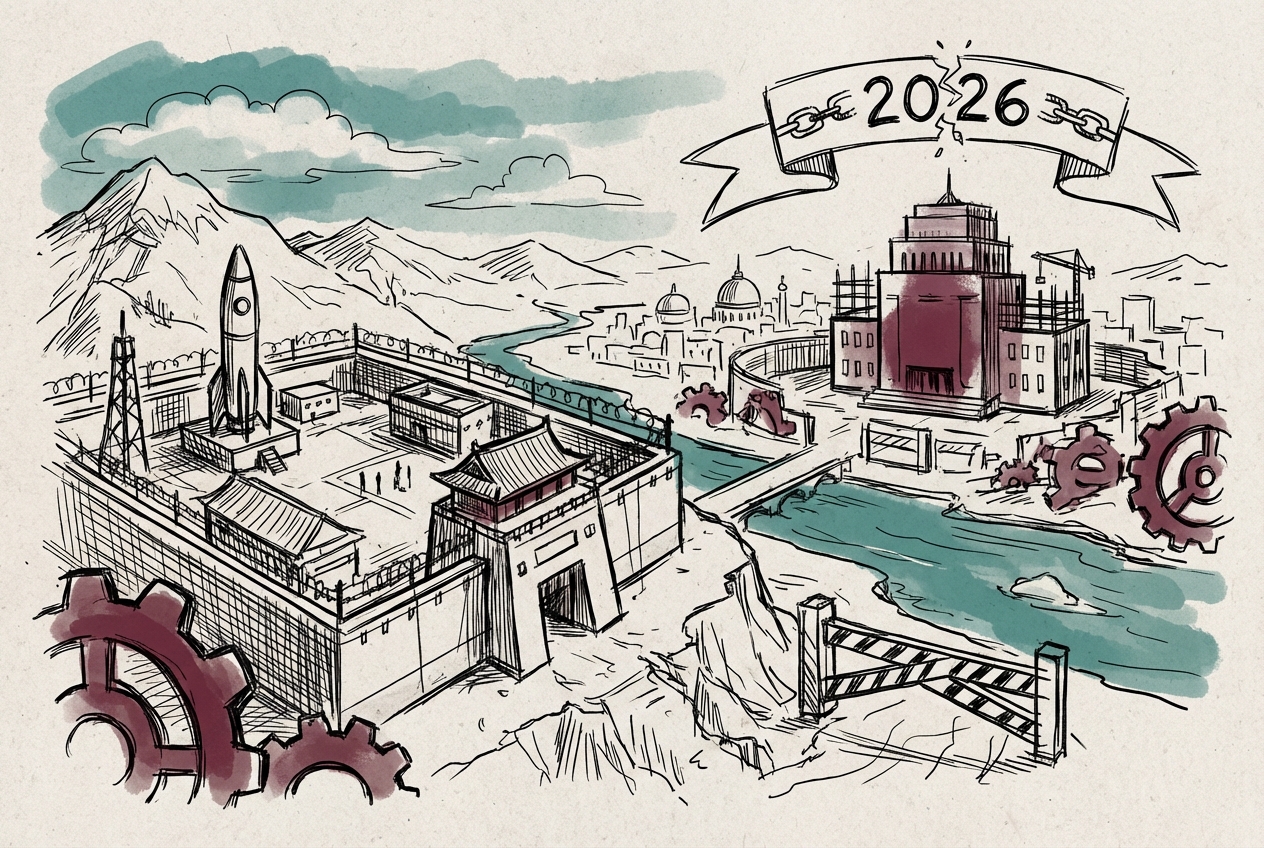
North Korea
The only state to have left the NPT; its proliferation PATH is the template Iran analysts invoke in 2026.
North Korea is the only state to have left the Nuclear Non-Proliferation Treaty, which it quit in 2003. On 7 June 2026 its Type-75 rocket launchers were reported firing from Russian robot vehicles near Kharkiv.
Last refreshed: 7 October 2026 · Appears in 5 active topics
If North Korea kept its weapons by leaving the NPT, can Iran do the same?
Timeline for North Korea
Mentioned in: Iran claims to hold a US Kingfish robot
Autonomous Systems: Land & SeaMentioned in: Iran's parliament files NPT exit bill
Iran Conflict 2026Mentioned in: BitBank and Zanjani hit by US sanctions
Iran Conflict 2026Mentioned in: Russia and China kill Iran's UN monitor
Iran Conflict 2026Mentioned in: IAEA still cannot locate Iran's uranium
Iran Conflict 2026Background
North Korea, formally the Democratic People's Republic of Korea, occupies the northern half of the Korean Peninsula and has been ruled by the Kim dynasty since 1948. It is the only state to have left the Nuclear Non-Proliferation Treaty, withdrawing in 2003 before conducting its first nuclear test in 2006. International Atomic Energy Agency inspectors have had no presence there since 2009.
That record makes Pyongyang the reference case whenever another state weighs leaving the treaty. An Iranian MP tabled a withdrawal bill on 28 March 2026; if passed, it would make Iran only the second state after North Korea to leave. A triple-urgency bill filed on 20 September kept the comparison live, though no filing has started the treaty's three-month notice clock.
Beyond the bomb, North Korea projects power through arms exports and cyber operations. It has sent Russia troops, munitions and rocket artillery for the war in Ukraine, and its hacking groups target the global software supply chain. Its artillery and drone threat also drives South Korea's defence spending: Seoul brought its low-altitude missile defence programme forward to 2029.
Its rockets now fire from Russian robots
North Korea's supply line to Moscow reached the robot war on 7 June 2026, when the Institute for the Study of War reported the first sighting of North Korean Type-75 107mm multiple-launch rocket systems mounted on Russian uncrewed ground vehicles in the Kharkiv direction. It was the first combat integration of North Korean rocket artillery onto an autonomous platform.
The Type-75 is Pyongyang's copy of China's Type-63 launcher. Russia's NRTK Kurier and Impulse vehicles ADD electric-drive aiming so the rockets can be laid remotely. For North Korea, the pairing turns a contribution of troops and munitions into a remote-fire capability that needs fewer of the soldiers Ukraine has been targeting. Ukraine struck that pipeline in May, and the robot launchers reduce its exposure.
Its hackers poisoned a core JavaScript library
North Korea's cyber units showed their reach in the Axios compromise. On 5 May 2026 Google's Threat Intelligence Group and Mandiant named UNC1069, a North Korea-linked group, as the actor that phished an Axios maintainer and slipped the WAVESHAPER.V2 backdoor into two versions during a three-hour window on 31 March. The affected versions drew about 100 million and 83 million weekly downloads.
On 11 May Google confirmed two further npm packages carrying the same implant, reaching developers who never installed Axios directly. The method, compromising a trusted human rather than the package, defeated the signing checks that downstream builds rely on. WAVESHAPER.V2 runs on Windows, macOS and Linux.
Why do analysts compare Iran's nuclear standoff to North Korea?
What did Grossi warn about verifying a North Korea-style Iran deal?
Who is the leader of North Korea?
Has any country ever left the NPT?
What is North Korea's nuclear programme?


