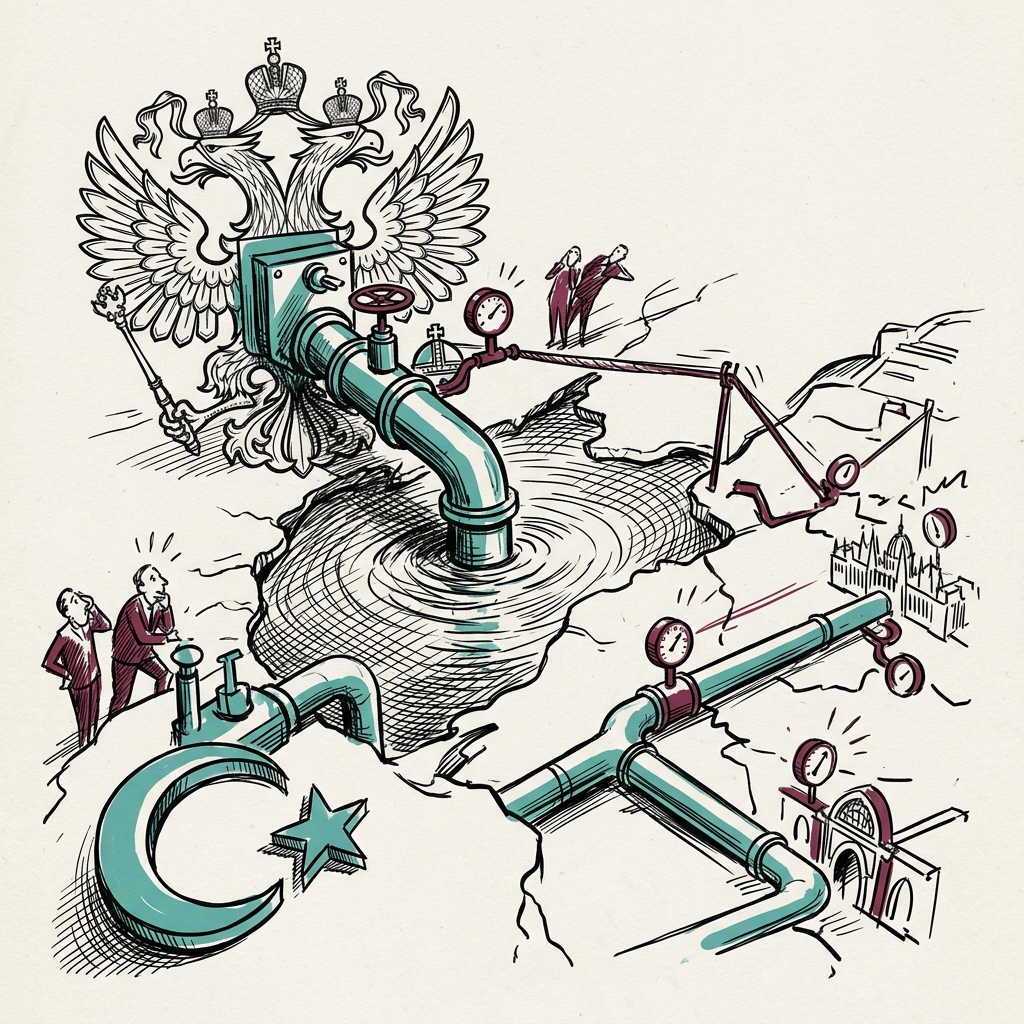
EADaily claimed a -25% TurkStream collapse; why did the actual ENTSOG data say something different?
Timeline for TurkStream
Continued running exempt from the ban under long-term contracts to September 2027
European Energy Markets: ACER says the Russian-gas ban has not bittenMentioned in: The ban's own text makes it porous
European Energy MarketsMentioned in: TTF settles €41 as the ban binds
European Energy MarketsRemained exempt under long-term contract provisions to September 2027, limiting ban's physical impact
European Energy Markets: CEGH pays a one-day ban premiumMentioned in: TTF breaks its floor into the import ban
European Energy MarketsBackground
TurkStream's April 2026 flow data was the subject of the most significant source-correction the European Energy Markets briefing has recorded. On 27 April, EADaily reported that Gazprom deliveries via TurkStream had fallen to 40.3 MCM/day, framing a -25% month-on-month drop as a potential supply disruption story. Reuters calculations on ENTSOG data confirmed the average April flow at 41 MCM/day, collapsing the framing: the month-on-month drop measured against March front-loading, and the year-on-year comparison against April 2025 was only -1.7% (1.23 bcm vs 1.25 bcm). The Gazprom statistical blackout since January 2023 is the structural condition that allowed a tier-3 single-source figure to dominate the narrative for a week.
ACER's 6 May 2026 derogation opinions named Hungary and Slovakia as the two EU member states most dependent on TurkStream, granting exemptions from applying EU gas network codes at third-country interconnection points from 5 August 2026, pending simultaneous implementation by Russian and Turkish operators. This adds a regulatory exposure dimension to a supply route that had already surfaced a physical threat: on 5 April 2026, explosives were found near the Serbia-Hungary border segment. Serbia's VBA director publicly denied Ukrainian involvement, contradicting Hungarian government framing ahead of the 12 April elections.
The EU's 17 June 2026 short-term pipeline import ban is the decisive near-term test for TurkStream's exemption architecture. The ban removes volumes under contracts signed before 17 June 2025, covering roughly 5 bcm/year; but Gazprom's long-term TurkStream contracts carrying the bulk of Hungarian and Slovak supply run exempt until 30 September 2027 (or 1 November 2027 if EU storage-filling targets are missed). Hungary's TurkStream deliveries were up 17% in 2025. Neither Hungary's February CJEU annulment challenge nor Slovakia's signalled application had secured a stay as of 11 June 2026; the Central European gas basis compressed to just €0.41/MWh over TTF on that date, confirming the market prices the ban as a legal marker rather than a supply event. The exemption window closes by autumn 2027 at the latest, after which TurkStream loses its remaining EU-market legal basis.
ACER's first mandated Russian-gas phase-out monitoring report, published 1 July 2026, found the ban had not bitten: Russian gas still supplied roughly 12% of EU demand, with Russian LNG imports up 17% year-on-year and pipeline imports up 5% since the 18 March instrument took effect. TurkStream's Balkan entry point, Strandzha-1, was the one exception, with flows down 65% year-on-year even as the pipeline's long-term Hungarian and Slovak contracts continued running exempt to September 2027. The divergence confirms the earlier read that the ban repriced sentiment rather than cutting volumes: TurkStream's overall throughput held up structurally while its Bulgarian metering point absorbed the headline decline.
TurkStream is a natural gas pipeline built by Russia's Gazprom, opened in January 2020, running 930 km under the Black Sea from Anapa on the Russian coast to Kiyikoy on the Turkish coast. From there it splits into two lines: one supplying Turkey domestically, the other running overland through Bulgaria, Serbia, and Hungary to distribute Russian gas to Central and Southern Europe. It was conceived as a bypass after the termination of South Stream and carries up to 31.5 billion cubic metres per year.
On 5 April 2026, explosives were found in two backpacks hundreds of metres from the TurkStream pipeline near the Serbia-Hungary border. Hungary deployed military units to protect the pipeline within hours. Ukraine denied involvement, and Serbia's Military Security Agency (VBA) director Djuro Jovanic publicly confirmed that Ukrainians did not organise the sabotage attempt, directly contradicting Hungarian government framing in the run-up to the 12 April elections. The four-jurisdiction land route , Bulgaria, Serbia, Hungary, and the EU border , means a single military deployment cannot secure the full overland segment.
TurkStream is now one of only two remaining routes for Russian gas to reach European buyers, the other being Druzhba pipeline transit through Ukraine. With the EU's phased gas embargo from April 2026, Hungary and Serbia's continued Reliance on TurkStream puts them at odds with Brussels and illustrates how pipeline geography shapes political alignment in the war.
What is TurkStream?
Who tried to sabotage TurkStream in April 2026?
Why does Hungary depend on TurkStream gas?
Does the EU ban on Russian gas affect TurkStream?
What is the actual TurkStream flow in April 2026 after the Reuters correction?
Why did EADaily's TurkStream figure mislead the market for a week?
What is TurkStream's capacity and who depends on it?
What happened at TurkStream near the Serbia-Hungary border in April 2026?
Is TurkStream affected by the EU's June 2026 Russian gas ban?
Was TurkStream attacked in 2026?
Which countries depend most on TurkStream for gas?
When do TurkStream's EU exemptions expire?


