
Skip to content
Briefings are running a touch slower this week while we rebuild the foundations.See roadmap
Russia-Ukraine War 2026
11APR

Day 1508: Three narrowings of US support for Kyiv

3 min read
16:48UTC

In one week the Trump administration signed a $4.76bn four-year Patriot contract allocated almost entirely to foreign buyers, the State Department warned Kyiv off striking Caspian Pipeline Consortium terminals owned by Chevron and ExxonMobil, and the Treasury headed toward extending a sanctions waiver that Bloomberg estimates is worth $150 million a day to Moscow. Putin's Kremlin calendar for the same seven days shows no bilateral US diplomatic activity.

Key takeaway

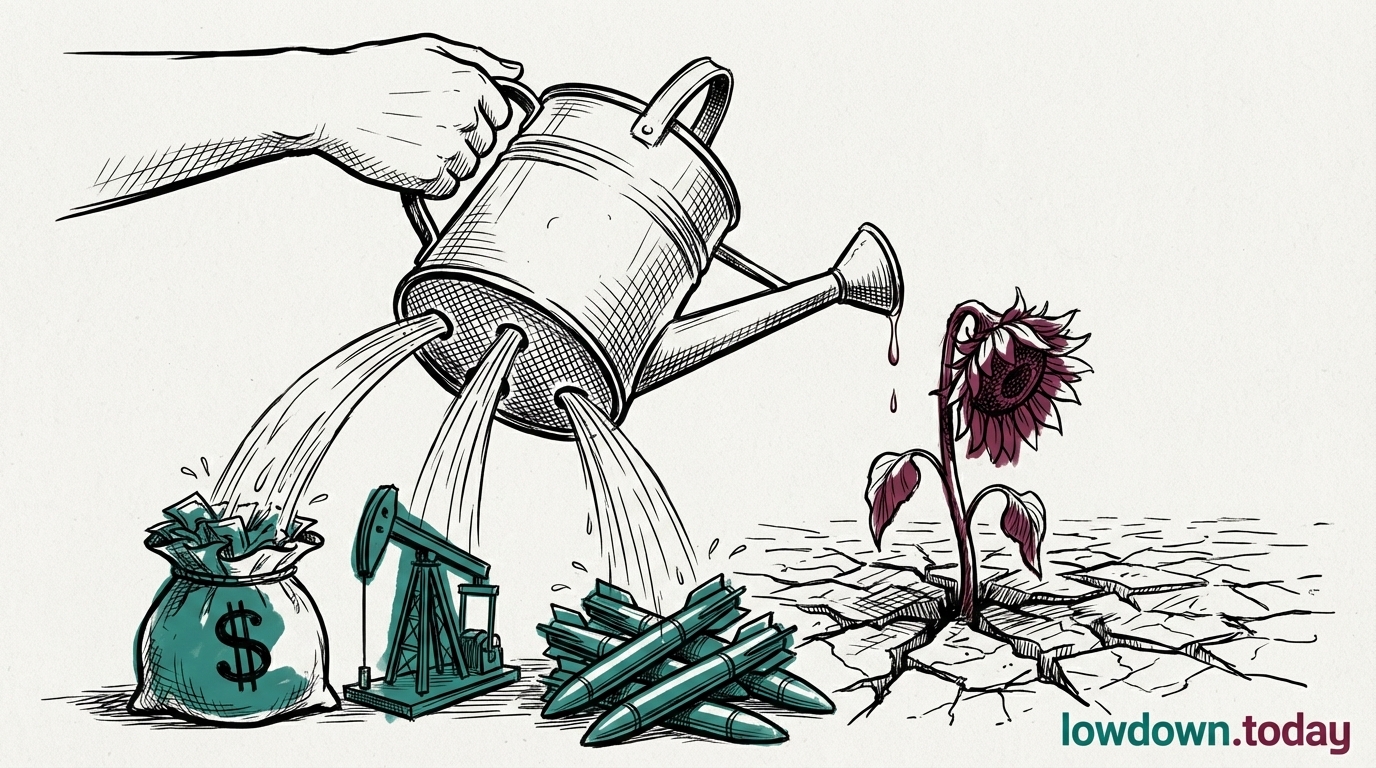
What Washington did this week, across Treasury, Pentagon, State and the envoys' itineraries, narrows US support for Ukraine on four tracks at once.

This briefing mapped
Loading map…
Economic
Military
Diplomatic
Domestic
Infrastructure

The Pentagon's four-year Patriot production contract routes 94% of the missile run to foreign buyers before the first round leaves the factory, locking Ukraine's mid-May shortfall in as a structural condition rather than a temporary shortage.

Sources profile:This story draws on neutral-leaning sources from United States
United States

The US Army awarded Lockheed Martin a $4.76 billion firm-fixed-price contract on 9 April 2026 for PAC-3 MSE interceptor production through 30 June 2030, with 94% of output pre-committed to foreign military sales.

A multi-year contract calendar that cannot close Ukraine's mid-May interceptor gap, with the allocation decided before Kyiv sees a schedule. 

Briefing analysis

The pattern of narrowing support across multiple channels without a single declaratory reversal has a recent precedent in US Afghanistan policy between 2020 and 2021: a Doha framework negotiation, a suspended air support agreement, a prisoner release schedule, and a troop drawdown calendar that were each defensible in isolation and collectively signalled withdrawal long before the Kabul airport images forced the political narrative to catch up. The Lowdown reader who remembers that sequence will recognise the shape of this week's Ukraine ledger: the decisions are on paper, the announcement is absent, and the recipients of the policy are the last to be told what it is.

Global Patriot export approvals went on ice after three days of Iran war operations burned through more rounds than the United States builds in an entire year.

Sources profile:This story draws on neutral-leaning sources from United States
United States

The White House suspended Patriot export approvals globally after more than 800 PAC-3 rounds were expended in three days of Iran war operations, against an annual US production rate of roughly 600.

An export freeze that converts a manageable Ukrainian shortage into an immovable global bottleneck. 

Treasury's Russian crude waiver expired on 11 April with wire reporting from Reuters, Semafor and Bloomberg pointing to renewal worth roughly $150 million a day to Moscow at current Urals prices.

Sources profile:This story draws on mixed-leaning sources from United Kingdom
United Kingdom
LeftRight

Treasury's General License 134A, the OFAC waiver authorising transactions for Russian crude loaded before 12 March 2026, expired on 11 April with wire reporting from Reuters, Semafor and Bloomberg pointing to a likely extension.

An expiring waiver at $73 was market stabilisation; the same instrument at $115 is a budget transfer. 

A formal warning told Ukraine to stop hitting the Caspian Pipeline Consortium terminal at Novorossiysk, protecting an American commercial asset rather than a Russian one.

Sources profile:This story draws on centre-left-leaning sources from Ukraine
Ukraine

Two envoys who were expected to make their first-ever Kyiv visit flew to Islamabad instead, leaving Zelenskyy to say the trip's timing was 'difficult to say.'

Sources profile:This story draws on neutral-leaning sources
Sources:kremlin.ru

A unilateral Kremlin decree halted combat from 16:00 Moscow time on 11 April until the end of 12 April, landing the quiet window squarely on Hungarian polling day.

Sources profile:This story draws on mixed-leaning sources from United States
United States
LeftRight

At 22:00 Moscow time on 9 April, Putin issued a Kremlin decree declaring a 32-hour Orthodox Easter ceasefire effective from 16:00 Moscow time on 11 April until the end of 12 April, instructing Defence Minister Andrei Belousov and General Staff chief Valery Gerasimov to halt combat on all fronts.

A 32-hour pause declared without any visible US coordination and timed to Hungarian election optics. 

The widest independent margin of the cycle arrived one day before Hungary votes, with Orbán's sixteen-year run suddenly testable.

Sources profile:This story draws on centre-leaning sources from United States
United States
LeftRight

Independent Hungarian pollster Medián published a final pre-election poll on 11 April showing Tisza at 58% against Fidesz at 33%, the widest independent margin of the cycle, ahead of parliamentary elections on 12 April.

A Tisza win is necessary but not sufficient to unlock the EU's €90 billion Ukraine loan before the mid-May deadline. 

IAEA Update 346 disclosed that Europe's largest nuclear plant has been running on a single backup power line since 24 March, with no sixth repair ceasefire brokered.

Sources profile:This story draws on neutral-leaning sources

The Ukrainian General Staff recorded 173 daily combat engagements to 11 April, while Mediazona's weekly verified Russian death rate fell to roughly 1,200.

Sources profile:This story draws on neutral-leaning sources

The Ukrainian General Staff recorded 173 combat engagements in the 24 hours to 11 April, up from the sub-120 range of late March. Mediazona confirmed 208,755 verified Russian military deaths as of 10 April, a weekly rate of approximately 1,200.

More contacts, fewer deaths per contact: the signature of probing attacks, not a combined-arms breakthrough. 

Ukrainian drones struck the Caspian Pipeline Consortium terminal at Novorossiysk on 6 April, extending an anti-oil campaign that had worked the Baltic ports to year-low throughput.

Sources profile:This story draws on mixed-leaning sources from Ukraine and United Kingdom
UkraineUnited Kingdom
LeftRight

On 6 April Ukrainian drones struck the Caspian Pipeline Consortium terminal at Novorossiysk. Ust-Luga resumed crude loading on 5 April but Primorsk berths fell from ten to four, with combined Baltic throughput at 115,000 tonnes a day, a year-low.

A southern pivot that trades diplomatic cover for visible damage on assets Chevron partly owns. 

Serbian intelligence said the explosives found in four backpacks near the TurkStream pipeline on 5 April were 'unequivocally' US-manufactured, with no state link identified.

Sources profile:This story draws on centre-leaning sources from United States
United States
LeftRight

Serbia's Military Security Agency director Đuro Jovanić stated on approximately 10 April that explosives found in four backpacks near the TurkStream pipeline at the Serbia-Hungary border on 5 April were 'unequivocally' US-manufactured.

An attribution that resolves the physics without naming an actor, with Ukraine explicitly cleared. 

David Axe at CEPA, citing RUSI research, assessed Ukraine's 130 oil strikes in 2025 produced $863 million of damage against roughly $189 billion in annual Russian oil revenue.

Sources profile:This story draws on neutral-leaning sources

David Axe at CEPA, citing RUSI research, assessed that Ukraine's 130 refinery and port strikes in 2025 produced only a 6% export reduction against 2024, at cumulative damage of $863 million against roughly $189 billion in annual Russian oil revenue.

Load-bearing counter-evidence against the narrative that Ukraine's strike campaign is constraining Russian oil revenue. 

Closing comments

Neither clearly escalatory nor de-escalatory in the classical sense. The Trump administration is lowering the ceiling on what Ukraine can fight with while Putin lowers the tempo on what Russia will hit. The result is a narrower war fought on narrower terms, not a wider one.

Different Perspectives
Trump administration (Treasury, Pentagon, State)
The Pentagon signed the $4.76 billion Lockheed contract on 9 April, the White House froze Patriot exports, Treasury moved toward extending GL 134A, and the State Department warned Kyiv off CPC strikes, citing Chevron and ExxonMobil's stakes. Envoys Witkoff and Kushner flew to Pakistan rather than Kyiv; no US official framed any of it as a change in Ukraine policy.
Kremlin / Vladimir Putin
Putin issued the 32-hour Easter ceasefire decree on 9 April without any prior call to Washington, per his published Kremlin calendar, which shows nine days of domestic engagements and no US contacts. Peskov said it was not pre-arranged; the schedule corroborates that denial. The ceasefire window ends at midnight on Hungarian polling day.
Zelenskyy / Ukrainian government and population
Zelenskyy accepted Easter ceasefire reciprocity but defied the State Department's CPC warning, confirming the Novorossiysk strike and proposing a mutual energy ceasefire via US intermediaries. Two were killed and 30 Russian strikes hit Dnipropetrovsk on 10 April, the day before the truce; the 2025 precedent, when both sides accused the other of violations, offers Pokrovsk residents little reassurance.
Hungarian government / Tisza opposition
The final Medián poll gave Tisza 58% against Fidesz 33%, the widest independent margin of the cycle; Magyar has committed to unlocking the €90 billion EU loan stalled since March. Fidesz's Nézőpont pollster gives Orbán a six-point lead, making the outcome genuinely contested.
EU Commission
EU Commission
The €90 billion EU loan for Ukraine remains blocked pending the Hungarian election, and the SAFE rearmament programme has been frozen since the EU withheld Hungary's own €16.2 billion tranche in March. A Tisza victory positions the Commission to move both instruments within weeks; an Orbán survival extends the stalemate.
India and Asian crude buyers
Indian and Philippine government representatives lobbied Washington to extend GL 134A, according to sources cited by Reuters and Semafor. Asian refiners have structured throughput around discounted Urals crude; a lapse without a replacement instrument would force them to source costlier alternatives mid-quarter.