Skip to content
Briefings are running a touch slower this week while we rebuild the foundations.See roadmap
Iran Conflict 2026
16MAY

Northwood coalition moves from planning to established

3 min read
12:41UTC

Lowdown Bureau / Military. The Macron-Starmer statement on GOV.UK confirmed the 51-nation Hormuz mission as active, with mine clearance on the mandate.

ConflictDeveloping
Key takeaway

Fifty-one nations are now writing the strait's rules of engagement without a US signature on the document.

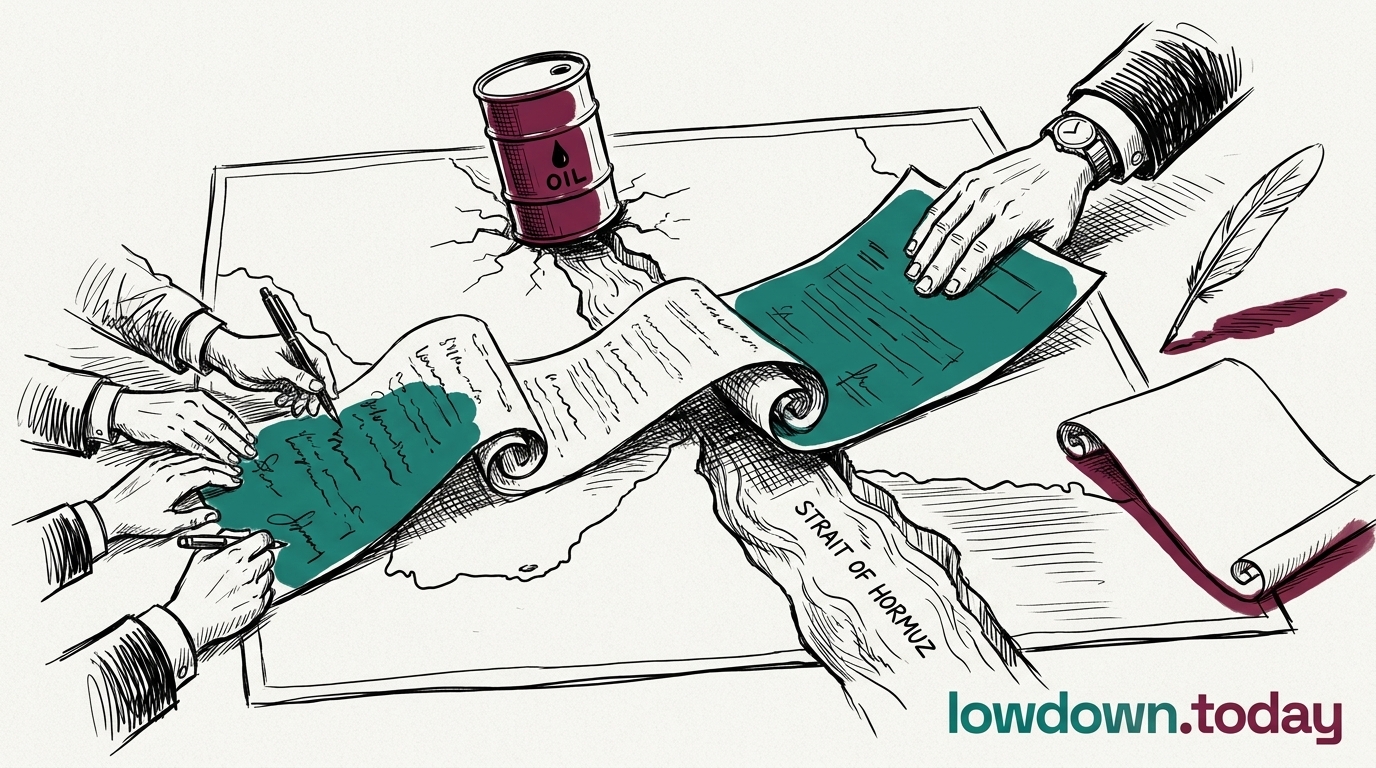
Emmanuel Macron and Keir Starmer, co-chairs of the International Summit on the strait of Hormuz, published a joint statement on GOV.UK on Monday reclassifying the fifty-one-nation mission from 'planning' to 'established' . The three-part mandate confirmed in the statement covers protection of merchant vessels, reassurance of commercial operators, and mine clearance. The coalition's operational headquarters is Northwood HQ in north-west London, the UK's standing joint command site and the seat of the NATO Maritime Command.

The move from 'planning' to 'established' changes the legal character of the forces involved. A planning construct rotates staff officers; an established mission assigns units, standing orders, and deconfliction protocols with other navies. The Northwood rules-of-engagement summit opened the same week without US or Gulf state signatures . Bahrain, headquarters of the US Fifth Fleet, is among the 23 post-summit confirmations sitting inside a mission with an RoE the Pentagon has not signed.

Macron and Starmer wrote mine clearance into the mandate deliberately, and that single line is the operational tell. Mine clearance was the specific capability gap that historically dragged non-US navies into Gulf operations during the 1987-88 Reagan-era Operation Earnest Will. It is high-risk, low-prestige work that requires dedicated platforms: Royal Navy Hunt-class vessels, French Tripartite-class, and European ammunition clearance divers. A coalition that has formalised a mandate including mine clearance has been briefed that the strait will require it, which is itself a signal about what CENTCOM and European planners expect from the Iranian blockade through the summer.

The Northwood coalition is now drafting the live legal framework for the strait under which US and European vessels will have to operate, whether or not Washington ever publishes its own text. Institutional gaps fill in when somebody else writes the document, and the unsigned actor inherits whatever the document says. The Pentagon is not in the planning room because there is no US text for its rules to attach to.

Deep Analysis

In plain English

Britain and France announced that their Hormuz maritime coalition; a group of countries that pledged to protect shipping through the Strait of Hormuz; has moved from 'planning' to officially 'established'. The group now has 51 member countries. The coalition has three jobs: protect merchant ships, reassure commercial shipping companies, and clear sea mines. Mine clearance is the most dangerous task, requiring ships to work close to Iran's coast. The meeting to work out the rules of engagement (who can do what, when, and under what circumstances) is happening at Northwood, the UK military headquarters, on 20 April. The US is not involved; Washington is in separate ceasefire negotiations with Iran, and joining the coalition would complicate that track.

Deep Analysis
Root Causes

The coalition's 51-nation breadth reflects a diplomatic strategy rather than an operational requirement: each additional member reduces the diplomatic cost of mine clearance operations that would otherwise appear as a bilateral UK-France confrontation with Iran. Gulf states (Saudi Arabia, GCC members) are notably absent from the confirmed participants, reflecting their structural dependency on Iranian non-escalation for their own oil export infrastructure.

The 1968 Traffic Separation Scheme, surfaced by IMO Secretary-General Dominguez , governs Hormuz movement under a tripartite Iran-Oman-IMO framework. Any coalition mine clearance operation within the separation scheme zones raises a direct legal question Northwood planners must resolve: whether the operation operates under UNCLOS transit passage rights or must obtain host-nation coordination from Oman.

What could happen next?
  • Consequence

    The coalition's reclassification to 'established' on 20 April activates Northwood's operational authority to issue mine clearance orders to willing member states without a further political decision; operationalising the Paris posture within 24 hours of the Northwood summit opening.

  • Risk

    Any mine clearance operation within the 1968 Traffic Separation Scheme zones requires coordination with Oman under the tripartite Iran-Oman-IMO framework; proceeding without Omani consent would undermine the legal basis of UNCLOS transit passage the coalition relies on.

First Reported In

Update #75 · Ceasefire ends in the water, a day early

GOV.UK· 21 Apr 2026
Read original
Different Perspectives
India (BRICS meeting host, grey-market beneficiary)
New Delhi hosted the BRICS foreign ministers' meeting on 14 May that Araghchi attended under the Minab168 designation, giving India a front-row seat to Iran's diplomatic positioning. India's state refiners have been absorbing discounted Iranian crude through grey-market routing since April; Brent at $109.30 means every barrel sourced outside the formal market generates a structural saving.
Hengaw / Kurdish human rights monitors
Hengaw's daily reports from Iran's Kurdish provinces remain the sole independent cross-check on Iran's judicial activity during the conflict. Two executions across Qom and Karaj Central prisons on 15 May and five Kurdish detentions on 15-16 May indicate the wartime judicial pipeline is operating independently of military tempo.
Pakistan (mediator and bilateral partner)
Islamabad spent its diplomatic capital as the US-Iran MOU carrier to secure LNG passage for two Qatari vessels through a bilateral Pakistan-Iran agreement, spending its mediation credit for direct economic gain. China's public endorsement of Pakistan's mediatory role on 13 May is the structural reward.
China and BRICS bloc
Beijing endorsed Pakistan's mediatory role on 13 May, one day after the BRICS foreign ministers' meeting in New Delhi. Chinese state banks are processing PGSA yuan toll payments; China has not commented on its vessels' continued Hormuz passage, but benefits structurally from a non-dollar toll system it did not design.
Iraq (bilateral passage partner)
Baghdad negotiated a 2-million-barrel VLCC transit without paying PGSA yuan tolls, offering political alignment in lieu of cash. Iraq's position inside Iran's adjacent bloc makes it the natural first bilateral partner and a template for how Tehran structures passage deals with states that cannot afford Western coalition membership.
Bahrain and Qatar (Gulf signatories)
Both signed the Western coalition paper while hosting US Fifth Fleet and CENTCOM's Al Udeid base, respectively. Qatar occupies the sharpest contradiction: it is on coalition paper while simultaneously receiving LNG passage through the bilateral Iran-Pakistan track, a position Doha has tacitly accepted from both sides.