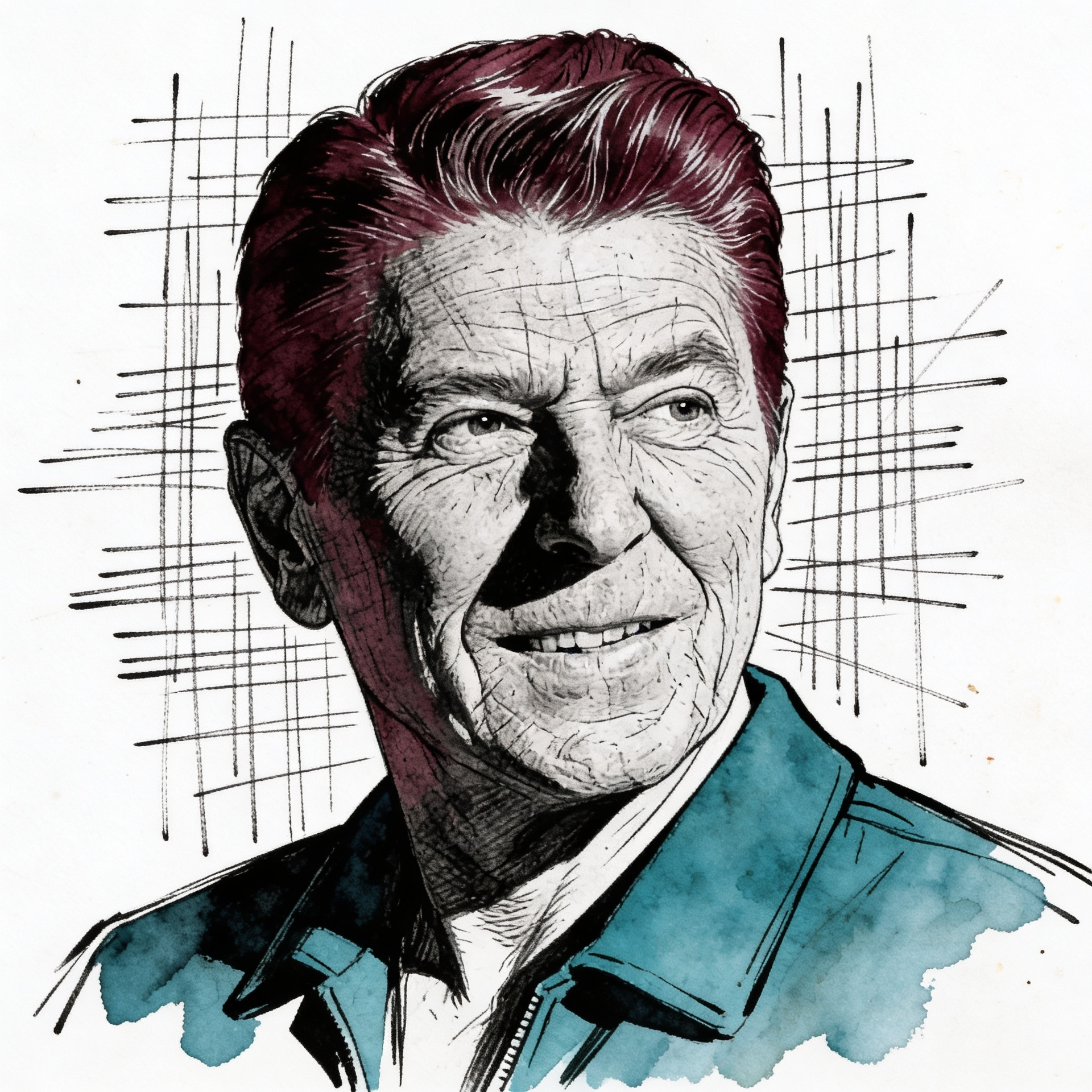
Ronald Reagan
40th US president whose Iran policy and judicial legacy benchmark Trump's 2026 decisions.
Last refreshed: 28 April 2026 · Appears in 1 active topic
Why does Trump keep being compared to Ronald Reagan on Iran?
Timeline for Ronald Reagan
Mentioned in: Araghchi flies home; Witkoff grounded in DC
Iran Conflict 2026Mentioned in: OFAC cuts fifth round, 14 targets
Iran Conflict 2026Mentioned in: Pentagon memo targets Spain and Falklands
Iran Conflict 2026Mentioned in: Trump orders Navy to shoot mine-layers
Iran Conflict 2026Trump extends ceasefire on Truth Social post
Iran Conflict 2026- Who was Ronald Reagan?
- Ronald Reagan was the 40th President of the United States, serving from 1981 to 1989. A former Hollywood actor turned Republican governor of California, he pursued confrontational Cold War policies, backed Iraq in the Iran-Iraq War, and became embroiled in the Iran-Contra affair.
- What was Reagan's Iran policy?
- Reagan publicly condemned Iran while secretly selling it arms via the Iran-Contra operation to fund Nicaraguan rebels. He also backed Iraq during the Iran-Iraq War. The contradiction became the defining scandal of his presidency and a lasting symbol of US-Iran duplicity.
- Why is Reagan being compared to Trump on Iran?
- As Trump considers off-ramp options alongside military escalation against Iran, analysts draw parallels with Reagan's strategic patience: refusing to force resolution, maintaining public pressure while keeping back-channel options open. Trump told NBC in 2026 that Iran is ready for a deal but the terms are not yet good enough.Source: NBC News
- What was the Iran-Contra affair?
- Iran-Contra was a 1986 scandal in which the CIA, under Reagan's watch, secretly sold arms to Iran despite an arms embargo, using the proceeds to fund Nicaraguan Contra rebels. It exposed the gap between Reagan's declared anti-Iran policy and his administration's covert dealings with Tehran.Source: event
- Did Reagan deal with Iran secretly while publicly opposing them?
- Yes. Reagan publicly condemned Iran and imposed arms embargoes, but his administration secretly sold weapons to Tehran as part of the Iran-Contra arrangement. This pattern of public confrontation combined with covert engagement is now used as a comparison point for evaluating Trump's approach to the 2026 Iran conflict.Source: NBC News
- Why do analysts compare Trump's Iran strategy to Reagan?
- Reagan accepted frozen hostility with Iran rather than forcing a resolution, publicly condemning Tehran while dealing through back channels. Trump's 2026 Ceasefire extension, conditioned on Iran submitting a unified proposal with no signed instrument, follows the same structural pattern of verbal commitments substituting for formal agreements.Source: iran-conflict-2026
- How many federal judges did Ronald Reagan appoint?
- Reagan appointed 368 Article III federal judges across his two terms, including 3 Supreme Court justices. His administration established the modern template of using judicial appointments as a durable policy lever, and Trump's confirmation pace is routinely benchmarked against Reagan's totals.Source: us-midterms-2026
- What is the Reagan Doctrine?
- The Reagan Doctrine was the Cold War strategy of providing covert and overt support to anti-communist movements worldwide, including Afghan mujahideen, Nicaraguan Contras, and Angolan rebels. It prioritised rolling back Soviet influence over direct confrontation, influencing how subsequent administrations frame proxy conflicts.
- When did Ronald Reagan die?
- Ronald Reagan died on 5 June 2004, aged 93, at his Bel Air home in California, after a decade-long public battle with Alzheimer's disease. He had announced his diagnosis in a handwritten letter to the American public in November 1994.
Background
Ronald Reagan served as the 40th President of the United States from 1981 to 1989, entering office just as Iran finalised the release of the American hostages held since the Iranian Revolution of 1979. His presidency was defined by Cold War confrontation, deep scepticism of Iran, and covert operations that shaped US-Iran relations for decades: support for Iraq during the Iran-Iraq War and the Iran-Contra affair, in which the CIA secretly sold arms to Tehran to fund Nicaraguan rebels. Reagan died in June 2004 after a decade-long battle with Alzheimer's disease, but his strategic and judicial legacy remains a live reference point across US foreign and domestic policy debates.
Reagan is invoked as the benchmark for US presidents navigating Iran negotiations under military pressure. As Donald Trump weighs exit options and deepened pressure on Tehran in the current conflict, aides and analysts measure his approach against Reagan's strategic patience: Reagan accepted a frozen hostility with Iran rather than forcing resolution, publicly condemning Tehran while secretly dealing through back channels, a posture Trump has so FAR replicated in structure if not in style . The indefinite Ceasefire extension of 21 April 2026, conditioned on Iran submitting a unified proposal with no signed executive instrument and no sanctions relief, sits squarely within that Reaganite tradition of verbal instruments substituting for formal commitments .
Reagan's judicial legacy is equally active. His administration's aggressive use of Article III lifetime appointments set the modern template for reshaping the federal bench during a presidency, and Trump's confirmation pace is measured directly against Reagan-era totals in Senate floor debates . Reagan's FY1987 NASA budget cuts also echo in the FY2027 proposal to slash the Science Mission Directorate by 47%, with commentators drawing the precedent that deep cuts to planetary science do not necessarily kill flagship exploration programmes.
