Skip to content
Briefings are running a touch slower this week while we rebuild the foundations.See roadmap
Iran Conflict 2026
1MAY

Treasury kills $150M-a-day Russian oil waiver

4 min read
10:38UTC

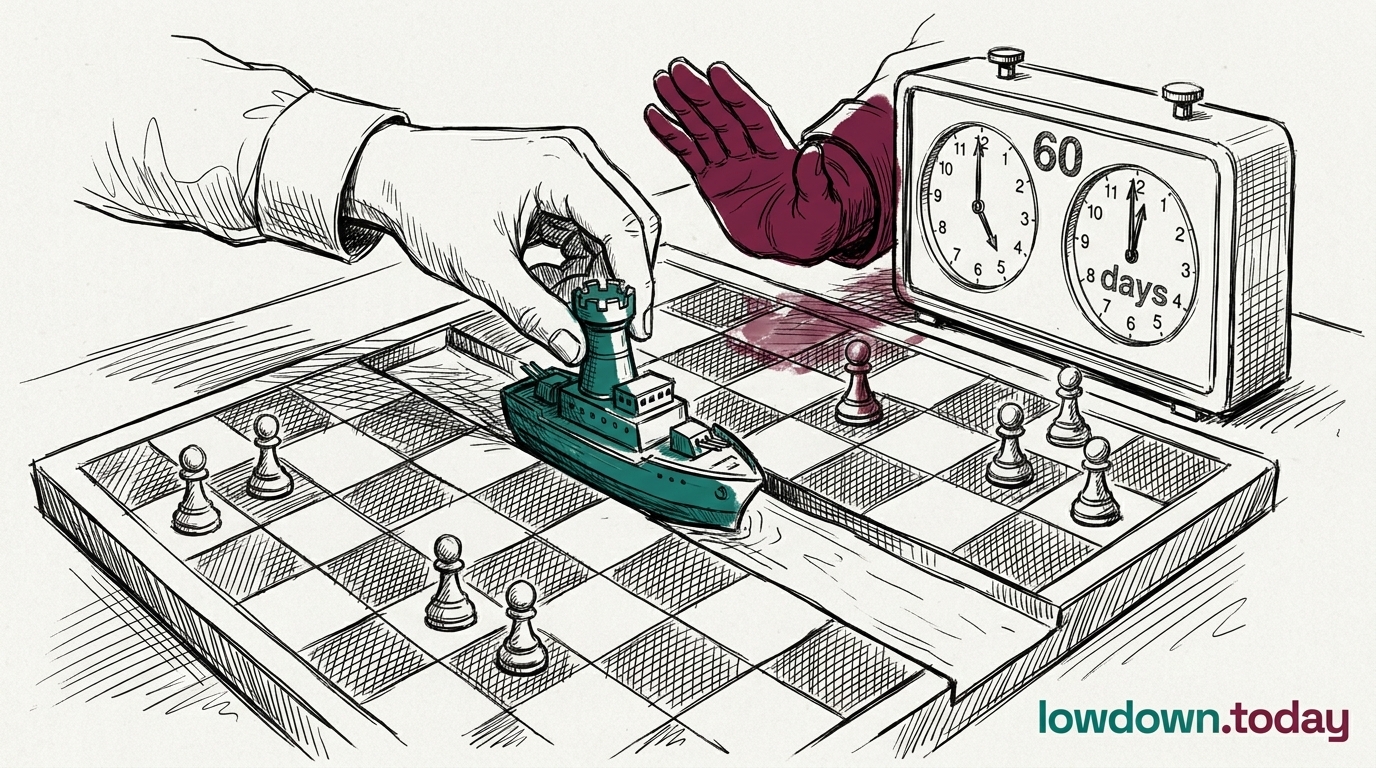
Scott Bessent confirmed the at-sea crude waiver is dead against wire consensus that it would survive. Rosneft and Lukoil go back on the blocked-entity list the same afternoon.

ConflictDeveloping
Key takeaway

Treasury chose the dollar column over envoy optics, and the wires calling extension were wrong.

US Treasury Secretary Scott Bessent confirmed at a White House briefing on 16 April that General License 134A, the OFAC (Office of Foreign Assets Control) waiver covering Russian crude loaded before 12 March, will not be renewed. "We will not be renewing the general license on Russian oil, and we will not be renewing the general license on Iranian oil," Bessent said. The waiver had expired on 11 April with Reuters, Semafor and Bloomberg pointing to extension. Treasury paired the non-renewal with a coordinated US, UK and EU redesignation of Rosneft and Lukoil under the SDN (Specially Designated Nationals) list, and a statement calling for "an immediate ceasefire."

The dollar figure is the point. At $121 Urals the waiver was handing Moscow roughly $150 million a day against the $73 barrel design price the sanctions architecture was built around . That is a 2.6x inversion: a waiver intended as a market-stabilisation tool was running as a windfall the price cap was built to prevent. OFAC granted Lukoil's non-Russian retail network, some 2,000 forecourts across Europe, the Middle East and the United States, a wind-down exemption to 29 October, and gave the Lukoil Neftochim Burgas refinery in Bulgaria a separate operational licence. Asian refiners led by India and the Philippines had lobbied openly for GL 134A to continue; the non-renewal landed against their lobbying.

The enforcement test now runs through the wind-down dates, not the press release. A six-month Lukoil retail grace period lets European and US forecourts liquidate inventory before the cliff falls in October. Shorter, unpublished licences for non-retail operations will appear in OFAC guidance over the coming weeks and are the measurable portion of the revenue cut. Whether GL 134A died as a deliberate Trump policy turn or as the only available answer to a 2.6x Urals-to-design-price inversion is a question about motive; the coordinated redesignation is the dated fact.

Deep Analysis

In plain English

Russia earns most of its war funding from selling oil. In March 2026, the US Treasury gave buyers a temporary permission slip, called a general licence, to keep buying Russian crude that was already loaded onto ships. This was meant to prevent a sudden oil price spike after the Iran war disrupted supply. The problem: oil prices rose sharply, meaning Russia was now earning far more per barrel than anyone expected when the permission was granted. On 16 April, US Treasury Secretary Scott Bessent announced the permission slip would not be renewed. At the same time, the US, UK, and EU placed Russia's two biggest oil companies, Rosneft and Lukoil, back on a blacklist, meaning most international banks and buyers face legal risk doing business with them. The combined effect is that Russia loses a major daily income stream just as its war costs are rising.

Deep Analysis
Root Causes

GL 134A's core structural problem was issuing a blanket volume waiver when the price variable was untethered. The original March 2026 licence was defensible: Urals was trading near $73, Hormuz disruption risk justified stabilisation, and the 124 million barrels at sea were stranded rather than newly exported. The instrument was calibrated for a price environment that evaporated within three weeks.

The secondary cause is institutional. OFAC's general licence toolkit was designed for narrow humanitarian and technical use cases, not for real-time oil price management across 124 million barrels. Treasury did not include a price escalator clause or a cap, which would have automatically triggered review at a defined Urals threshold. That omission converted a temporary stabilisation measure into an open-ended subsidy as price moved.

A third structural driver: the coordinated US-UK-EU redesignation of Rosneft and Lukoil on the same day as GL 134A non-renewal signals the action was pre-planned across three jurisdictions, not improvised. That coordination timeline implies Treasury knew by at least early April that non-renewal was the outcome, yet continued signalling extension publicly. The gap between private planning and public messaging is its own governance failure.

What could happen next?
  • Consequence

    Asian refiners holding Rosneft/Lukoil delivery contracts face a spot-sourcing scramble as SDN exposure risk crystallises before the wind-down deadline.

    Immediate · 0.82
  • Risk

    China and India may accelerate bilateral rouble-yuan and rouble-rupee oil settlement mechanisms to insulate future Russian crude purchases from OFAC reach.

    Short term · 0.71
  • Consequence

    Russia's monthly oil budget receipts fall by an estimated $3-4.5 billion, compressing the fiscal buffer that has kept the National Wealth Fund solvent.

    Short term · 0.78
  • Precedent

    Non-renewal of a general licence over a market price anomaly, rather than a policy breach, establishes that OFAC can revoke stabilisation instruments unilaterally, changing how non-Western buyers model US sanctions reliability.

    Long term · 0.76
First Reported In

Update #13 · Treasury kills the Russian crude waiver

Interfax Ukraine· 16 Apr 2026
Read original
Different Perspectives
Oil markets
Oil markets
Brent fell $1.05 to $106.0 on summit Day 1 but remains $5-7 above the post-ceasefire equilibrium analysts modelled in March; the market is pricing a holding pattern, not a breakthrough. OilPrice.com and Aramco CEO Nasser converge on buffer-exhaustion before Hormuz reopens if the blockade extends past mid-June.
Iranian dissidents and human rights monitors
Hengaw documented a five-prison simultaneous execution cluster on 13 May, with Gorgan appearing for the first time in the wartime register. Espionage charges framed as Israel-linked moharebeh now extend across Mashhad, Karaj, and Gorgan, using the war as judicial cover for protest-era detainees.
BRICS / Global South
Araghchi's Delhi appearance positioned Iran as a victim of US aggression before non-Western foreign ministers, with Deputy FM Bagheri Kani calling on BRICS to act against US aggression. India, as the largest non-Chinese user of Iranian-routed crude, faces pressure to balance bloc solidarity against its own shipping and sanctions exposure.
China
China
Beijing accepted the Nvidia chip clearance on summit Day 1 and gave Rubio verbal acknowledgement of Iran as an Asian stability concern, having already put Pakistan on paper as the mediatory channel on 13 May (ID:3253), deflecting the US ask for direct Chinese action without refusing it.
Iran (government and civilian diplomatic track)
Araghchi denied any Hormuz obstruction at BRICS Delhi on 14 May while Iran's SNSC had finalised a Hormuz security plan the day before. Israel Hayom's single-sourced 15-year freeze offer gives Tehran a deployable figure in non-Western forums regardless of corroboration; the state attributed 3,468 wartime deaths with no independent verification.
United States (Trump administration and Senate moderates)
Trump signed a chip clearance for 10 Chinese firms on summit Day 1 and zero Iran instruments across 76 days; Rubio and Vance made verbal Iran asks without paper. Murkowski voted yes on the 49-50 war-powers resolution after Hegseth told the Senate that Article 2 makes an AUMF unnecessary.