Skip to content
Briefings are running a touch slower this week while we rebuild the foundations.See roadmap
Iran Conflict 2026
1MAY

GL 134A lapses toward quiet extension

3 min read
10:38UTC

Treasury's Russian crude waiver expired on 11 April with wire reporting from Reuters, Semafor and Bloomberg pointing to renewal worth roughly $150 million a day to Moscow at current Urals prices.

ConflictDeveloping
Key takeaway

The Russian oil waiver is the same instrument doing the opposite job it was designed for.

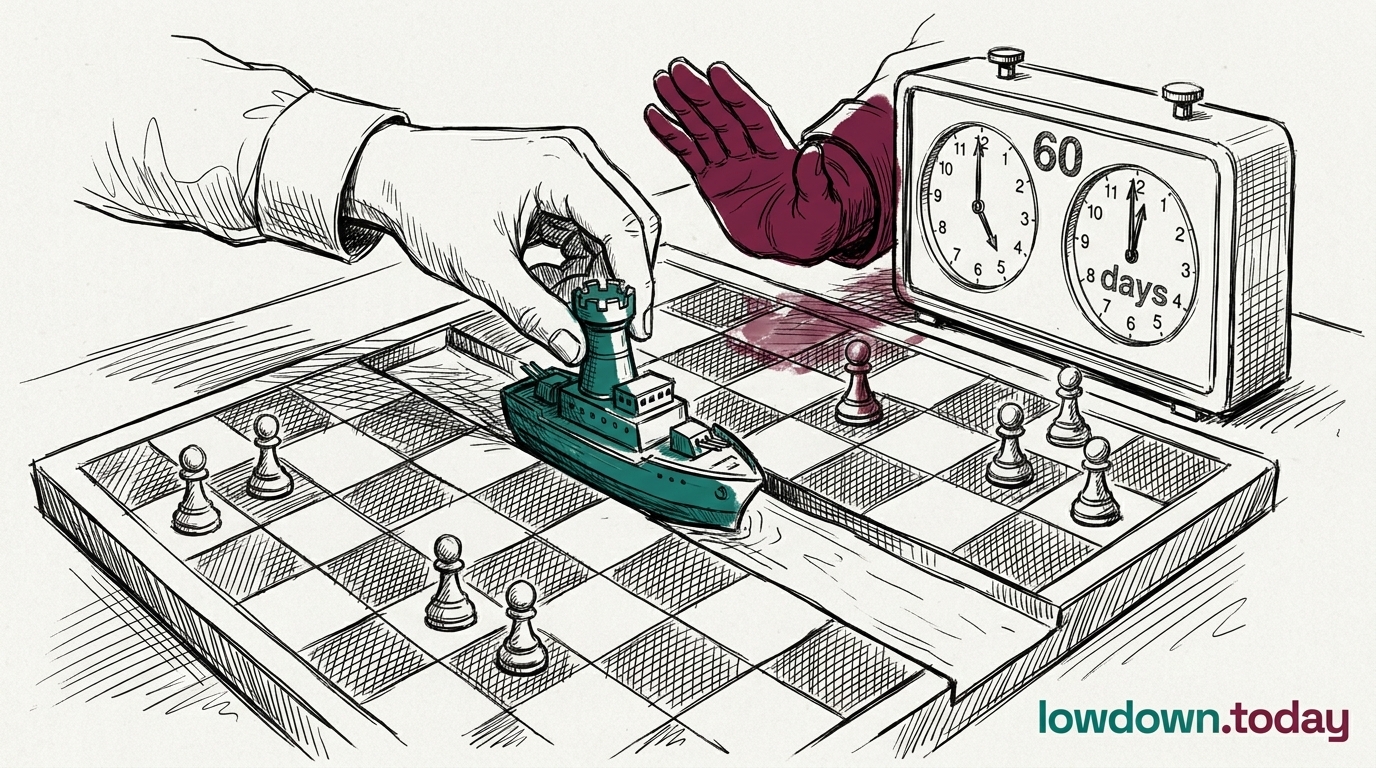
General License 134A (GL 134A), the OFAC (Office of Foreign Assets Control) waiver that authorised transactions for Russian crude loaded before 12 March, expired on 11 April. Reuters, Semafor and Bloomberg report, citing people familiar with the discussions, that an extension is coming 1. A Treasury spokesperson offered only that the department "does not preview actions related to our sanctions."

Daniel Fried at the Atlantic Council called on Treasury Secretary Scott Bessent on 8 April to let the waiver lapse and fall back on the price cap. Asian governments led by India and the Philippines are pushing in the other direction. A week ago this was framed as a binary choice at $121 Urals . Bloomberg estimates the waiver is worth roughly $150 million a day in additional Russian budget revenue at $114 to $116 Urals.

One week of that uplift covers a fortnight of Kinzhal strikes. A full year covers a sum the EU has spent months trying to route to Kyiv against Hungarian opposition. The original GL 134 was defensible in March at $73 a barrel as market stabilisation after the Strait of Hormuz closed. At 64% above that price, and with the Iran ceasefire of 8 April partially reopening Hormuz, the same instrument now hands Moscow a surplus the sanctions architecture was designed to prevent. The Russia-Iran corridor that Israel struck at Bandar Anzali last month still runs.

Deep Analysis

In plain English

When the Iran conflict disrupted oil markets in March, the US Treasury issued a temporary waiver allowing banks and traders to continue processing payments for Russian crude already at sea. The idea was to prevent a sudden oil price spike. The waiver was set to expire on 11 April. The problem: when the waiver was issued, Russian oil was selling at $73 per barrel. By expiry it was trading at $114-116. That means every extra day of extension hands Russia roughly $150 million in war-funding revenue that sanctions were supposed to block.

Deep Analysis
Root Causes

GL 134A was issued on 12 March 2026 as a market-stabilisation measure when the Iran war disrupted Gulf crude flows. The structural problem is that the licence's dollar value is oil-price-sensitive: a barrel-price doubling since issuance means the waiver now hands Moscow a windfall the original policy never contemplated.

The secondary cause is bureaucratic path dependency. Once a sanctions waiver is issued to enable active market transactions, financial institutions and energy traders build positions around it. Lapse without a wind-down window triggers counterparty defaults that US regulators are reluctant to own.

What could happen next?
  • Consequence

    Each week of extension at current Urals prices transfers approximately $1.05 billion to Russia, partially offsetting the impact of the EU's phased gas import ban beginning 25 April.

  • Risk

    If the waiver is extended without a firm sunset date, it establishes precedent that sanctions can be indefinitely deferred when market conditions create lobby pressure, weakening the credibility of the entire OFAC architecture.

First Reported In

Update #12 · Three narrowings of US support for Kyiv

Reuters (via Kyiv Independent)· 11 Apr 2026
Read original
Different Perspectives
Oil markets
Oil markets
Brent fell $1.05 to $106.0 on summit Day 1 but remains $5-7 above the post-ceasefire equilibrium analysts modelled in March; the market is pricing a holding pattern, not a breakthrough. OilPrice.com and Aramco CEO Nasser converge on buffer-exhaustion before Hormuz reopens if the blockade extends past mid-June.
Iranian dissidents and human rights monitors
Hengaw documented a five-prison simultaneous execution cluster on 13 May, with Gorgan appearing for the first time in the wartime register. Espionage charges framed as Israel-linked moharebeh now extend across Mashhad, Karaj, and Gorgan, using the war as judicial cover for protest-era detainees.
BRICS / Global South
Araghchi's Delhi appearance positioned Iran as a victim of US aggression before non-Western foreign ministers, with Deputy FM Bagheri Kani calling on BRICS to act against US aggression. India, as the largest non-Chinese user of Iranian-routed crude, faces pressure to balance bloc solidarity against its own shipping and sanctions exposure.
China
China
Beijing accepted the Nvidia chip clearance on summit Day 1 and gave Rubio verbal acknowledgement of Iran as an Asian stability concern, having already put Pakistan on paper as the mediatory channel on 13 May (ID:3253), deflecting the US ask for direct Chinese action without refusing it.
Iran (government and civilian diplomatic track)
Araghchi denied any Hormuz obstruction at BRICS Delhi on 14 May while Iran's SNSC had finalised a Hormuz security plan the day before. Israel Hayom's single-sourced 15-year freeze offer gives Tehran a deployable figure in non-Western forums regardless of corroboration; the state attributed 3,468 wartime deaths with no independent verification.
United States (Trump administration and Senate moderates)
Trump signed a chip clearance for 10 Chinese firms on summit Day 1 and zero Iran instruments across 76 days; Rubio and Vance made verbal Iran asks without paper. Murkowski voted yes on the 49-50 war-powers resolution after Hegseth told the Senate that Article 2 makes an AUMF unnecessary.