Skip to content
Briefings are running a touch slower this week while we rebuild the foundations.See roadmap
Iran Conflict 2026
1MAY

Day 63: "Not at war": three claims, no treaty

5 min read
10:38UTC

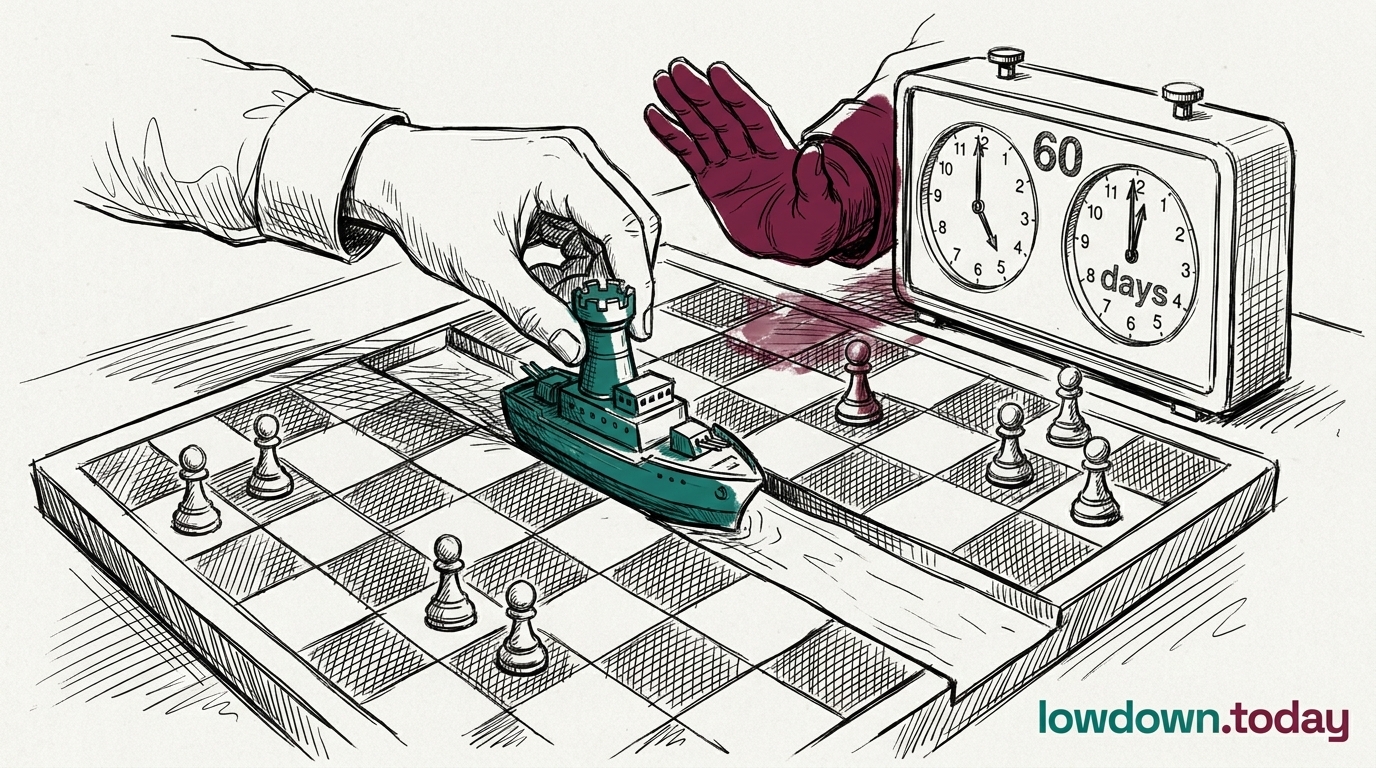
Day 64 produced three sovereignty claims on one strait, none of them a treaty. The White House formally argued the United States is 'not at war' with Iran as the WPR clock expired, while Mojtaba Khamenei claimed 'new management' of Hormuz. The Senate's sixth War Powers vote failed 47-50, with Susan Collins becoming the first Republican to back a WPR since the war began; Brent settled at $123.

Key takeaway

The US-Iran legal vocabulary split produced three sovereignty claims on one strait and zero binding instruments on Day 64.

This briefing mapped
Loading map…
Legal
Diplomatic
Military
Economic
Humanitarian
Domestic

The Trump administration told reporters on 1 May 2026 that the United States is not at war with Iran, the day the War Powers Resolution 60-day clock expired.

Sources profile:This story draws on neutral-leaning sources

The Trump administration formally stated on 1 May 2026 that the United States is 'not at war' with Iran as the War Powers Resolution 60-day deadline expired, asserting the WPR clock never started rather than merely that it was paused by ceasefire.

If the Office of Legal Counsel ratifies the position, both the WPR clock and the 1 June Section 1544(b) wind-down lose their statutory weight against the executive. 

Sources:ANI News
Briefing analysis

Since the 1973 War Powers Resolution was passed over President Nixon's veto, no president has formally accepted that the 60-day clock binds presidential war-making authority. Every administration from Carter onwards has treated WPR notifications as a courtesy rather than a constitutional concession. Federal courts have consistently dismissed individual senators' WPR suits on standing grounds, most recently in Kucinich v. Obama (2011) over Libya. The Trump administration's 1 May 2026 not at war claim is the most expansive WPR-evasion theory in 50 years: not that the clock has expired and the president has discretion, but that the clock never started. Whether anyone has standing to test the theory in a federal court before the Section 1544(b) 1 June cliff is the open constitutional question.

Susan Collins voted Yes on the sixth Iran War Powers Resolution on 30 April 2026, becoming the first Republican to back a WPR challenge since the war began on 28 February.

Sources profile:This story draws on neutral-leaning sources from India
India
LeftRight

For the first time since the Iran war began on 28 February 2026, a Republican senator broke ranks with the White House on 30 April 2026: Susan Collins (R-ME) voted with Democrats to demand withdrawal under the War Powers Act, joining Rand Paul as only the second Republican to defy The Administration across six congressional challenges. The bipartisan bloc reached 47 votes, up four from the 43 who backed the fifth challenge on 22 April 2026 , but still fell short of the 50 needed; John Fetterman held as the lone Democrat No.

The four-vote shift against the White House since the fifth vote, plus a first Republican Yes, gives Lisa Murkowski political cover to file her AUMF without standing alone. 

Mojtaba Khamenei, Iran's Supreme Leader, issued a written statement read on Iranian state television on 30 April 2026 announcing "new management" of the Strait of Hormuz.

Sources profile:This story draws on centre-leaning sources from France
France
LeftRight

Iranian Supreme Leader Mojtaba Khamenei issued a written statement read on Iranian state television on 30 April 2026 announcing 'new management' of the strait of Hormuz, warning that foreigners arriving 'from thousands of kilometres away to act with greed and malice' would have 'no place in it, except at the bottom of its waters'. He asserted Iran's nuclear and missile capabilities are national assets that 'ninety million proud and honourable Iranians will protect just as they protect the country's waters'.

Khamenei's statement is the highest-authority Iranian declaration of sovereign governance over Hormuz since the war began, and it landed on the same afternoon the US launched its competing Maritime Freedom Construct

Sources:Euronews

Pete Hegseth told the Senate Armed Services Committee on 30 April 2026 that the War Powers Resolution 60-day clock is paused by the ceasefire, a theory Tim Kaine rejected from the dais.

Sources profile:This story draws on neutral-leaning sources

Pete Hegseth told the Senate Armed Services Committee on 30 April 2026 that the WPR 60-day clock is paused by the ceasefire, arguing 'we are in a ceasefire right now, which our understanding means the 60-day clock pauses or stops in a ceasefire.' Senator Tim Kaine rejected the theory as unsupported by the statute. This was the first time The Administration formally argued a clock-pause legal theory before a congressional committee.

Hegseth's clock-pause theory is a different and weaker legal position than the next day's *not at war* claim, leaving two incompatible White House lines on the congressional record within 24 hours. 

The State Department launched the Maritime Freedom Construct (MFC) alongside CENTCOM on 30 April 2026, naming no member countries and signing no framework document.

Sources profile:This story draws on centre-left-leaning sources from United States
United States

The US State Department launched the Maritime Freedom Construct (MFC) alongside CENTCOM on 30 April 2026, describing it as a diplomatic hub to provide 'real-time information, safety guidance, and coordination to ensure vessels can transit securely' through the strait of Hormuz. No member countries were named in the announcement; no framework document was signed. The launching instrument was a diplomatic cable.

An MFC without member countries cannot publish rules of engagement, leaving the European Northwood/Paris track months ahead on the documentation that would govern Hormuz transit. 

Sources:CBS News

Adm Brad Cooper told reporters on 30 April 2026 that CENTCOM has redirected 44 commercial vessels, 41 of them tankers, carrying 69 million barrels of crude under the US blockade since 28 February.

Sources profile:This story draws on neutral-leaning sources

CENTCOM Commander ADM Brad Cooper stated on 30 April 2026 that 44 commercial vessels, 41 of them tankers, carrying 69 million barrels of redirected crude had been turned around at sea under the US blockade as of 30 April, up from 38 vessels on Day 60 , a six-vessel increase since the prior count.

The 69 million barrels figure equates to roughly one week of global Brent demand removed from the spot market by US naval action alone, on a pace unchanged by the WPR political theatre. 

Seven OPEC+ members agreed a 206,000 bpd June 2026 production increase on 30 April 2026, with Saudi Arabia taking its share of the joint figure rather than lifting unilaterally after the UAE's exit took formal effect.

Sources profile:This story draws on neutral-leaning sources from Iran
Iran

Seven OPEC+ members — Saudi Arabia, Russia, Iraq, Kuwait, Kazakhstan, Algeria, and Oman — agreed a 206,000 bpd June 2026 production increase, adjusted down to exclude the UAE's 18,000 bpd voluntary-cut share following its OPEC and OPEC+ exit effective 1 May. Saudi Arabia took its share of the joint figure rather than lifting unilaterally. Brent settled at $123 a barrel on 30 April, the wartime settle high.

The cartel's new ceiling is not the 206,000 figure; it is the 5 million bpd of UAE capacity now sitting outside any quota discipline. 

Iranian authorities executed Sasan Azadvar, 21, a karate champion from Isfahan, at Dastgerd Prison at dawn on 30 April 2026 on charges of attacking security forces.

Sources profile:This story draws on centre-right-leaning sources from United Kingdom
United Kingdom

Iranian authorities executed Sasan Azadvar, 21, a karate champion from Isfahan, at Dastgerd Prison at dawn on 30 April 2026. He had been detained during the 9 January 2026 protests and convicted of attacking State Security Force personnel and inciting riots. His lawyer said no credible evidence supported the charges. Hengaw recorded confessions extracted under torture. He was the tenth protester from the December 2025 and January 2026 protests executed during wartime.

Azadvar is the tenth protester from the December 2025 and January 2026 protests executed during wartime, a sub-category emerging within the wider Hengaw register. 

Iran Human Rights counted 22 political executions in six weeks since 19 March 2026, the fastest sustained political-execution rate Iran has recorded since the 1988 prison massacres.

Sources profile:This story draws on centre-right-leaning sources from United Kingdom
United Kingdom

Iran Human Rights counted 22 political executions in the six weeks since 19 March 2026 — an average of one execution every two days — making it the fastest sustained political-execution rate Iran has recorded since the 1988 prison massacres. Ten of the 22 were protesters from the December 2025 and January 2026 protests. The count includes Sasan Azadvar (30 April) and is concurrent with what Hengaw described as the longest internet blackout in modern history remaining partly unwound.

An average of one political execution every two days, recorded under blackout conditions, is a humanitarian register independent of the kinetic ceasefire and outside any sanctions traction the UN OHCHR machinery has yet brought to bear. 

Lisa Murkowski announced on 30 April 2026 that she would introduce her drafted Iran AUMF the week of 11 May if the White House did not present a 'credible plan' within seven days.

Sources profile:This story draws on neutral-leaning sources from India
India
LeftRight

The Trump administration faced its first explicit Republican congressional ultimatum on 30 April 2026: Alaska Senator Lisa Murkowski stated publicly that she would move her pending Iran bill to the floor the week of 11 May unless the executive branch delivered a strategy document within seven days. Her prior silence had served as informal cover ; the public statement ended that cover and set a concrete deadline The Administration had not faced on prior votes.

Conditioning the filing on a White House non-response gives Murkowski a deadline she controls and a public benchmark for what 'credible' means. 

Iran's nursing organisation publicly refused the SNSC-approved Internet Pro scheme on 30 April 2026, the first professional-body break with the framework that allotted internet access to selected businesses, doctors and academics.

Iran's nursing organisation publicly refused the SNSC-approved Internet Pro scheme on 30 April 2026, describing it as discriminatory — the first professional-body break with the SNSC framework that allotted internet access to selected businesses, doctors, and academics while the general public remained at approximately 2% pre-war connectivity. The refusal occurred amid the longest internet blackout in modern history still partly unwound.

A professional institution is now publicly aligned with the general public's blackout, opening a domestic resistance track distinct from street protest and the execution register. 

Closing comments

Legally escalating, kinetically holding. CENTCOM redirected six more vessels in 48 hours (38 on Day 60 to 44 on Day 64) with no new firing event; Brent settled at $123, the wartime high. The constitutional confrontation is widening: Collins crossing on the WPR and Murkowski's conditional AUMF target of 11 May put legislative pressure on a four-week calendar against the 1 June Section 1544(b) cliff. The 'not at war' claim widens the inter-branch dispute; the side that produces the first binding legal instrument, whether an OLC opinion or an AUMF filing, sets the terms for every subsequent escalation or de-escalation decision.

Different Perspectives
Iran (government, IRGC and hardline bloc)
Khamenei's 'new management' declaration is the IRGC's Hormuz posture made sovereign text; Pezeshkian and Araghchi cannot translate it into a diplomatic instrument without the corps's sign-off. Ghalibaf and Vahidi have repeatedly overridden the civilian track; the execution cadence at one every two days reflects IRGC-backed judiciary control, not presidential oversight.
United States (White House and Senate)
The White House pivoted from 'clock paused' to 'not at war' in 24 hours; if the OLC ratifies the reading, both legal cliffs dissolve. Senate moderates pushed back: Collins's first WPR Yes and Murkowski's conditional AUMF target of 11 May are now the primary legislative instruments against an open-ended uninstrumented war.
Saudi Arabia
Saudi Arabia
Riyadh took its share of the 206,000 bpd June OPEC+ increase rather than lifting unilaterally, codifying joint discipline at $123 Brent while its breakeven sits at $87. Saudi Arabia has no fiscal incentive to crash the war risk premium; its June decision confirms it will ride the spread rather than break it.
UAE
UAE
The formal OPEC and OPEC+ exit effective 1 May places 5 mbpd of capacity outside any quota discipline. Abu Dhabi prices independently against a war-driven Brent that its own exit helped push higher, while Khamenei's 'new management' framing distinguishes UAE-adjacent operators from the 'foreigners from thousands of kilometres away'.
Russia / Putin (Kremlin track)
Moscow provides diplomatic cover for Tehran at the UN Security Council while Urals prices at approximately $98 against Brent's $123 capture part of the war premium. Russia declared the US blockade unlawful in Araghchi's Kremlin readout and benefits from every week the strait stays shut.
China (MOFCOM / embassy)
Beijing held its Hengli Petrochemical response at embassy level while the OFAC GL-V wind-down clock runs to 24 May; Hengli transferred 95% of its Singapore arm to a Chinese state entity. Khamenei's 'new management' framing distinguishing 'foreigners' from Asian operators preserves a differentiated risk profile for Chinese tanker operators in Hormuz.
