
Skip to content
Briefings are running a touch slower this week while we rebuild the foundations.See roadmap
Iran Conflict 2026
23APR

Day 55: Pentagon: six months to clear Hormuz mines

3 min read
08:02UTC

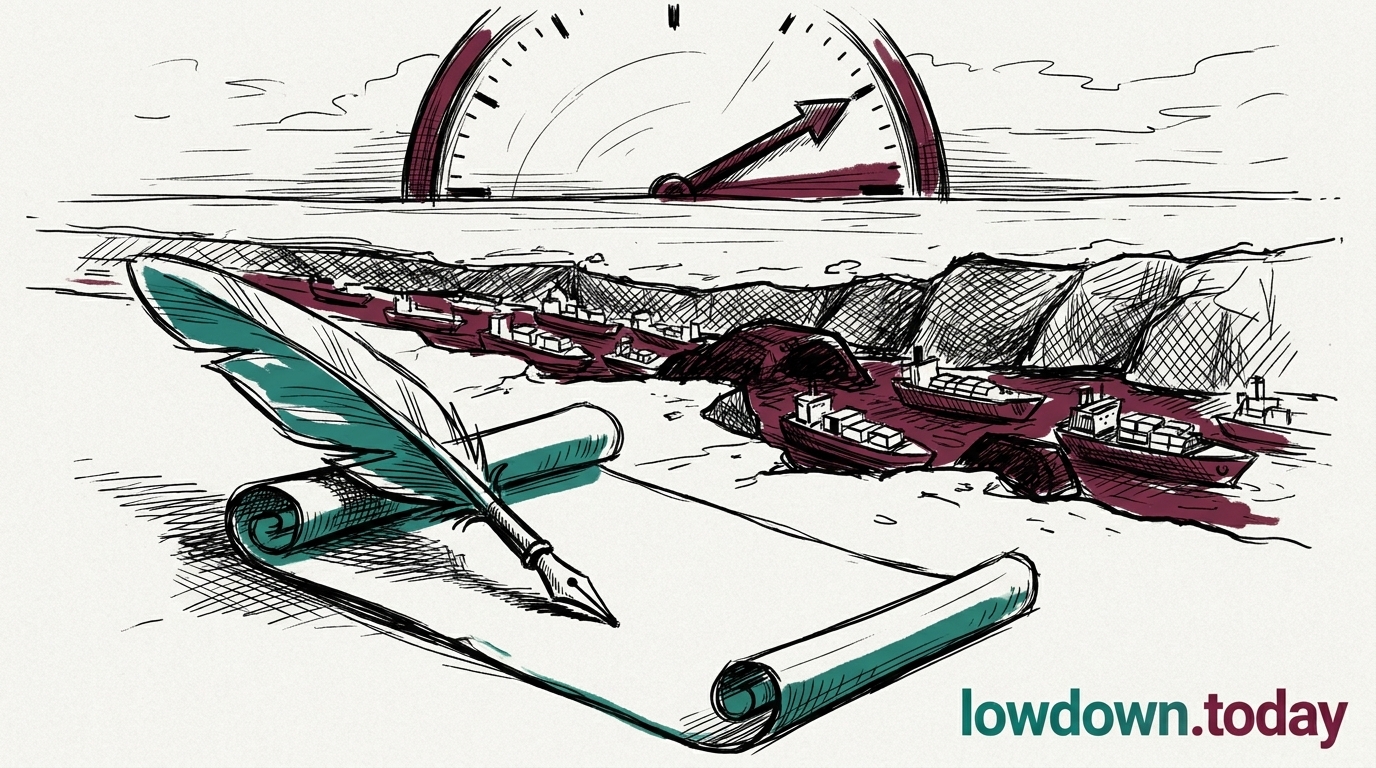
The Pentagon told the House Armed Services Committee on 22 April that clearing the Strait of Hormuz of Iranian mines could take up to six months, and would not begin until the war ends. Within the same 24 hours, the IRGC Navy seized two merchant ships in the strait, fired on a third, and executed a former atomic agency employee on Mossad charges. Trump's indefinite ceasefire extension remains an unsigned Truth Social post on Day 54 of the war.

Key takeaway

A verbal ceasefire, an active IRGC seizure campaign, and a six-month mine-clearance clock ran simultaneously on Day 54 without a single signed instrument behind any of them.

This briefing mapped
Loading map…
Military
Domestic
Diplomatic
Economic

A senior Defence Department official told a classified House Armed Services Committee (HASC) briefing on 22 April that clearing Iranian mines from the Strait of Hormuz could take up to six months and would not begin until the war ends.

Sources profile:This story draws on centre-left-leaning sources from United States
United States

The Pentagon told the House Armed Services Committee on 22 April that clearing Iranian mines from the strait of Hormuz would take up to six months, and that no clearing would begin until fighting stops. Both parties left the classified briefing frustrated.

That estimate means any ceasefire signed tomorrow leaves the strait closed until October at the earliest. Goldman Sachs's $120-per-barrel forecast for the third quarter of 2026 is now a defence planning assumption, not just a bank model. 

The IRGC Navy boarded and seized the MSC Francesca and the Epaminondas in the Strait of Hormuz on 22 April and fired on a third vessel, the Euphoria, according to Lloyd's List. The seizures are the first since the war with the US and Israel began on 28 February.

Sources profile:This story draws on mixed-leaning sources from United States and United Kingdom
United StatesUnited Kingdom

Iran's Revolutionary Guard Navy boarded two ships in the strait of Hormuz on 22 April and fired on a third. Lloyd's List confirmed the MSC Francesca and Epaminondas seizures as the first since the conflict started. The boardings came within 24 hours of Trump's indefinite ceasefire extension post.

The Epaminondas was heading to Gujarat, pulling India into the kinetic track for the third time in eight days. Charterers can now plan around a 24-hour rhythm: Washington statement, Iranian boarding party. 

Sources:NPR·Lloyd's List

The IRGC carried out drone strikes on Salalah port in Oman on 19 and 20 April, Omani authorities confirmed: two strikes, one expatriate injured and a crane damaged. The IRGC said it was targeting a US naval vessel off the Omani coast.

Sources profile:This story draws on neutral-leaning sources

Iran's Revolutionary Guard Corps launched drone strikes on Salalah port in Oman on 19 and 20 April. Oman confirmed two strikes: one worker injured, one crane damaged. Iran claimed it was targeting a nearby US Navy vessel. The US military issued no public response.

Oman has been the quiet back-channel for US-Iran contact throughout the conflict. Striking Omani port infrastructure puts Muscat in an impossible position and leaves Pakistan as the only neutral ground for any future talks. 

Major General Ahmad Vahidi and his hardline IRGC faction have seized operational control of Iran's military posture and negotiating delegation, sidelining civilian moderates including Foreign Minister Abbas Araghchi, according to GlobalSecurity.org analysis on 22 April.

Sources profile:This story draws on neutral-leaning sources

Major General Ahmad Vahidi and his hardline Revolutionary Guard faction took operational control of Iran's military and diplomatic positions on 22 April, sidelining Foreign Minister Abbas Araghchi. The Hormuz open-then-close sequence on 17-18 April and the 22 April ship seizures confirmed the pattern.

The Majlis voted 221-0 on 11 April to suspend international nuclear inspections, giving the corps legal cover. Any deal Araghchi might sign is a starting offer that Vahidi will decide whether to honour. 

India's Ministry of External Affairs engaged Tehran at high level on 23 April after the Epaminondas was seized carrying cargo bound for Mundra port in Gujarat. The MEA has held public silence for eight days on the 15 April OFAC designations naming Indian nationals and India-registered firms in the Shamkhani network.

Sources profile:This story draws on neutral-leaning sources

India's foreign ministry engaged Tehran on 23 April after the cargo ship Epaminondas was seized heading for Mundra port in Gujarat. Delhi stayed silent for eight days on US Treasury sanctions naming five Indian nationals and eight Indian firms in the Shamkhani network.

India moved fast when crews were at sea and said nothing when Indian firms appeared on a US blacklist. The two tracks require contradictory positions, so Delhi is speaking only on the one it can handle. 

Iran executed a former employee of the Atomic Energy Organisation on 22 April on charges of spying for Mossad, according to Euronews and Shabtab News. No name has been released publicly. The execution fell on the same day as the MSC Francesca and Epaminondas seizures.

Sources profile:This story draws on centre-leaning sources from France
France
LeftRight

Iran executed a former Atomic Energy Organisation employee on 22 April on charges of spying for Mossad; Iran's judiciary released no name publicly. The hanging fell on the same afternoon IRGC Navy boarding parties seized the MSC Francesca and Epaminondas.

Tehran's counter-intelligence believes former Atomic Energy Organisation staff supplied coordinates that let Israel destroy Natanz, Esfahan, and Fordow in Operation Roaring Lion on 28 February. The regime is running espionage and protest-era executions simultaneously on 2 separate judicial tracks. 

Sources:Euronews

Windward logged only three Hormuz transits on 19 April, the lowest since the blockade began, alongside seven Very Large Crude Carriers (VLCCs) clustered near Chabahar with combined 14 million barrel capacity. The International Maritime Organization estimates roughly 20,000 mariners and 2,000 ships stranded in the Persian Gulf, with Iran's internet blackout passing 1,296 hours at 1-4 per cent of normal connectivity.

Sources profile:This story draws on neutral-leaning sources from Israel
Israel

Windward logged only three Hormuz transits on 19 April, the lowest since the blockade began. Seven large tankers were clustered near Iran's Chabahar Port with combined 14 million barrel capacity. The International Maritime Organization estimated 20,000 mariners and 2,000 ships stranded inside the Persian Gulf.

Iran's internet blackout passed 1,296 cumulative hours on Day 54. The regime's diplomats are negotiating abroad while most Iranians cannot see any news of what is being offered. 

Brent crude closed at $101.91 on 23 April, up more than 3 per cent on the IRGC seizures, erasing the post-extension decline recorded after Trump's 21 April Truth Social post. CENTCOM's cumulative vessel-intercept figure reached 28 on Day 54, up from 25 on Day 52.

Sources profile:This story draws on neutral-leaning sources

Brent Crude hit $101.91 on 23 April, up more than 3% after Iran's Revolutionary Guard seized two ships in the strait of Hormuz. That erased the $97.91 close from two days earlier, when Trump's ceasefire extension post had briefly pulled the price down.

US military intercepts reached 28 vessels by Day 54, up from 25 on Day 52. One social media post bought markets a single trading session of relief before boarding parties took it back. 

Closing comments

Institutionally de-escalatory (Northwood planning, ceasefire extension, Hawley AUMF bid for signed paper) and operationally escalatory (MSC Francesca and Epaminondas seizures, Salalah strikes, atomic-agency execution). Both tracks have run in parallel for 54 days without converging, long enough to classify the split as structural rather than transient. The IRGC's 72-hour response cadence to every US verbal de-escalation is now predictable enough to plan against.

Different Perspectives
US Administration (Trump / Pentagon)
Trump posted an indefinite ceasefire extension on Truth Social on 21 April naming Pakistan as requestor, while the White House presidential-actions page recorded zero signed Iran instruments for the 54th consecutive day. The Pentagon, speaking separately to Congress, put a six-month mine-clearance estimate on the post-war economy that the executive branch has not addressed in any public instrument.
Iran (Araghchi / Baqaei civilian track vs Vahidi IRGC)
Spokesman Baqaei said Tehran is 'reviewing various dimensions' of Trump's extension without formal acceptance, while Vahidi's IRGC seized two ships within 24 hours, confirming the corps controls Iran's operational posture. Araghchi calling the blockade 'an act of war' and Vahidi opposing all talks while it stands are irreconcilable positions running through the same state simultaneously.
UK / France (Northwood coalition)
British and French officers convened 30-plus nations at Northwood on 22-23 April to translate the Paris posture into a joint Hormuz military plan, with the deployment trigger set at 'when conditions permit following a sustainable ceasefire'. The coalition is drafting rules of engagement and will inherit a six-month mine-clearance burden from a war it did not fight.
Pakistan (Munir mediation)
Trump named Pakistan as the country that requested the indefinite ceasefire extension; Vance's Islamabad 2 trip was postponed after Iran said it had no plans to re-engage, suspending the mediation track that Munir had advanced with his April 16 Tehran visit.
India (MEA)
India (MEA)
The Ministry of External Affairs engaged Tehran quietly on 23 April after the Epaminondas, bound for Mundra, was seized, but maintained eight days of public silence on OFAC designations naming Indian nationals in the Shamkhani network. Delhi cannot simultaneously demand IRGC stop targeting Indian-bound vessels while avoiding any public comment on US sanctions hitting Indian firms.
Russia (Rosatom / Kremlin)
Rosatom completed its Bushehr evacuation before Day 54, leaving only 24 volunteers and 282 tonnes of material, while the Kremlin continues to advance its uranium custody offer. The evacuation removes Russia's operational capacity to execute the offer its spokesmen are still making.
