Skip to content
Briefings are running a touch slower this week while we rebuild the foundations.See roadmap
Iran Conflict 2026
3JUN

Day 96: Washington signs a sanction, not a strike

3 min read
09:04UTC

On Day 96 the war moved off Iran's coastline and onto its balance sheet. Washington's one signed instrument hit Tehran's crypto rails, not a target, while Iran's foreign minister rang six capitals to undo Monday's talks suspension. The rial rose for the first time in the war, and the only hard fighting was Israeli boots above the Litani.

Key takeaway

Treasury sanctioned Iran's crypto rails while the rial rose and boots advanced in Lebanon.

This briefing mapped
Loading map…
Regulatory
Diplomatic
Economic
Military
Domestic

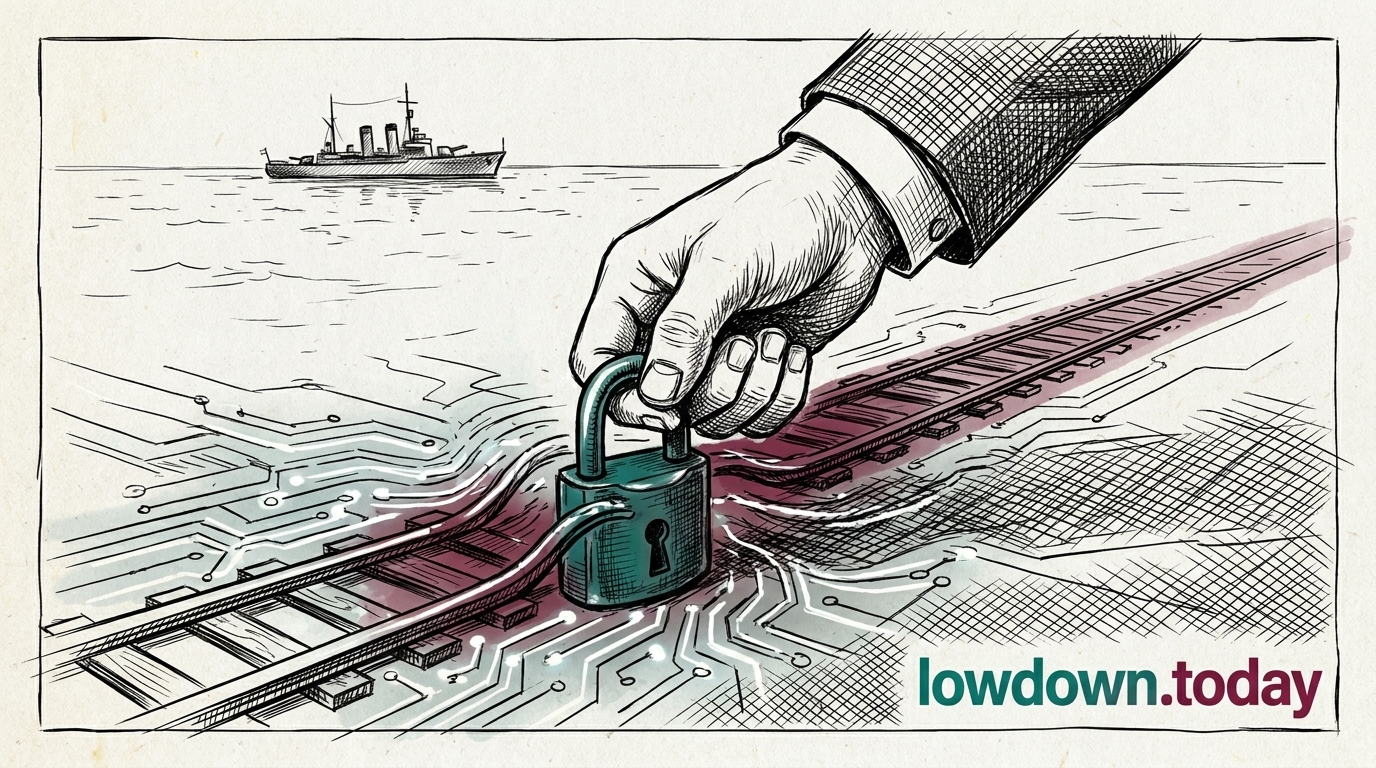
OFAC designated Nobitex and three more Iranian exchanges on 2 June, cutting off the stablecoin route the Central Bank used to defend the rial and the IRGC used to bank Hormuz tolls.

Sources profile:This story draws on mixed-leaning sources from United States
United States
LeftRight

US Treasury sanctioned Iran's four largest crypto exchanges on 2 June, including Nobitex which handled more than half of Iran's digital-asset inflows in 2025. The total frozen under the Economic Fury campaign reached roughly $500 million.

The designations cut two channels at once: the Revolutionary Guard's toll revenue from the strait of Hormuz and the Central Bank of Iran's only dollar-buying mechanism. Both were severed on the same days the rial recovered 1.7%. 

Sources:PBS NewsHour

Iran's foreign minister rang six capitals on 2 and 3 June to reopen the talks his own Security Council had suspended on Monday, denying the IRGC line that messages with Washington had stopped.

Sources profile:This story draws on neutral-leaning sources

Foreign Minister Araghchi contradicted Tasnim's claim on 2 June that Iran had stopped answering US messages, calling it speculation. He then phoned Pakistan, Qatar, Turkey, France and Belgium to reopen the channels Iran's Supreme National Security Council had suspended on 1 June.

The move exposed the split between Iran's civilian Foreign Ministry and the Revolutionary Guard-aligned security council. Araghchi used the Lebanon ceasefire as his re-entry point, keeping talks alive without formally overturning the suspension. 

Sources:Alanchand

In his first war testimony, Marco Rubio told the Senate the strait reopens before any centrifuge talks, with no sanctions relief for reopening alone.

Sources profile:This story draws on mixed-leaning sources from Qatar and United States
QatarUnited States
LeftRight

Rubio testified before the Senate Foreign Relations Committee on 2 June. He set the US sequence: Iran reopens the strait of Hormuz first. Nuclear talks follow. No sanctions are lifted for reopening alone.

Rubio confirmed Khamenei has been sending written messages through intermediaries. That slow channel sits awkwardly against the 30/60/90-day timelines Rubio proposed. The 440.9 kg enriched uranium stockpile remains, in Rubio's words, buried deep in a mountain. 

Iran's currency firmed 1.7 per cent over three days on Rubio's sequencing signal, its first gain since the fighting began, though a six-month 43 per cent slide still stands.

Sources profile:This story draws on mixed-leaning sources from United Arab Emirates and Israel
United Arab EmiratesIsrael

The rial gained 1.7%, moving from its record low of 1,746,000 per dollar to 1,716,000 between 1 and 3 June. Traders priced Rubio's Hormuz-first testimony as a deal signal; Brent Crude sat at $95-97 on the same optimism.

Trump signed nothing to drive that. On the same days, the US Treasury sanctioned the crypto exchanges Iran's central bank had used to defend the rial, cutting Tehran's last informal dollar-liquidity tool as the rate reversed. 

Israeli forces seized the fortress above the Litani on 1 to 2 June, their first hold since the 2000 withdrawal, advancing on ground the Beirut ceasefire never covered.

Sources profile:This story draws on neutral-leaning sources

Israeli forces captured Beaufort Castle, a hilltop fortress above the Litani river in southern Lebanon, on 1 to 2 June 2026. It was the first Israeli occupation of the position since the May 2000 withdrawal.

The advance continued despite Trump's 1 June ceasefire covering Beirut, which explicitly excluded the southern front. Taking the castle during a nominal truce establishes that the ceasefire boundary runs along the Beirut city limit, not the front line. 

Sources:NCRI

A Hezbollah drone killed Staff Sgt Adam Tzarfati, 20, at Yohmor on 1 June as Israel's advance reached its deepest point in Lebanon in 25 years.

Sources profile:This story draws on neutral-leaning sources

Staff Sergeant Adam Tzarfati, 20, was killed by a Hezbollah FPV (first-person-view) drone near Beaufort Castle on 1 June. Three other soldiers were wounded, bringing Israel's Lebanon ground toll to 23 dead since 2 March.

Israeli forces were simultaneously pushing roughly 10 kilometres north of the Litani river toward the Zaharani, the deepest advance into Lebanon in 25 years. The drone attack happened while Israeli troops were taking the highest ground in the Nabatieh district. 

Sources:NCRI

The fourth round of Israel-Lebanon ceasefire talks opened in Washington on 2 June while Israeli forces advanced north of the Litani and struck two districts.

Sources profile:This story draws on centre-left-leaning sources from United States
United States

The fourth round of Israel-Lebanon ceasefire talks opened at the US State Department on 2 June. Lebanon sought a full ceasefire and Israeli withdrawal; Israel sought Hezbollah disarmament guarantees. Both delegations left Washington on 3 June without an agreement.

While the delegations were in Washington, Israeli forces struck Nabatieh and Tyre and pushed north of the Litani. Lebanon's government has no mechanism to force Hezbollah to disarm, so Israel's central demand cannot be delivered by the party at the table. 

Sources:CNBC

Students protested in Tehran, Mashhad and Hamadan on 2 June over university entrance-exam changes, the same day rights monitors logged executions at wartime tempo.

Students marched in Tehran, Mashhad and Hamadan on 2 June against exam-policy changes by Iran's Supreme Council of Cultural Revolution. Ghezel Hesar Prison hanged two protesters from January 2026 the day before.

The National Council of Resistance of Iran counted 37 executions since 19 March, roughly one every other day. Iran Human Rights Monitor ran its anti-execution campaign in 56 prisons the same day. The 2 June protests show that domestic opposition has not been quieted by the war. 

Closing comments

The trajectory on Day 96 is sideways on the Iran-US nuclear track and upward on the Lebanon front. The specific tip-point is the Zaharani advance: if Israeli forces consolidate at the river, Lebanon's delegation loses the ability to demand full southern withdrawal as a ceasefire condition, locking in a new territorial baseline that will require a larger Israeli concession to reverse. On the Iran-US financial track, the tip-point is whether Iran delivers a written counter on the HEU disposal clause before the rial's sentiment-driven recovery reverses, since the CBI no longer has the Nobitex rail to absorb a slide. Rubio's 2 June SFRC testimony set a hard public asymmetry: Hormuz reopens first, sanctions relief comes later, and no timeline was offered for 'later'. That asymmetry is the same structural flaw the Peterson Institute's Esfandyar Batmanghelidj identified in the 2018 JCPOA withdrawal: the party demanding the first concession is the same party not offering a concurrent one.

Different Perspectives
US Treasury / Marco Rubio
Treasury designated four exchanges on 2 June, freezing the crypto rail the IRGC uses to collect Hormuz tolls and the CBI uses to defend the rial; Rubio testified under oath that Hormuz reopens before any nuclear talks, with no sanctions relief for reopening alone. The sequence puts Iran's only strategic leverage on the table for nothing in return.
Iran: Foreign Ministry and domestic population
Araghchi rang six capitals in 48 hours to reopen talks the SNSC had suspended, calling the IRGC line 'speculation'; at home, 37 political prisoners were executed since 19 March while students marched in Tehran, Mashhad and Hamadan. The diplomatic thaw has not eased the state's wartime repression tempo.
Israel / Benjamin Netanyahu
Israeli forces seized Beaufort Castle above the Litani on 1-2 June and advanced to within 10 km of the Zaharani river while ceasefire delegations sat in Washington; the advance ran entirely outside the Beirut-only truce Netanyahu accepted on 1 June. Each kilometre taken raises Israel's withdrawal price before any permanent text is signed.
Lebanon / Hezbollah
Lebanon / Hezbollah
Lebanon's Washington delegation demanded full Israeli withdrawal and the return of 1.2 million displaced; Hezbollah deployed an FPV drone that killed an Israeli soldier at Yohmor while talks ran, demonstrating it can impose costs even at Israel's deepest penetration point. Lebanon's government cannot deliver the Hezbollah disarmament guarantee Israel demands.
China
China
OFAC's Nobitex designation leaves China's informal bilateral currency-swap lines with Iran as the CBI's remaining rial-defence mechanism; Chinese financial institutions face secondary-sanctions risk if they interact with successor wallets. Beijing's MOFCOM Blocking Rules protect mainland refineries from direct designation but do not shield informal swap-line counterparties.
Saudi Arabia and Gulf states
Brent crude at $95-97 on 2-3 June reflects Gulf producers benefiting from the conflict premium; a genuine Hormuz deal would likely cut that premium by $10-15 per barrel. Riyadh's $87 per barrel budget breakeven means the current price is comfortable, reducing the Gulf's urgency to push for a rapid settlement.