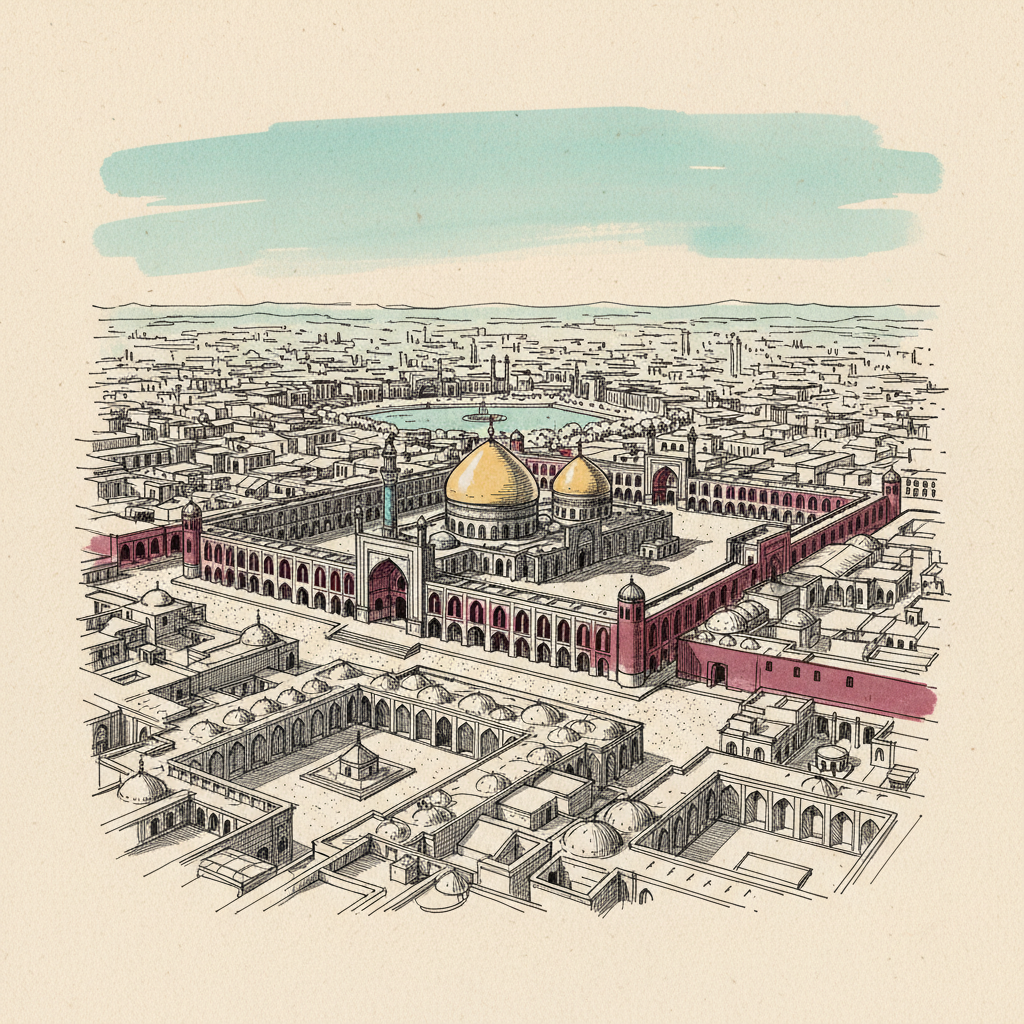
Mashhad
Iran's second-largest city; Shia pilgrimage capital and hardline Conservative stronghold in Khorasan.
Mashhad was chosen as Ali Khamenei's burial place, closing its airspace on 9 July 2026 for the last stage of his funeral, two months after the city hosted a cluster of fast-tracked wartime executions.
Last refreshed: 28 September 2026 · Appears in 1 active topic
Why are Iran's most sensitive 2026 executions happening in Mashhad rather than Tehran?
Timeline for Mashhad
Iran hangs two men over Mashhad unrest
Iran Conflict 2026Mentioned in: Qatar files a UN claim against Iran
Iran Conflict 2026Mentioned in: Araghchi takes Hormuz talks to Muscat
Iran Conflict 2026Hosted the Qatari delegation's meeting with Araghchi
Iran Conflict 2026: Qatari envoy reopens the Doha channelMentioned in: A senior cleric blesses Khamenei's coffin
Iran Conflict 2026Background
Mashhad is Iran's second-largest city, with roughly 3.4 million people, and its most important Shia pilgrimage site. It is home to the Imam Reza shrine, burial place of the eighth Shia imam, which draws tens of millions of pilgrims a year. The city lies in north-eastern Iran near the Afghan and Turkmen borders and is the centre of Razavi Khorasan province.
Its clerical and security networks give it a hardline Conservative character distinct from Tehran. That surfaced on 13 June 2026, when women protested in Mashhad against Foreign Minister Abbas Araghchi's Hormuz negotiations and the semi-official Fars News Agency circulated the footage; crowds in the city chanted against him again on the night of 14 to 15 June.
The war added two further roles. The city served as a venue for fast-tracked political executions, and, as Ali Khamenei's birthplace, it was chosen as the site of his burial in July 2026.
Mashhad hosts the final burial
Iran's plans for Ali Khamenei's funeral ended in Mashhad, his birthplace. The funeral ran from 4 to 9 July, with a leg through Najaf and Karbala in Iraq on 8 July. The Army sent extra troops to the borders and put air-defence crews on round-the-clock watch, with Tehran's airspace to shut on 6 July and Mashhad's on 9 July.
The security planning answered a precedent: Khomeini's funeral in 1989 killed at least eight people in a crowd crush. The city's role outlasted the rites. On 10 July a Qatari delegation met Foreign Minister Abbas Araghchi in Mashhad to restart the Doha channel, which had been paused for the funeral, though no date was set for talks to resume.
The city's courts fast-tracked death sentences
Mashhad was a repeated venue for Iran's wartime executions. On 4 May the city hanged Mehdi Rasouli and Mohammadreza Miri, whom state media called Mossad agents involved in a January 2026 coup attempt; no Independent evidence linking either man to Israeli intelligence has been published.
Protest leader Ebrahim Dolatabadi was executed in Mashhad the same day, six days after sentencing. Iran Human Rights confirmed that as the shortest gap in the wartime record, against the usual three to six months of Supreme Court and clemency review. The cases kept coming: a new Israel-linked moharebeh charge was brought in Mashhad on 9 May, and by 28 May 30 women were held in a so-called "Peace Ward" at the city's Vakilabad Prison.