Skip to content
Briefings are running a touch slower this week while we rebuild the foundations.See roadmap
Iran Conflict 2026
4JUN

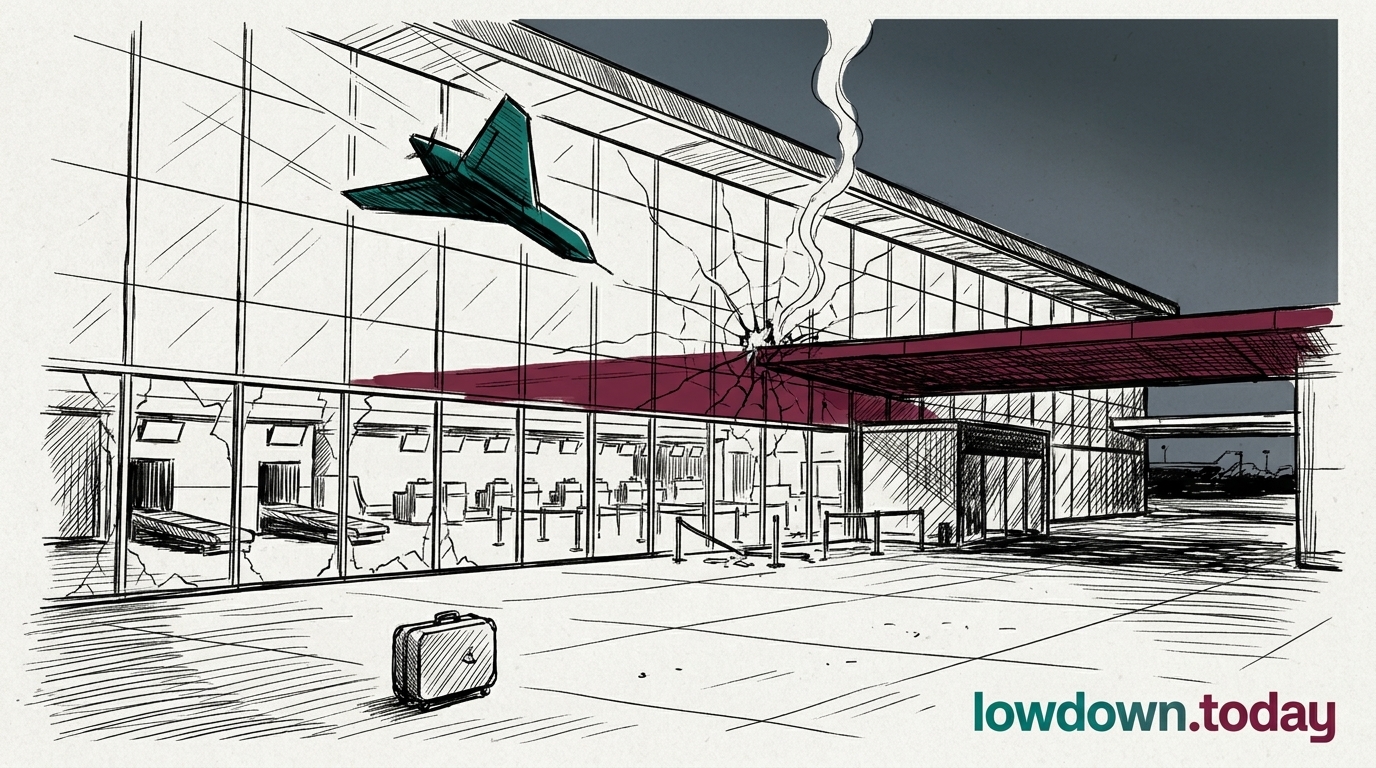
Day 97: Iran's drone finds Kuwait's arrivals hall

4 min read
11:25UTC

An IRGC Shahed-136 drone struck Kuwait International's Terminal 1 on Wednesday, killing an Indian worker and injuring 63 two days after it reopened. Kuwait expelled two Iranian diplomats within a day. Trump said a deal could come over the weekend; Qatar offered Iran half the cash it demanded, Iran sent no nuclear counter, and the House voted to end the war. Every signed instrument moved against the optimism.

Key takeaway

On Day 96 the deal lives only in Trump's narration; every instrument that moved moved against it.

This briefing mapped
Loading map…
Military
Diplomatic
Legal
Economic
Humanitarian
Domestic

An IRGC Shahed-136 drone struck Terminal 1 of Kuwait International Airport on Wednesday 3 June, killing one Indian national and injuring 63, two days after the building reopened.

Sources profile:This story draws on mixed-leaning sources from Qatar and United Arab Emirates
QatarUnited Arab Emirates

An Iranian Revolutionary Guard Corps drone hit Kuwait Airport Terminal 1 on 3 June 2026, killing one Indian national and injuring 63. The terminal had reopened 48 hours earlier after a 55-day war closure. US Central Command called the strike deliberate and rejected Iran's claim a US interceptor caused the damage.

First Iranian strike on an active civilian passenger terminal in the war. The Guards signalled they can target Gulf civilian normality, raising stakes for Gulf states hosting US forces. 

Kuwait declared two members of Iran's diplomatic mission persona non grata within 24 hours of the airport strike, summoning Tehran's charge d'affaires and handing over a formal protest note.

Sources profile:This story draws on centre-right-leaning sources from United Arab Emirates
United Arab Emirates

Kuwait expelled two Iranian diplomats and handed a formal protest within 24 hours of the 3 June airport strike. The Arab League, the United Arab Emirates, Qatar, Egypt, and Bahrain all condemned the attack. Abu Dhabi called for a coordinated Gulf response.

Two expelled rather than the full mission: Kuwait kept a line open while putting Iran on formal record as the aggressor. It is the strongest and fastest Kuwaiti diplomatic move of the conflict. 

Sources:Gulf News

A delegation led by Parliament Speaker Mohammad Bagher Ghalibaf went to Doha and came home with a refusal; Qatar offered $6bn against Iran's $12bn precondition, and could not lawfully go higher.

Sources profile:This story draws on centre-right-leaning sources from United Kingdom
United Kingdom

Parliament speaker Mohammad Bagher Ghalibaf led an Iranian delegation to Doha on 3 June demanding Qatar release $12bn in frozen assets unconditionally before any deal. Qatar offered $6bn under US restrictions and sent the delegation home empty-handed.

The $6bn gap is a legal ceiling, not a negotiating difference. Qatar cannot exceed what US Treasury sanctions rules permit. Secretary of State Rubio confirmed on 2 June that no sanctions relief comes before a signed deal. 

Iran delivered no written counter on its 60%-enriched uranium against the US memorandum sent on 1 June; Araghchi told Tasnim there was 'no tangible progress' while Trump said a deal 'could happen over the weekend'.

Sources profile:This story draws on centre-leaning sources from Jordan, India and 1 more
JordanIndiaUnited States
LeftRight

Iran sent no written counter after Trump transmitted a revised nuclear proposal via Pakistan on 1 June 2026. Foreign Minister Araghchi told Tasnim there had been no tangible progress; Trump said a deal could happen this weekend.

Khamenei uses written couriers with a 3-5 day lag, so a physical reply cannot arrive before 4-6 June. Araghchi speaking to a Revolutionary Guards-linked outlet signals the hardline bloc has not cleared any concession on Iran's 440.9kg enriched uranium stockpile. 

The House passed a war-powers resolution 215-208 on Wednesday 3 June, the first time either chamber carried such a measure since the war began, after four Republicans crossed the floor.

Sources profile:This story draws on centre-left-leaning sources from United States
United States

The House voted 215-208 on 3 June 2026 to direct Trump to wind down the Iran operation without a war declaration. Four Republicans crossed the floor to flip a 212-212 stalemate from 14 May into the first carried chamber vote of the conflict.

The resolution is non-binding and the White House issued no veto threat. It puts Congress on record for the first time, creating a legal reference point for court challenges or budget fights over war funding. 

Bahrain's stock of PAC-3 interceptors is an estimated 87% depleted, leaving roughly eight rounds, and its 50-round resupply runs on an 18-month timeline that leaves the gap open now.

Sources profile:This story draws on centre-leaning sources from United States
United States
LeftRight

Bahrain's Patriot interceptor stock hit an estimated 87% depletion before the 3 June Iranian barrage, leaving roughly eight rounds. Bahrain was excluded from a US emergency resupply approved in May for four other Gulf states. The 50 replacement rounds ordered on 1 June carry an 18-month delivery timeline.

Bahrain hosts the US Fifth Fleet headquarters. Iran struck the island on 3 June with sirens still sounding, probing defences that could be exhausted before replacement stock arrives in 2027. 

Sources:Fortune

Brent crude settled at $94.98 on 1 June, spiked to $101.36 on the morning of 3 June, then fell to $96.97 by 4 June, a round-trip that priced neither a signed deal nor a full blow-up.

Sources profile:This story draws on neutral-leaning sources

Brent Crude hit $101.36 on 3 June 2026 after the Kuwait Airport strike. That was its first move above $100 since 25 May; by 4 June it had fallen back to $96.97. Lloyd's of London held its Hormuz war-risk pricing unchanged.

The round-trip puts Brent in a $95-102 band tracking managed conflict, not a deal or closure. Physical shipping costs through Hormuz stay $10-14 million per voyage above pre-conflict rates regardless of the daily futures screen. 

Sources:Democrata

The rial firmed 1.7% to 1,716,000 per dollar on Rubio's 2 June testimony, but the gain was gone by the next close; it sits at 1,736,000 on 4 June, near its record low.

Sources profile:This story draws on neutral-leaning sources from Iran
Iran

Iran's rial gained 1.7% to 1,716,000 per dollar on 2 June after Rubio's Senate testimony, then surrendered the move within 24 hours. By 4 June it sat at 1,736,000, just 10,000 above the 1 June record low.

Rubio implied relief only after a full deal and Hormuz reopening; the market priced that correctly. The stablecoin rail the Central Bank used to defend the rate was shut on 2 June, leaving nothing to support the rial short of a signed deal. 

Sources:Hengaw

A UNIFIL peacekeeper, Serbian Sgt Milovan Jovanovic, was killed by mortar near Marjayoun on 4 June, the same day a Washington framework for a Lebanon ceasefire was announced.

Sources profile:This story draws on centre-leaning sources from Israel
Israel
LeftRight

Serbian UN peacekeeper Sergeant Milovan Jovanovic was killed by mortar near Marjayoun on 4 June 2026; two others were wounded. The UN Interim Force in Lebanon said the attack may be a war crime. Washington announced a Lebanon-Israel ceasefire framework the same day.

Israel's military chief said on 3 June there is no ceasefire for his forces, and ground operations continued. One peacekeeper dead on framework announcement day marks the gap between what diplomats signed and what soldiers did. 

President Masoud Pezeshkian sent Supreme Leader Mojtaba Khamenei a letter on 1 June accusing the IRGC of cutting the presidency out of war decisions; the government denied he had quit.

President Masoud Pezeshkian sent Khamenei a letter on 1 June 2026, reported publicly on 3-4 June, accusing the Revolutionary Guards of sidelining the presidency from war decisions. The government denied he had quit; his office said he remained committed to serving.

Khamenei warned on 3-4 June that causing public frustration aided Iran's adversaries, framing the leak as an enemy operation. The letter shows Iran's civilian-military fault line has breached the internal-management threshold. 

Closing comments

Upward on the kinetic track, stalled on the diplomatic one. The 3 June airport strike crossed the civilian-terminal threshold; Kuwait's 24-hour persona-non-grata declaration is harder to walk back than a missile exchange. Bahrain's estimated eight PAC-3 rounds and an 18-month resupply gap leave the US Fifth Fleet headquarters in Manama exposed to saturation before 2027. The specific mechanism that would tip escalation downward is a written Iranian HEU counter arriving via Pakistan by 7-8 June; past that date the absence confirms IRGC-bloc veto rather than Khamenei's courier delay.

Different Perspectives
Iran (IRGC-aligned bloc)
The IRGC struck Kuwait's airport terminal on 3 June, denied it while CCTV showed otherwise, and sent Ghalibaf to Doha for a $12bn precondition Qatar refused. The corps holds the deal's cash and nuclear conditions in the same IRGC budget orbit Vahidi consolidated on 22 April, while Araghchi told a Guards-linked outlet there was no progress.
United States
United States
Trump narrated a weekend deal while the channel Rubio described under oath, Khamenei's written-only couriers with a 3-to-5-day lag, cannot answer at that speed; CENTCOM called the airport strike deliberate, calculated and unjustified. The House 215-208 vote gave Congress its first on-record war-powers position against the deployment Trump has run without a signed instrument for 96 days.
Kuwait
Kuwait
Kuwait expelled two Iranian diplomats within 24 hours of the airport strike, the strongest and fastest Kuwaiti diplomatic move of the conflict, while keeping the full mission in place to preserve a communication channel; it has now invoked Article 51 self-defence, filed a formal protest, and expelled diplomats, exhausting its formal toolkit short of full rupture.
Qatar
Qatar
Qatar offered $6bn under OFAC Licence L-2 restrictions and sent Ghalibaf's delegation home empty-handed; the $6bn ceiling is a legal constraint, not a negotiating floor, and Rubio's no-sanctions-relief testimony means Qatar cannot revise it without White House action that has not been requested.
Bahrain
Bahrain
The IRGC struck Bahrain on 3 June as its sirens sounded and its PAC-3 magazine neared exhaustion; excluded from Rubio's 2 May emergency resupply, Bahrain received a 50-round Federal Register notice on 1 June on an 18-month delivery timeline, meaning it is defending the US Fifth Fleet headquarters on the last rounds it has.
Israel
Israel
IDF Chief Zamir said on 3 June there is no ceasefire for his forces even as Israel signed the Washington Lebanon framework requiring Hezbollah withdrawal south of the Litani; a UNIFIL peacekeeper was killed by mortar near Marjayoun on the same day, exposing the gap between the diplomatic framework and a ground advance that has not stopped.
