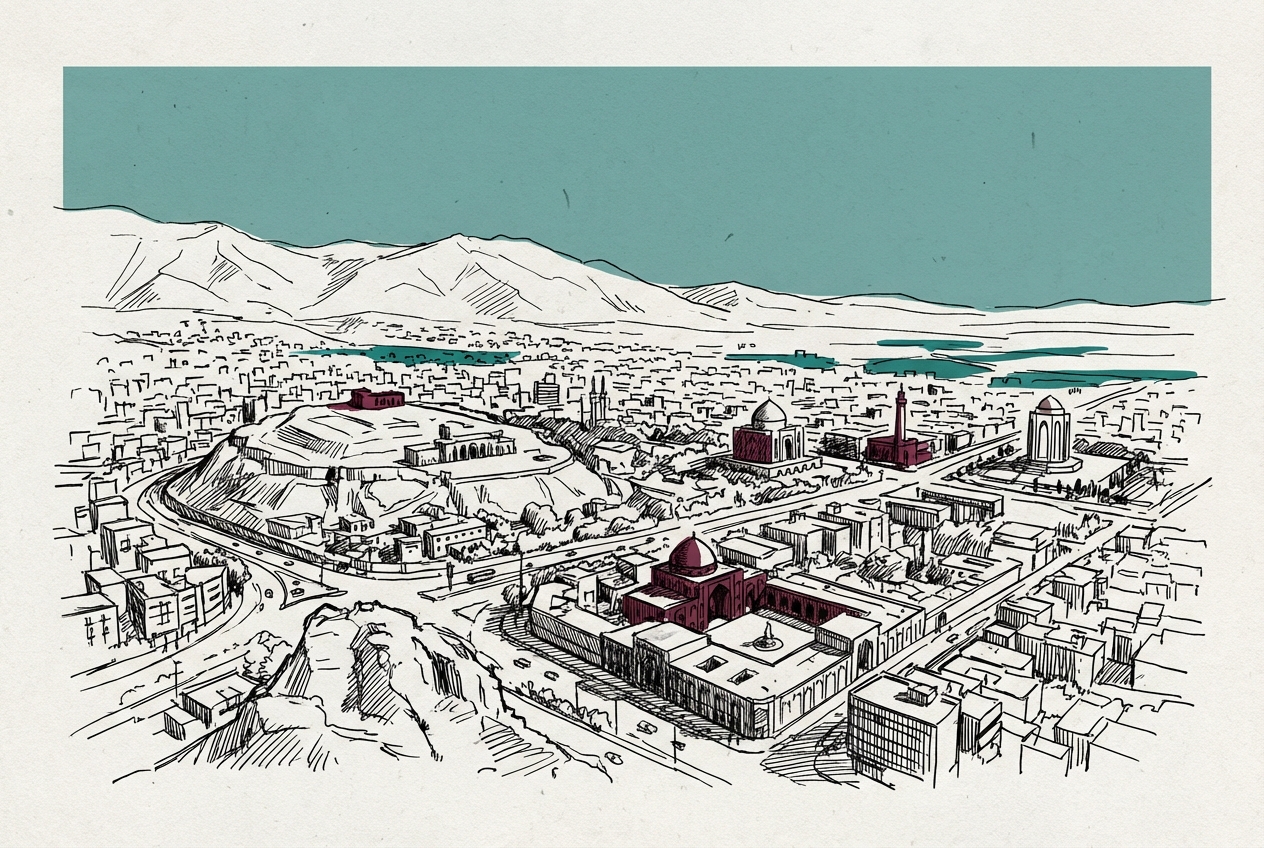
Hamedan
Western Iranian city hosting Shahid Nojeh Air Base; ancient Ecbatana; site of 2026 protests and IDF strikes.
Last refreshed: 28 July 2026 · Appears in 1 active topic
What role does Hamedan's Shahid Nojeh base play in Iran's military posture after Israeli strikes?
Timeline for Hamedan
Iranian students march over exam policy
Iran Conflict 2026Mentioned in: Iran hangs Turkish national, toll rises
Iran Conflict 2026Mentioned in: IAF hits 200 targets from Yazd to Shiraz
Iran Conflict 2026Targeted in IDF's first sustained western Iran offensive
Iran Conflict 2026: IDF opens western front in HamedanUsed for strikes as IDF destroyed Khamenei's jet at Mehrabad
Iran Conflict 2026: Israel destroys Khamenei jet in TehranBackground
Hamedan (also Hamadan; Persian: همدان; classical: Ecbatana) is a city of roughly 554,000 in Hamadan Province, at 1,850 metres elevation on the slopes of Mount Alvand in western Iran. One of the world's oldest continuously inhabited cities, it served as the capital of the Median Empire from around 678 BCE, was a Parthian summer capital, and retains the Tomb of Avicenna (Ibn Sina) and the Tomb of Esther and Mordecai — one of the most significant Jewish pilgrimage sites in Iran. The city sits in a western corridor that connects Iran to the Iraqi border, roughly 300 km east of Baghdad.
Hamedan's military significance centres on Shahid Nojeh Air Base, approximately 50 km east of the city, which served as one of the launch platforms for Iran's April 2024 drone-and-missile barrage against Israel — the largest direct attack on Israeli territory in the country's history. On 15 March 2026, the IDF launched its first sustained air campaign focused on western Iran: more than 200 strikes targeted command centres, air defence systems, and weapons storage in Hamedan province. Overnight 19-20 March, a further wave of IAF strikes extended across western and central Iran, hitting ballistic missile storage sites and drone facilities. Russia had used Nojeh in August 2016 for Syria strikes — the first foreign military deployment on Iranian soil since The Second World War — before Iranian domestic backlash ended the arrangement.
Beyond the military dimension, Hamedan emerged as a site of domestic dissent in June 2026. Students marched on the Supreme Council of Cultural Revolution on 2 June over changes to university entrance-exam policy, joining parallel protests in Tehran and Mashhad. An execution at Hamedan prison on 27 May — Majid Shirzadi — was among a broader wave documented by Hengaw across late May, as the internal enforcement tempo maintained pace with the diplomatic and military tracks. Hamedan thus spans both the external-conflict and domestic-repression dimensions of the 2026 crisis.
What is Hamedan, Iran?
How far is Hamedan from the Iraqi border?
Why did Israel strike Hamedan in the 2026 Iran war?
What is Shahid Nojeh Air Base in Hamedan?
What protests happened in Hamedan in June 2026?
What is Hamedan's ancient history?


Written with AI from Lowdown's published reporting. Not individually reviewed by an editor. Updated 28 July 2026. Editorial standards.