Skip to content
Briefings are running a touch slower this week while we rebuild the foundations.See roadmap
European Energy Markets
4MAY

Storage pace 0.21 vs 0.257; floor not yet met

5 min read
13:52UTC

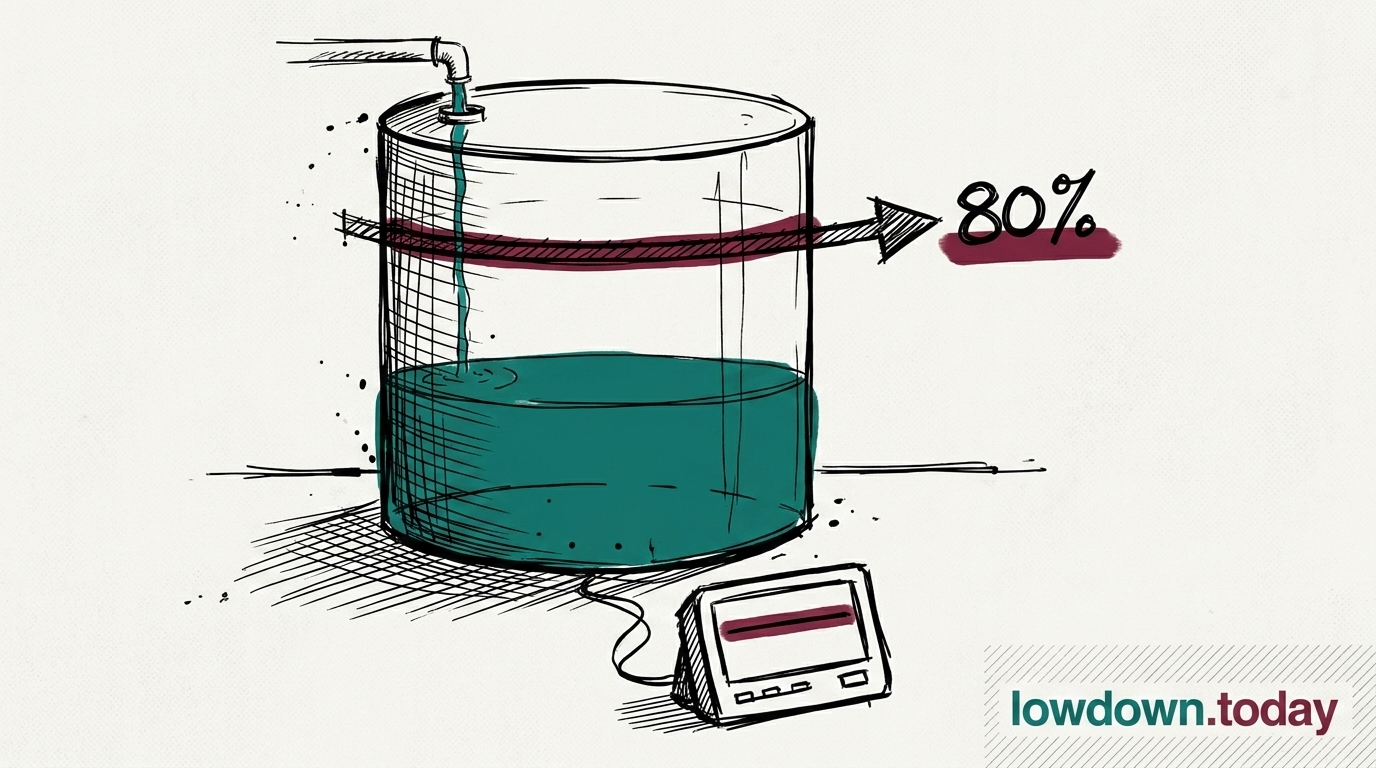
EU gas storage reached 33.06% on Saturday 2 May, up from 32% on Tuesday 28 April. The five-day pace works out to 0.21 percentage points per day; the minimum required to hit 80% by 1 November is 0.257. TTF held a tight EUR 43.4 to 47.4/MWh range through the week, pricing the injection problem as resolved. The arithmetic disagrees.

Key takeaway

Markets price the storage headline; the pace data prices a 72-73% November landing with no policy instrument to close the gap.

This briefing mapped
Loading map…
Economic
Infrastructure

EU aggregate gas storage reached 33.06% on Saturday 2 May, up from 32% on Tuesday 28 April. The five-day gain works out to 0.21 percentage points per day; the floor needed to land 80% by 1 November is 0.257.

Sources profile:This story draws on neutral-leaning sources

EU aggregate gas storage reached 33.06% (374.21 TWh) on 2 May 2026, up from 32% on 28 April. The five-day gain works out to 0.21 percentage points per day, against a 0.257 pp/day minimum floor required to reach 80% by 1 November across the 183 remaining days. TTF settled EUR 46.44/MWh on 4 May, up from EUR 45.77 on 1 May, pricing the injection trajectory as resolved despite the pace gap.

European industrial offtakers reading the tight TTF range as a settled environment may be mispricing winter 2026/27 if November fill lands at 72-73% rather than 80%. 

GasTerra depleted Norg (59 TWh) and Grijpskerk (24 TWh) ahead of the NAM handover on 1 April, leaving both at zero carry-in. Bergermeer now carries the full weight of Dutch injection.

Sources profile:This story draws on neutral-leaning sources

GasTerra depleted Norg (59 TWh of working volume) and Grijpskerk (24 TWh) ahead of the NAM handover on 1 April, leaving both facilities at structural zero carry-in for the 2026/27 injection season. Combined with the 8.95% Netherlands fill recorded on 25 April , this leaves Bergermeer carrying the full weight of Dutch injection against the EBN EUR 233m state mandate. The GTS 2026/27 security-of-supply target sets a 115 TWh combined fill target across the three facilities; with Norg and Grijpskerk starting empty, the Dutch contribution to EU aggregate pace is binary on whether EBN can ramp injection through May and June.

The Dutch contribution to EU aggregate pace becomes binary on whether EBN can ramp Bergermeer through May and June against its EUR 233m state mandate. 

The EU 20th sanctions package banned EU yards from servicing Arc7 ice-class LNG carriers from 25 April. Six named vessels are due dry-dock across summer 2026; all six were last serviced in France or Denmark in 2023.

Sources profile:This story draws on neutral-leaning sources

Six Arc7 ice-class LNG carriers are due for dry-dock across summer 2026 under the EU 20th sanctions package Arc7 maintenance ban operative from 25 April: Rudolf Samoylovich, Georgiy Brusilov, Boris Davydov, Vladimir Vize, Nikolay Zubov, and Nikolay Yevgenov. All six were last serviced in France or Denmark in 2023. Operators face a binary fork: reach non-EU yards (Singapore, China, UAE) inside the summer window, or push servicing into the 2026/27 Arctic operating season after sea ice returns. If two or three fail to secure servicing, Yamal LNG breakdown risk rises through next winter. This risk sits outside every published EU refill model.

Yamal LNG winter 2026/27 reliability now depends on whether non-EU yards in Singapore, China and the UAE can absorb the work, a risk no published EU refill model prices. 

Reuters calculations on ENTSOG data put TurkStream average April flow at 41 mcm/day, only 1.7% below April 2025. The week-old 25% drop framing collapses on inspection.

Sources profile:This story draws on neutral-leaning sources

Reuters calculations on ENTSOG data, relayed via Baird Maritime on 4 May, put TurkStream average April flow at 41 mcm/day. The figure is -25.5% MoM against March 2026 but only -1.7% YoY against April 2025 (1.23 bcm vs 1.25 bcm). The March surge was front-loading ahead of the Hormuz price spike; Reuters attributes the April reversion to demand and pricing effects, not pipeline disruption. The EADaily 40.3 mcm/day single-source figure is thus reframed: March was the anomaly, not April.

TurkStream is not a new disruption layered onto European supply; March 2026 was the front-loading anomaly, and the corrective wire-service framing now lands. 

Bill Farren-Price ranks the Iran shock alongside the early 1970s in OIES Issue 148. Five contributing analysts converge on multi-year tightness, not a transitional pass-through.

Sources profile:This story draws on neutral-leaning sources

The Oxford Institute for Energy Studies published Oxford Energy Forum Issue 148, 'Global Gas: Battling the Next Crisis', in late April 2026. The introduction by Bill Farren-Price frames the Iran shock as 'potentially the most profound episode of energy market disruption since the early 1970s'. Papers by Vitaly Yermakov (Russia-to-China LNG diversion), Anouk Honoré (European industrial gas demand recovery 'very limited'), Samia Adel and Carole Le Henaff (storage resilience as security baseline), and Klaus-Dieter Borchardt (LNG wave may undermine EU energy transition) collectively frame the disruption as multi-year, not transitional.

Issue 148 places the IEA Q2 GMR multi-year LNG capacity delay inside the institutional consensus, raising the cost of any unplanned outage between now and mid-November. 

Trump announced a 15,000-personnel Hormuz shipping escort on 3-4 May. TTF moved from EUR 45.77/MWh on Friday 1 May to EUR 46.44/MWh on Monday 4 May, a 1.48% session gain.

Sources profile:This story draws on neutral-leaning sources from Qatar
Qatar

Donald Trump announced Project Freedom on 3–4 May, a US military escort for stranded shipping through the strait of Hormuz backed by 15,000 personnel, 100-plus aircraft, warships, and drones. Iran's Abdollahi warned that any US forces approaching the strait 'will be attacked'; Fars claimed two missiles were fired at a US warship, denied by the US side. UK MTCO classified the Hormuz threat level as critical on 4 May. TTF moved from EUR 45.77/MWh on 1 May to EUR 46.44/MWh on 4 May, a +1.48% session gain on the announcement day. The muted price action indicates European markets price Project Freedom as geopolitical risk, not as a route by which European cargoes return, consistent with the Mubaraz precedent where the first loaded post-conflict LNG transit headed to Asia, not Europe.

European markets are pricing Project Freedom as geopolitical risk credible enough to dent supply, not as a route by which European cargoes return. 

Norway's Sodir March 2026 release recorded gas sales of 10.8 bcm and production of 349.3 mcm/day, down 1.6% MoM and 0.8% YoY, the second consecutive month of marginal decline.

Sources profile:This story draws on neutral-leaning sources

Norway's Norwegian Offshore Directorate (Sodir) March 2026 gas production print recorded gas sales of 10.8 bcm and production averaging 349.3 mcm/day, -1.6% MoM and -0.8% YoY, the second consecutive month of marginal decline. The April release is expected to land lower still as Hammerfest LNG has been offline since 22 April, removing roughly 0.15 bcm from the Norwegian total that was already drifting.

The April release will land lower with Hammerfest LNG offline since 22 April, removing roughly 0.15 bcm from a Norwegian total that was already drifting. 

Equinor signed NOK 17 billion of extended drilling and well-services agreements on Monday 4 May. The 10 July Hammerfest LNG target sits 67 days out with no update from the operator.

Sources profile:This story draws on neutral-leaning sources

Equinor published NOK 17 billion of extended drilling and well-services supplier agreements for the Norwegian Continental Shelf on Monday 4 May, stating the deals 'contribute to stable energy supplies to Europe'. Neither that announcement nor Equinor's Q1 2026 safety results published on 30 April issued any guidance on the Hammerfest LNG return date. The 10 July target sits 67 days out with no update from Equinor; the company's pattern across prior cycles has been silence until the unit restarts.

Equinor's pattern across prior cycles has been silence until the unit restarts; the 10 July assumption carries the same risk profile it did a fortnight ago. 

Sources:Equinor

TTF held EUR 43.4 to 47.4/MWh across the week to 4 May, settling EUR 46.44 on Monday. Month-to-date down 7.27%, year-on-year up 40.53%; the France-Germany power spread held at EUR 55.75.

Sources profile:This story draws on neutral-leaning sources

TTF held a EUR 43.4 to 47.4/MWh range through the week 30 April to 4 May, settling EUR 46.44/MWh on Monday 4 May per ICE data. Month-to-date the contract is down 7.27%; year-on-year it is up 40.53%. The France May-26 power contract traded at EUR 21.80/MWh versus Germany May-26 at EUR 77.55/MWh; the EUR 55.75 spread held through 4 May with no compression.

The contract narrowing alongside an underlying storage-pace shortfall is the data setup that lets the headline diverge from the arithmetic. 

The REMIT 2.0 recast entered force on Wednesday 29 April. The first 14-day transaction reporting deadline lands around Tuesday 12 May, the recast framework's first compliance test.

Sources profile:This story draws on neutral-leaning sources

REMIT 2.0 (Regulation on Wholesale Energy Market Integrity and Transparency), the recast framework, has its first 14-day transaction reporting deadline landing around 12 May, the first compliance test of the recast framework that entered force on 29 April. No ACER guidance note or enforcement signal has yet been issued in the days following REMIT 2.0's entry into force.

Whether ACER issues guidance or enforcement signal in the week after 12 May sets the tone for how strictly the recast obligations bite this year. 

Closing comments

Storage pace is the binding constraint between now and 1 November. A sustained breach below 0.20 pp/day for five consecutive sessions would force a re-rate of TTF Q4 2026 and Q1 2027 forward contracts; the current EUR 46/MWh front-month implies the market sees this as unlikely. An Equinor Hammerfest extension into late July or August removes roughly 0.15 bcm from the Norwegian injection baseline during the highest-rate weeks and would widen the pace gap measurably. An Arc7 servicing failure for two or more vessels introduces a winter 2026/27 Yamal LNG reliability variable that no current model prices; that risk is dormant through summer and becomes acute in October-November as sea ice returns.

Different Perspectives
European Commission (DG Energy)
The Commission's AccelerateEU package, published 22 April, chose consumer-relief instruments over a storage injection mechanism, a decision the Cyprus summit confirmed without modification. At EUR 46/MWh TTF, Brussels calculates that market signals are sufficient to drive injection to the 80% target without a mandatory pace instrument.
Bundesnetzagentur (German Federal Network Agency)
Germany's storage estate flipped to net injection on 22 April and reached a season-high 745 GWh/day on 25 April, with national fill reaching 24.39%. BNetzA has not reinstated the federal storage levy that lapsed in January 2026, relying instead on the commercial incentive that reversed once Germany cleared its mid-April withdrawal period.
Bruegel (Georg Zachmann and Simone Tagliapietra)
Bruegel's three-scenario refill model costed the injection season at EUR 26bn at EUR 45/MWh TTF and treated the pace question as a volume-and-cost arithmetic problem. The model assumes the 0.257 pp/day floor is delivered; it does not stress-test the inverse where EUR 26bn buys 73% rather than 80% because merchant operators face inverted spreads.
Oxford Institute for Energy Studies (Bill Farren-Price)
OIES Issue 148 ranks the Iran shock alongside the 1973 OPEC embargo on structural grounds: a politically-motivated chokepoint closure with no short-term substitute, requiring demand-side adjustment at speed. Anouk Honore's companion paper in the same issue finds European industrial demand recovery prospects very limited, meaning the demand-side buffer the bloc used in 2022 has already been spent.
Equinor
Equinor
Equinor issued no guidance on the Hammerfest LNG return date between 30 April and 4 May, relying on the 10 July target set at maintenance entry. The 2025 cycle entered on the same date, targeted 10 July, and overran twice to 3 August on a cooling compressor fault.
Gasunie Transport Services (GTS)
GTS published the 2026/2027 security-of-supply overview confirming the 115 TWh combined fill target and the EBN EUR 233m state-backstop mandate, with Bergermeer carrying the full active injection weight after Norg and Grijpskerk were depleted to zero before the NAM handover. Facility-level rates are not in the AGSI+ public feed.