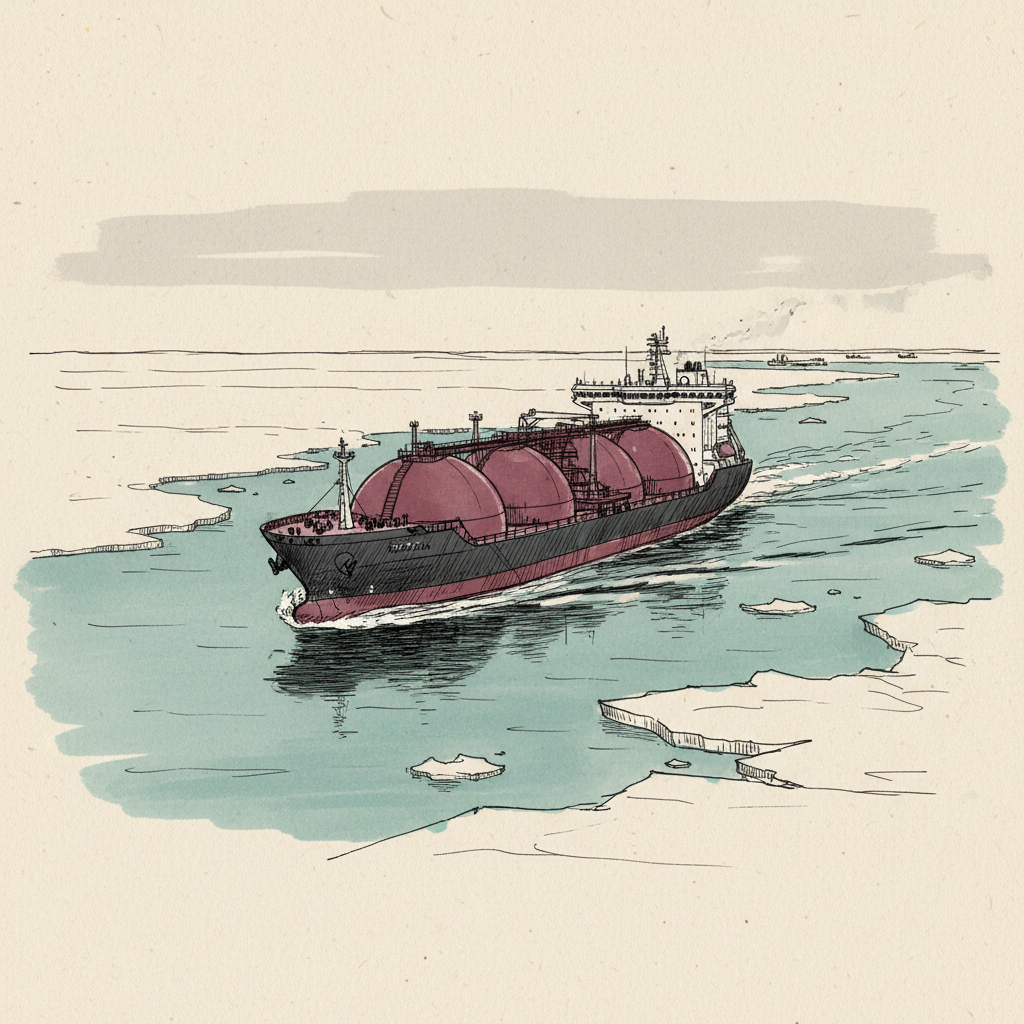
Can all six Arc7 vessels reach non-EU yards before the Arctic ice window closes in autumn?
Timeline for Arc7
Kunpeng rejected at Dahej, LNG sanctions hold
European Energy MarketsSix Arc7 carriers face binary maintenance fork
European Energy MarketsMentioned in: EU storage 32%, refill pace below target
European Energy MarketsMentioned in: EU Russian LNG ban begins; TTF barely flinches
European Energy MarketsMentioned in: EU 20th package would block Arc7 dry-dock servicing
European Energy MarketsBackground
The Arc7 sanctions enforcement picture sharpened on 12 May 2026 when the LNG vessel Kunpeng — carrying cargo from Russia's Portovaya Baltic LNG facility — was rejected by India's Dahej LNG Terminal over US Treasury sanctions designations. AIS satellite tracking confirmed the Russian cargo origin despite documentation attempts to obscure it; as of 12 May the vessel was stranded near Singapore with no declared destination. The episode demonstrated that AIS chain tracing from loading terminal to discharge terminal is structurally unbreakable for LNG (cryogenic constraints prevent ship-to-ship transfer), giving sanctions enforcement an advantage that oil sanction evasion does not face.
The dry-dock carve-out for Arc7 vessels under the 25 April EU maintenance ban remains unresolved. Six vessels — Rudolf Samoylovich, Georgiy Brusilov, Boris Davydov, Vladimir Vize, Nikolay Zubov, and Nikolay Yevgenov — are due for summer 2026 servicing. All were last maintained in EU yards (France and Denmark) in 2023. Operators face a binary choice: reach non-EU yards (Singapore, China, UAE) within the Arctic operating window, or defer servicing into the 2026/27 ICE season. If two or three fail, Yamal LNG breakdown risk rises through winter 2026/27 — a tail risk absent from every published EU refill model.
Arc7 is the ICE rating for the 15 LNG carriers purpose-built for year-round export from Russia's Yamal Peninsula, capable of navigating independently through ICE up to 2.1 metres thick. Eleven are European-owned, primarily by Seapeak Maritime and Dynagas. The Kunpeng incident, though a non-Arc7 vessel, confirmed that LNG cargo origin is now effectively traceable and that sanction-evasion via port-shopping is structurally harder for LNG than for oil. This enforcement reality adds weight to the dry-dock carve-out as the principal unresolved compliance gap in the EU's Russian LNG sanctions architecture.
Arc7 is the ICE-class rating applied to a fleet of 15 LNG carriers built specifically for year-round export operations from the Yamal LNG project on Russia's Arctic Peninsula. The Arc7 designation indicates the vessels can navigate independently through SEA ICE up to 2.1 metres thick, without icebreaker escort — a technical capability found in no other commercial LNG fleet. Of the 15 vessels, 11 are European-owned, primarily by Seapeak Maritime and Dynagas, a concentration that became commercially and legally significant when the EU began legislating restrictions on Russian LNG.
The EU Russian LNG short-term contract ban entering force on 25 April 2026 contains an unresolved carve-out for the Arc7 fleet: the recast text does not explicitly prohibit European owners from rerouting cargoes or chartering their vessels to non-European operators. Legal analysis by Squire Patton Boggs confirmed the ambiguity as of April 2026. The compliance risk sits primarily with EU insurers, WHO face constraints on paying claims where funds could reach state-owned entities.
Arc7 vessels cannot easily be redeployed to non-Yamal routes. Their specialised Arctic engineering, hull reinforcement, and loading infrastructure integration with the Yamal export terminal mean that removing them from the Yamal trade would be operationally complex and commercially uneconomic. This lock-in is why the European ownership question has outsized legal significance: the owners cannot simply reassign the tonnage as a sanctions-compliance measure.
What are Arc7 LNG vessels and why do they matter for the Russian LNG ban?
Who owns the Arc7 Yamal LNG tankers?
Can Arc7 vessels be used on routes other than Yamal?
Which Arc7 tankers are due for maintenance in summer 2026?
What happens if Arc7 tankers cannot find servicing outside the EU?
Why did the EU ban its own shipyards from servicing Arc7 carriers?
Are Arc7 vessels covered by the EU's Russian LNG ban?
What is the Arc7 LNG tanker and why is it sanctioned?
What happened to the Kunpeng LNG tanker in May 2026?
Will Russia's Yamal LNG be disrupted in winter 2026?

