
Skip to content
Cybersecurity: Threats and Defences
17APR

Stryker MDM wipe exposes identity perimeter

19 min read
13:56UTC

Iran-linked Handala wiped 80,000 to 200,000 Stryker devices across 79 countries on 11 March using one stolen Microsoft Intune admin credential, with no malware deployed. NHS Supply Chain issued a UK disruption alert; Stryker filed an SEC 8-K/A. US defenders face this with a proposed $707m CISA cut and a Citrix/F5 vendor stack still burning.

Key takeaway

Identity and administration planes are now the primary attack surface; US defenders face this reality with a proposed $707m CISA cut.

In summary

Iran-linked Handala wiped up to 200,000 Stryker devices across 79 countries on 11 March using a single stolen Microsoft Intune admin credential and no malware, prompting an SEC 8-K/A materiality filing and an NHS Supply Chain disruption alert. The incident lands alongside two critical Citrix and F5 vendor CVEs under active exploitation, a 393-day China-nexus dwell benchmark inside virtualisation stacks, and a Trump budget proposal that would cut CISA by $707m and cancel the counter-ransomware programme.

This briefing mapped
Loading map…
Military
Regulatory
Economic
Infrastructure
Legal

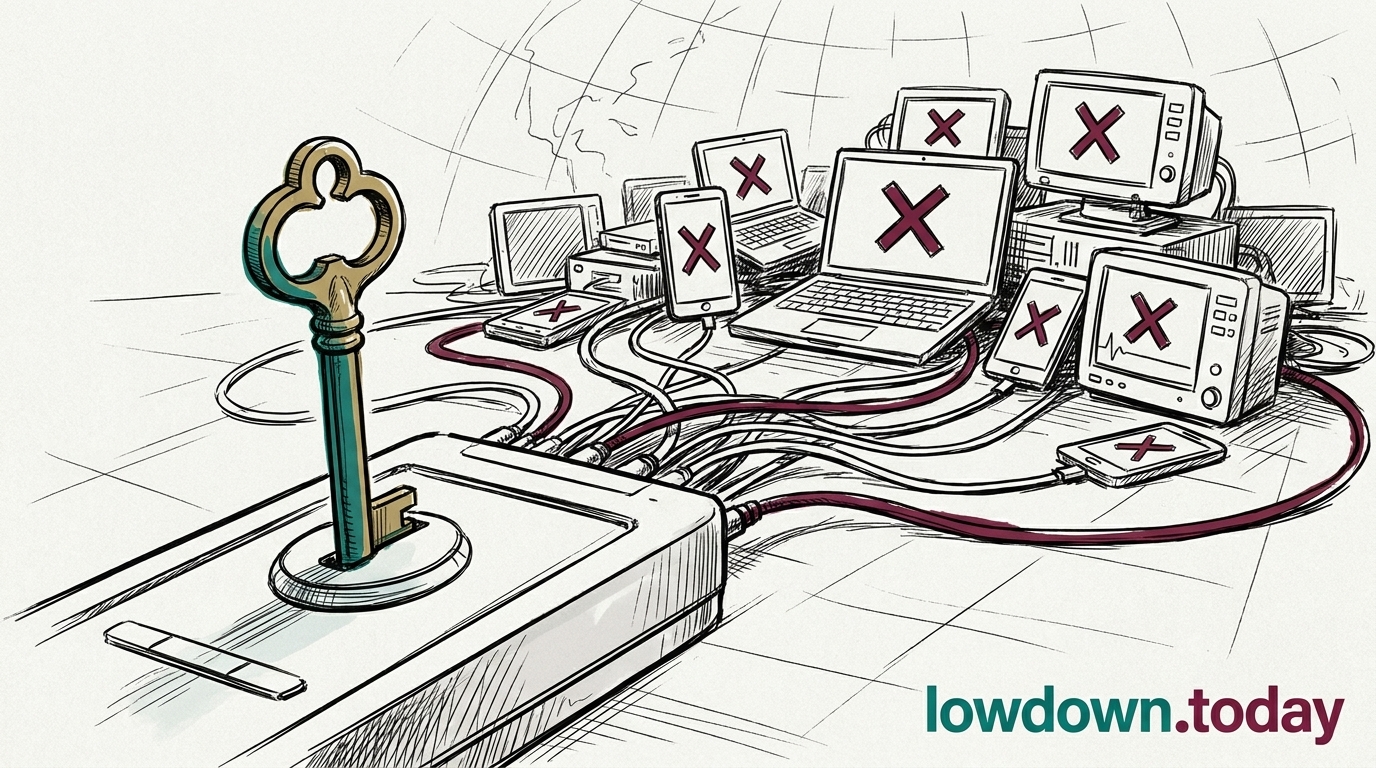
One stolen login, no malware, up to 200,000 devices dark in hours across 79 countries. The Microsoft Intune admin console used exactly as designed.

Sources profile:This story draws on neutral-leaning sources from United States
United States

Iran-linked hacktivist group Handala remotely wiped between 80,000 and 200,000 devices belonging to US medical-device maker Stryker across 79 countries on 11 March 2026 using a single stolen Microsoft Intune administrator credential 1. No malware was deployed. No payload ran on the endpoints. The attackers used the Mobile Device Management (MDM) console, Microsoft's cloud platform for remotely configuring and wiping enrolled laptops, phones and tablets, the way its legitimate operators do, from the Stryker tenant's own admin pane.

Stryker is the Kalamazoo-headquartered Fortune 500 manufacturer whose orthopaedic implants, surgical tables and hospital beds sit in almost every operating theatre in the United Kingdom and United States. NHS Supply Chain, the National Health Service procurement body for England, issued a disruption alert to UK hospitals on 18 March warning that Stryker ordering, manufacturing and invoicing systems were degraded, with most product lines projected to return by 10 April 2. For three weeks, trusts running Stryker-supplied kit reverted inventory workflows to paper and delayed scheduled procedures. Handala claimed 50 terabytes exfiltrated and framed the operation as retaliation for a February missile strike on an Iranian school.

An Intune admin account has authority equivalent to root on every device in the tenant. Most Endpoint Detection and Response (EDR) products cannot block a wipe command issued from the legitimate MDM console because, to the EDR, it looks like authorised IT activity. The defensive perimeter the industry has spent five years building, around endpoints, around networks, even around cloud workloads, has no view into the console that controls all of them. Conditional Access, Microsoft's policy engine for step-up authentication on admin roles, is the control that should have caught this. The question the Stryker incident forces on every Chief Information Security Officer (CISO) is whether their own MDM tenant has it configured tightly enough to stop a single stolen credential from reaching the wipe button.

The industry has been told this for half a decade. The 2020 SolarWinds SUNBURST compromise and the 2022 Okta Lapsus$ breach established identity as the attack surface. Zero Trust became doctrine. Conditional Access was sold as the answer. Stryker is the first mass-scale, no-malware, MDM-level demonstration that the doctrine did not translate into operational posture. CrowdStrike's $740m acquisition of session-revocation vendor SGNL in January, and the 80 cybersecurity acquisitions announced across February and March, track the same thesis commercially. The commercial signal is now running ahead of the defensive one.

Explore the full analysis →
Briefing analysis

The December 2020 SolarWinds SUNBURST compromise and the March 2022 Okta incident taught the industry to treat identity as the attack surface. Zero Trust became doctrine. Conditional Access was marketed as the answer. Five years on, Handala's wipe of up to 200,000 Stryker devices through a single Microsoft Intune administrator credential is the first mass-scale, no-malware demonstration that the lesson has not translated into operational posture on MDM and cloud admin consoles. The commercial signal is moving faster than the defensive one: CrowdStrike's January $740m acquisition of SGNL (real-time access revocation), and the broader M&A pace of 80+ cyber deals in February and March 2026, track the thesis that session-binding and just-in-time privilege control are the next purchase category. Stryker is the incident that will be cited in the 2027 procurement cycle as the reference case.

The first public company to formally disclose a credential-only wipe as material. Q1 2026 earnings take a hit; full-year guidance held.

Sources profile:This story draws on neutral-leaning sources

Stryker Corporation filed a Form 8-K/A with the US Securities and Exchange Commission (SEC) on 10 April 2026 disclosing the March MDM compromise as a material cybersecurity incident, acknowledging a hit to Q1 2026 earnings while maintaining full-year guidance 1. The 8-K/A is the amendment form listed companies file to update a previously reported event; Stryker had filed an initial disclosure in March and the April filing added the material-impact conclusion.

Materiality is the test the SEC's 2023 cyber disclosure rule turns on. Since the rule took effect, every publicly traded US company has had four business days from determining an incident is material to file an 8-K describing its nature, scope and timing. Stryker's lawyers had to decide that a credential-only attack, with no ransomware demand, no encrypted files and no exfiltrated customer data proven at scale, nevertheless met the threshold. Their answer, filed in black and white to the SEC, is that it did.

The filing matters because disclosure counsel at every Fortune 1000 company now has a precedent. Before Stryker, the working assumption inside many general-counsel offices was that a material 8-K attached to a cyber incident meant ransomware, data theft at scale or operational shutdown. Stryker's 8-K/A reframes the threshold: an attack that required no malware, left no ransom note and compromised no customer records was still material because the business disruption and remediation cost were severe enough to move the quarter's numbers. For boards with proxy statements on the line, that reframes which incidents the disclosure committee has to escalate.

Explore the full analysis →

Google-Wiz is the largest pure-cybersecurity deal of the post-CrowdStrike era. SecurityWeek counted 38 cyber M&A deals in March and 42 in February.

Sources profile:This story draws on neutral-leaning sources

Google completed its $32 billion acquisition of cloud security vendor Wiz in March 2026, closing the largest pure-cybersecurity deal of the post-CrowdStrike-Humio era 1. Wiz is a cloud-infrastructure risk platform founded in 2020; its product scans customer estates on Amazon Web Services, Microsoft Azure and Google Cloud for misconfiguration, exposed credentials and lateral-movement paths. Inside Google Cloud, the platform becomes the native security layer fronting every workload the hyperscaler hosts.

SecurityWeek's deal tracker counted 38 cybersecurity mergers and acquisitions announced in March 2026, on top of 42 in February. Databricks, the US data and AI platform, acquired Antimatter and SiftD.ai to launch its Lakewatch Security Information and Event Management (SIEM) product. OpenAI acquired Promptfoo to fold prompt-injection defence into its Frontier platform. Prompt injection is the attack class where malicious instructions embedded in user input hijack a large-language-model application; Promptfoo's tooling is aimed at catching it in production.

The pace matters because consolidation sequences tell you what buyers think the next defensive stack looks like. Cloud security, SIEM re-platforming on AI-native data stores, and large-language-model application security are the three categories absorbing capital. Cloud security is where the Handala-style MDM and Entra ID attack surface lives; SIEM re-platforming is an answer to the 393-day BRICKSTORM dwell problem at detection speed; LLM application security is a new surface that did not exist at the scale it does now three years ago. The money is going where the offensive tradecraft in this briefing is also heading.

Explore the full analysis →

CVE-2026-3055 is the third critical memory-disclosure bug in NetScaler in thirty months. Researchers are calling it CitrixBleed 3.

Sources profile:This story draws on neutral-leaning sources

Citrix disclosed CVE-2026-3055 on 23 March 2026, an unauthenticated memory overread in NetScaler Application Delivery Controller (ADC) and NetScaler Gateway appliances configured as a Security Assertion Markup Language (SAML) Identity Provider, with a Common Vulnerability Scoring System (CVSS) v4.0 score of 9.3 1. A Common Vulnerabilities and Exposures (CVE) number is the public identifier assigned to a given software flaw; the CVSS score rates severity from 0 to 10. Researchers are already calling the new flaw CitrixBleed 3. The attack shape is familiar from the 2023 original: a crafted SAMLRequest to the `/SAML/login` endpoint, omitting the AssertionConsumerServiceURL field, causes the appliance to leak memory via the `NSC_TASS` cookie.

The Cybersecurity and Infrastructure Security Agency (CISA), the US federal cyber defence agency, added the CVE to its Known Exploited Vulnerabilities (KEV) catalogue on 28 March with a 2 April deadline for federal civilian agencies to patch. The KEV catalogue is the authoritative list of bugs confirmed to be exploited in the wild; a place on it triggers a Binding Operational Directive that carries statutory force inside the federal government. Security research firm WatchTowr has detected active reconnaissance in the wild, and the UK National Cyber Security Centre (NCSC), the operational arm of GCHQ, issued a patching advisory to UK operators on 25 March.

Mandiant's incident response on the 2023 CitrixBleed recorded exploitation by the LockBit ransomware affiliate and multiple Advanced Persistent Threat (APT) groups within weeks of public disclosure. CitrixBleed 2 followed in 2024 on the same appliance family. Three serial critical memory-management bugs in thirty months, with the same structural pattern around SAML request parsing, stops being a coincidence. For the enterprises running NetScaler as their SAML broker for single sign-on, which means NetScaler fronts every other authentication decision inside the estate, the appliance is now a top-tier item on the 2026 architecture review, not a patch-management ticket.

Explore the full analysis →
Sources:Citrix·ENISA

A vulnerability triaged in 2025 as a medium-severity denial-of-service issue turned out to be unauthenticated Remote Code Execution. 14,000+ instances still exposed.

Sources profile:This story draws on neutral-leaning sources

F5 reclassified CVE-2025-53521 in its BIG-IP Access Policy Manager (APM) on 28 March 2026 from a medium-severity denial-of-service (DoS) bug to an unauthenticated Remote Code Execution (RCE) vulnerability with a Common Vulnerability Scoring System (CVSS) v3.1 score of 9.8 1. BIG-IP APM is the module in F5's load-balancer line that handles identity-aware remote access, so exploitation gives the attacker code execution on the box sitting between the public internet and an organisation's internal applications. F5 simultaneously confirmed memory-only web shells were being deployed in the wild.

The Cybersecurity and Infrastructure Security Agency (CISA) placed the bug in its Known Exploited Vulnerabilities (KEV) catalogue on the same day, and the UK National Cyber Security Centre (NCSC) issued an advisory on 30 March urging UK operators to patch immediately. Data from Shadowserver, the Netherlands-based security research foundation that scans the public internet for exposed assets, showed more than 14,000 BIG-IP APM instances still unpatched at the point of reclassification despite F5 having released the fix months earlier.

Severity reclassification after patch is the structural problem the enterprise triage model was not built to handle. Most vulnerability-management programmes rank patches against the initial CVSS score, slot the work into a priority queue, and do not revisit the score once the patch is scheduled. An organisation that triaged the original DoS rating as a lower-tier issue and deferred the patch to the next maintenance window was, in effect, patched into the wrong queue by F5's own first call. For the CISOs running appliance-heavy edge estates, the lesson is blunter than the advisory: reclassification history now has to be a formal input to patch scheduling, because the vendor can move a bug from yellow to red after the board has already signed off the quarter's cyber plan.

Explore the full analysis →
Briefing analysis
What does it mean?

Every major incident in this window exploited the same structural gap: the control plane that sits above endpoint detection. Handala reached 200,000 devices without malware because the MDM admin credential was the attack. BRICKSTORM lived 393 days inside vCenter because ESXi is below the EDR line.

APT28 harvested M365 tokens by sitting upstream of the corporate perimeter on the home router. CitrixBleed 3 leaks session tokens from the SAML broker that authenticates everything else. The adversary has moved from exploiting vulnerabilities on endpoints to operating legitimately from the administration layer that manages them.

Against this, the US is proposing to cut the agency that issues the patching deadlines this briefing is full of. The transatlantic regulatory divergence is not subtle: UK legislation at Report Stage mandates 24-hour incident reporting and makes NCSC guidance a GDPR enforcement floor; the EU CRA heads toward September 2026 manufacturer reporting obligations; the US counter-ransomware initiative has already been cancelled. The enforcement machine and the threat machine are on diverging tracks.

Watch for
  • CitrixBleed 3 reconnaissance escalating to mass exploitation within 30 days, repeating the 2023 LockBit arc. Whether the $707m CISA cut survives Congressional markup. OFAC secondary PAIPA designations against other exploit brokers. Whether the UK CS&R Bill 24-hour reporting window survives Lords-stage amendment.

CVE-2009-0238 was cut during the Bush administration. Attackers dug it back up and CISA put it on the active-exploitation list in April.

Sources profile:This story draws on neutral-leaning sources

The Cybersecurity and Infrastructure Security Agency (CISA) added CVE-2009-0238, a seventeen-year-old Microsoft Office remote-code-execution vulnerability, to its Known Exploited Vulnerabilities (KEV) catalogue on 14 April 2026 after confirming active exploitation in the wild 1. The bug was first patched in 2009 during the second Bush administration, before iPhones ran iOS 3. Attackers are mining old CVE databases for flaws that still work against legacy Office deployments, particularly in public-sector estates where migration lag is measured in decades rather than years.

The attack vector is macro-based. A Microsoft Office macro is a scripting command stored inside a document file; a malicious macro embedded in an Office document, delivered over email, runs attacker code on the target machine when opened. In modern Office installations the exploit is blocked by later patches and default macro restrictions. In unpatched legacy installations, still widespread in NHS trusts, council back-office systems and small public-sector departments, the chain completes often enough that the ransomware affiliates buying access have revived it.

For a Chief Information Officer in local government or a trust finance director, a CVE on the KEV catalogue is no longer a line item in the backlog. It is a federal compliance deadline in the United States and, through the Information Commissioner's Office (ICO)'s recent practice of treating NCSC guidance as enforceable data-protection baseline, a UK enforcement posture too. The public-sector legacy-Office problem has moved from technical debt to regulatory exposure.

Explore the full analysis →
Sources:ENISA

NCSC attributed a DNS-hijack campaign to APT28, assessed with near-certainty as GRU Unit 26165. The target was the Outlook login in the kitchen.

Sources profile:This story draws on neutral-leaning sources

The UK National Cyber Security Centre (NCSC) published an attribution-backed advisory on 7 April 2026 stating that APT28, a Russian state hacking group the UK assesses "almost certainly" to be GRU Unit 26165 (the 85th Main Special Service Centre of Russia's military intelligence agency), has since 2024 exploited small-office and home-office (SOHO) routers to hijack Domain Name System (DNS) resolution and conduct adversary-in-the-middle credential theft 1. DNS is the internet address-book service that translates human-readable names like `outlook.live.com` into numeric server addresses; control DNS and you control which server the user actually reaches.

The targeted hardware is mundane: TP-Link WR841N (via CVE-2023-50224), WR840N, ARCHeR C7, WDR4300 and several MikroTik models. The targeted services are not. APT28 rewrote the primary DNS entry on the compromised router to a Virtual Private Server (VPS) running `dnsmasq-2.85` on UDP port 53, while the secondary DNS stayed legitimate. Only `outlook.live.com` and `outlook.office365.com`, the Microsoft 365 sign-in endpoints, resolved to the attacker-controlled server; everything else resolved normally. For a director working from home on a default-configured TP-Link, their Outlook login passed through a GRU DNS server without anything unusual appearing in their browser.

Standard corporate network monitoring sees nothing anomalous because the traffic never crosses the corporate perimeter; the interception happens upstream of the user's home router. Conventional detection cannot fix this. Architecture can. The defensive response is to treat any user's local DNS environment as untrusted for authentication traffic, which in practice means binding Microsoft 365 sign-in flows to corporate-managed DNS over HTTPS, or forcing sign-in through a trusted tunnel rather than the home ISP's resolver. The US Federal Bureau of Investigation (FBI) Internet Crime Complaint Center issued a coordinated public-service announcement, PSA260407, alongside the NCSC advisory.

Explore the full analysis →
Sources:NCSC UK

Russia's FSB, China's APT31 and Iran's IRGC are all running the same trade against journalists, lawyers and politicians. NCSC and Dutch AIVD advised passkeys plus a device audit.

Sources profile:This story draws on neutral-leaning sources

The UK National Cyber Security Centre (NCSC) and the Dutch General Intelligence and Security Service (AIVD) issued joint advisories on 31 March and 9 March 2026 warning that state-linked actors are targeting the Signal, WhatsApp and Facebook Messenger accounts of politicians, journalists, academics and lawyers using malicious QR codes and contact impersonation 1. The named clusters span three adversary states: Russia's Federal Security Service (FSB) running the operation known as Star Blizzard, China's APT31, and the Iranian Islamic Revolutionary Guard Corps (IRGC). A QR code linked in a message, scanned on a phone, can add an attacker's device as a linked Signal or WhatsApp session; contact impersonation through a spoofed voice or typed identity gets the target to send that QR on in the first place.

Three unrelated services arriving at the same attack vector is a tradecraft signal. Messaging apps have become the collection target because they now sit outside the corporate email perimeter where most monitoring lives. A journalist's Signal conversations with a source, a barrister's WhatsApp group with a client, a member of parliament's encrypted chat with a constituent, all carry the material that traditional lawful-intercept once got from telephone taps. The mitigation both agencies recommend, passkeys plus a device audit on every linked session, is specific and actionable in a way that generic state-threat advisories rarely are. A passkey is a cryptographic key bound to the user's device that replaces the password and cannot be phished; device audits on Signal and WhatsApp are done from the app's own "linked devices" menu.

Explore the full analysis →
Sources:NCSC UK

Mandiant's M-Trends 2026 set the China-nexus benchmark at a 393-day average dwell inside VMware hypervisors. The telemetry built for malware does not see it.

Sources profile:This story draws on neutral-leaning sources

Mandiant, the Google-owned incident-response firm, published its annual M-Trends 2026 report this month based on more than 500,000 hours of incident response, disclosing a 393-day average undetected dwell time for UNC5221's BRICKSTORM campaign 1. UNC5221 is a China-nexus espionage cluster; BRICKSTORM is a Go-language backdoor that lives on VMware vCenter and ESXi hosts, the management plane and the hypervisor of most enterprise virtualisation estates. The primary targets are US and UK legal services, Business Process Outsourcers (BPOs, firms that run back-office operations on behalf of clients), Software-as-a-Service (SaaS) providers and technology companies.

The tradecraft bypasses classic endpoint telemetry entirely. A companion servlet filter called BRICKSTEAL captures the vCenter Hypertext Transfer Protocol (HTTP) Basic Authentication credentials used by administrators; domain-controller virtual machines are cloned at the hypervisor layer for offline credential extraction; and mailbox access is achieved through legitimate Microsoft Entra Identity (Entra ID) Enterprise Apps granted the `mail.read` or `full_access_as_app` permission scopes. Command-and-control traffic is relayed through Cloudflare Workers and Heroku, meaning blocklist-based network defences see benign cloud traffic rather than known-bad infrastructure.

The 393-day figure is a calibration point. Any enterprise whose detection-to-eviction time exceeds that number is performing below the observed China-nexus median attacker advantage. For London legal-sector incident-response leads in particular, the benchmark sits uncomfortably close to the reality of a firm that runs a six-month threat-hunt cycle and processes no hypervisor-level forensic data between cycles. EDR sensors, designed to catch malware running on laptops and servers, see nothing at the ESXi layer because they are not installed there.

Explore the full analysis →
Causes and effects
Why is this happening?

MDM, SAML broker, and hypervisor management consoles each concentrate estate-wide authority in credentials that most enterprise security programmes still protect as ordinary admin accounts rather than as equivalent to root on every managed system. Conditional Access, break-glass governance, and session-binding for privileged management roles remain optional Entra ID features, not defaults.

Vendor appliance markets under release-cadence pressure continue to ship critical memory-management bugs at a rate that exceeds customer patch capacity, and severity reclassifications routinely arrive after enterprise triage decisions have already been made and queued.

An FBI official told CyberTalks 2026 the China-linked telecoms compromise is not contained. 200+ companies, 80 countries, and Volt Typhoon sits behind it.

Sources profile:This story draws on neutral-leaning sources

An FBI official told CyberTalks 2026 in February that the China-linked Salt Typhoon telecoms compromise was "still very, very much ongoing" with at least 200 companies across 80 countries affected as of August 2025 1. Salt Typhoon is the name the US government has used since 2024 for the cluster that penetrated at least nine major US telecoms operators, including routes used to intercept lawful-intercept wiretap metadata on US political figures. The FBI's "still ongoing" line is the first public confirmation by a named agency that remediation has not concluded.

Running in parallel, the Cybersecurity and Infrastructure Security Agency (CISA) continues to assess with high confidence that Volt Typhoon, a separate China-linked cluster, is pre-positioning in US Critical National Infrastructure (CNI) Information Technology (IT) networks for later lateral movement into Operational Technology (OT), the industrial control systems that run physical processes like power generation, water treatment and rail signalling. Communications, energy, transportation and water and wastewater sectors have all been confirmed compromised.

CISA has labelled the Volt Typhoon activity as disruption-capability pre-positioning rather than espionage. Espionage exfiltrates secrets and leaves; pre-positioning installs the remote-access footholds that let an adversary trigger real-world effects at a moment of its choosing. For Security Operations Centre (SOC) leads inside US CNI operators, that reframes the adversary model from "what are they reading" to "what could they turn off, and when".

Explore the full analysis →
Sources:CyberScoop

Treasury sanctioned Sergey Zelenyuk, Matrix LLC and five associates for trafficking 8+ zero-days stolen from L3Harris. The statute was not written for cyber.

Sources profile:This story draws on neutral-leaning sources

The US Treasury Office of Foreign Assets Control (OFAC) used the Protecting American Intellectual Property Act (PAIPA) for the first time in a cyber matter, sanctioning Sergey Sergeyevich Zelenyuk, his firm Matrix LLC trading as Operation Zero, and five associated individuals and entities for acquiring and distributing US government cyber tools 1. PAIPA was originally drafted to punish intellectual-property theft that harms US competitiveness; applying it to a Russian exploit broker creates a new sanctions lane alongside the traditional Specially Designated Nationals (SDN) regime, one tuned specifically to the exploit-supply chain.

The underlying theft anchors the case. Per US Department of Justice (DOJ) sentencing documents, Peter Williams, a 39-year-old Australian national and former executive at Trenchant, the cyber unit inside US defence contractor L3Harris, pleaded guilty on 29 October 2025 to stealing at least eight zero-day exploits developed exclusively for US government use and selling them to Operation Zero between 2022 and 2025. A zero-day is a software vulnerability for which no patch exists, typically sold to intelligence services for espionage or to militaries for offensive cyber operations. A federal court sentenced Williams to 87 months, roughly seven years and three months, on 24 February 2026.

The secondary designations describe the broker network's plumbing: Marina Vasanovich (Zelenyuk's assistant), Special Technology Services based in the United Arab Emirates, Azizjon Mamashoyev, Oleg Kucherov (identified as a suspected Trickbot operator), and Mamashoyev's brokerage Advance Security Solutions. The UAE vehicle is the structural insight. Russian-origin exploit brokers have been routing acquisitions through Gulf shell companies to keep sanctioned Russian entities off the paperwork. Treasury's action names that routing explicitly and punishes it, which shifts the broker market's preferred jurisdictions one step further from OFAC reach.

Explore the full analysis →

Ryan Goldberg worked at Sygnia. Kevin Martin negotiated ransoms at DigitalMint. Both admitted to using ALPHV/BlackCat against the organisations they were hired to defend.

Sources profile:This story draws on neutral-leaning sources

The US Department of Justice (DOJ) secured guilty pleas from two cybersecurity professionals for using the ALPHV/BlackCat ransomware family against US victims between April and December 2023 1. Ryan Goldberg, 40, worked at Israeli incident-response firm Sygnia. Kevin Martin, 36, was a ransomware negotiator at DigitalMint, a firm whose product is helping victims buy their way out of exactly this kind of attack. Both pleaded guilty to conspiracy to obstruct commerce by extortion. Sentencing was scheduled for 12 March 2026. ALPHV/BlackCat is the ransomware-as-a-service family that US Treasury previously sanctioned and that operated the Colonial Pipeline-era model of breach, encrypt and extort.

The surprise was not that external attackers compromised incident-response firms. It was that the incident responders and the negotiator used their own privileged access, including pre-existing victim relationships, to extort the organisations they were paid to help. A ransomware negotiator sits in the middle of a client's worst week: privy to the executive committee's willingness to pay, the internal assessment of what was actually encrypted, and the addresses of the wallets. Those are the data points a ransomware affiliate would otherwise spend weeks collecting.

For buyers of Incident Response (IR) services, the due-diligence conversation has now shifted. "Does this vendor have the technical skills" is no longer the difficult question. The difficult question is whether the vendor has the personnel controls, background checks, privilege segmentation and activity monitoring, to stop its own staff from using their access against the client. That is a different kind of audit than the one cyber insurance underwriters and general counsels have been running to date.

Explore the full analysis →

Michigan State Police co-led. German BKA and Finnish KRP ran infrastructure. A Russian national is charged with running the exchange since 2017.

Sources profile:This story draws on neutral-leaning sources

The US Federal Bureau of Investigation (FBI) and Michigan State Police seized cryptocurrency exchange and payment processor E-Note and charged Russian national Mykhalio Petrovich Chudnovets with conspiracy to launder more than $70 million in ransomware and account-takeover proceeds through E-Note since 2017 1. The German Federal Criminal Police (Bundeskriminalamt, BKA) and Finnish National Bureau of Investigation (Keskusrikospoliisi, KRP) cooperated on the infrastructure seizure. Account-takeover proceeds are the funds stolen from hijacked bank or crypto accounts; ransomware proceeds are the extortion payments victims send to recover encrypted files.

E-Note had operated openly for years despite visible ties to the ransomware ecosystem. Its role in the supply chain is the off-ramp: the service that converts bitcoin, monero or stablecoins paid by victims into cash, clean tokens or traditional fiat held in jurisdictions beyond Western reach. Take the off-ramp out and the attackers' business model runs into a working-capital problem. The operational interest for FBI Cyber in 2026 is the laundering rail rather than the operator, because there are far fewer cash-out services than there are ransomware affiliates, and each seizure reaches hundreds of downstream crimes.

A state police force co-leading a takedown alongside the Bureau and two European national police services is an operational template worth noting. Michigan State Police brought the local jurisdictional hook that the federal case needed; the BKA and KRP brought the overseas server infrastructure. For the cash-out services still running, the enforcement geography just widened.

Explore the full analysis →
Sources:The Record

The FY27 budget would leave CISA on roughly $2bn with 860 fewer staff. The counter-ransomware initiative is already gone.

Sources profile:This story draws on neutral-leaning sources

The Trump administration's FY27 budget proposal, published on 7 April 2026, proposes cutting the Cybersecurity and Infrastructure Security Agency (CISA) by $707 million, eliminating 860 positions and bringing the agency's operating budget to roughly $2 billion 1. The counter-ransomware initiative, which coordinated federal response to incidents including the 2021 Colonial Pipeline attack, had already been cancelled under earlier reductions. CISA lost roughly one-third of its staff through 2025-2026 cuts before the FY27 number landed. The FBI's cybercrime obligations would fall a further $560 million, with around 1,900 FBI staff affected across cyber and adjacent portfolios.

The National Institute of Standards and Technology (NIST), the US federal standards body for measurement and technology, is also inside the cuts envelope. NIST maintains the vulnerability-scoring baselines, Common Vulnerabilities and Exposures (CVE) enrichment and Software Bill of Materials work the private sector relies on to run any modern patch-management programme. Stripping budget from NIST at the same time as CISA removes both the agency that publishes the Known Exploited Vulnerabilities (KEV) deadlines and the agency that scores the CVEs those deadlines attach to.

The budget proposal is not law; Congressional appropriations can modify or reject it through markup and committee amendments. But the direction of travel is already set by prior reductions that cleared the appropriations process. For US private-sector Chief Information Security Officers, the federal KEV deadlines issued in April, CitrixBleed 3, the F5 reclassification, the 17-year-old Office bug, are now scheduled to be enforced by an agency with one-third fewer staff. The UK and EU, moving the opposite way on cyber regulation, are widening the transatlantic policy gap at exactly the point the threat cadence is tightest.

Explore the full analysis →

The Cyber Security and Resilience Bill passed Public Bill Committee. ICO fined Capita £14m for missing PAM and AD tiering, citing NCSC guidance as the GDPR baseline.

Sources profile:This story draws on neutral-leaning sources

The UK Cyber Security and Resilience (CS&R) Bill reached Report Stage on 2 March 2026, after the Public Bill Committee concluded in February and a carry-over motion was passed; the bill is expected to reach the House of Lords in the next parliamentary session 1. The substantive provisions rewrite the operating model for UK in-scope organisations. Initial incident reports become due within 24 hours, full reports within 72 hours. Data centres are classified as essential services under joint oversight from the communications regulator Ofcom and the Department for Science, Innovation and Technology (DSIT). The definition of organisations covered by statutory cyber standards widens beyond the current Network and Information Systems (NIS) perimeter.

The 24-hour clock is the operational change. For UK-listed companies, board-level incident-escalation playbooks now have to land within a single trading day, which is a tighter cycle than most legal and communications teams have tested. Tabletop exercises run on a 72-hour assumption become out of date on the day the bill receives Royal Assent.

The enforcement template is already set. Per a decision by the UK Information Commissioner's Office (ICO), the information regulator fined outsourcing firm Capita £14 million in October 2025 for its 2023 breach, and the technical basis has become the 2026 template 2. The ICO cited Capita's absence of Privileged Access Management (PAM) controls, the tooling that gates and audits access to the highest-risk admin accounts, and the absence of Active Directory (AD) tiering, the Microsoft reference model for separating admin credentials by privilege level, as the General Data Protection Regulation (GDPR) security failures that enabled the attacker's privilege escalation. Precedent from Capita and the earlier Advanced Computer Software decision (£3.07m, March 2025) treats NCSC guidance as the GDPR technical baseline. For any organisation in ICO scope, NCSC cyber hygiene advice now carries the force of enforceable data-protection standard.

Explore the full analysis →

European Commission draft CRA guidance opened 3 March. Only a third of German entities registered by the NIS2 deadline. Infringement proceedings are running.

Sources profile:This story draws on neutral-leaning sources

The European Commission published draft implementation guidance for the Cyber Resilience Act (CRA) on 3 March 2026, with a feedback window to 31 March 1. The CRA entered force in December 2024 and sets mandatory cybersecurity requirements for products with digital elements sold into the EU single market, from routers to industrial sensors. Manufacturer reporting obligations start 11 September 2026; the main substantive obligations apply from 11 December 2027.

Behind the CRA, the Network and Information Systems Directive 2 (NIS2) transposition picture remains uneven. NIS2 is the EU's core cybersecurity compliance framework, requiring member states to designate essential and important entities across critical sectors and enforce minimum security and incident-reporting standards. Only fourteen EU member states had fully transposed NIS2 by June 2025. Germany published its national implementation law on 5 December 2025 and required covered entities to register by 6 March 2026; only around one-third had actually registered by the deadline. The Commission's infringement proceedings against non-compliant member states are running in parallel.

The NIS2 fine ceiling is €15 million or 2.5 per cent of worldwide annual turnover, a number designed to reach boardroom attention. The test for 2026 is whether member-state regulators actually apply it, or whether the enforcement pattern continues the lag visible in the German registration data. For multinational vendors selling into the single market, the divergence between fully transposed and partially transposed jurisdictions creates an uneven market-access picture that product compliance teams have to map country by country.

Explore the full analysis →

In Brief

  • Google completed its $32 billion acquisition of Wiz in March, closing what is now the largest pure-cybersecurity deal of the post-CrowdStrike-Humio era; however, it reshapes the cloud security competitive map without resolving the identity-layer gaps Stryker exposed.
  • SecurityWeek counted 38 cybersecurity mergers and acquisitions in March alone, on top of 42 in February, with Databricks acquiring Antimatter and SiftD.ai to launch the Lakewatch Security Information and Event Management (SIEM) product and OpenAI acquiring Promptfoo to fold prompt-injection defence into its Frontier platform.
  • The European Union Agency for Cybersecurity (ENISA) opened public consultation on a draft EU Digital Wallet certification scheme on 3 April, a significant early signal of how the eIDAS2 certification regime will intersect with CRA product requirements.
  • Mandiant and Google Cloud published M-Trends 2026 based on over 500,000 hours of incident response, flagging "Recovery Denial" tactics (attacks on backup and disaster-recovery infrastructure) and sub-second affiliate-to-deployment handoff velocity in the ransomware ecosystem as two Tactics, Techniques and Procedures (TTPs) that mature in 2025.
  • March 2026 saw 808 ransomware victim postings across 65 active groups, up 19 per cent month-on-month and 33 per cent above the 2025 monthly average; despite widespread zero-trust adoption rhetoric, the US still took 50 per cent of all victim claims.
  • LockBit5, the post-Operation Cronos rebuild of LockBit, and DragonForce dominated leak-site activity in April, with a newer group calling itself Coinbasecartel appearing in the tracker for the first time.
  • CISA added nine CVEs to the KEV catalogue in the 30-day window, including CVE-2026-21643 (Fortinet SQL injection), CVE-2026-32201 (SharePoint Server Improper Input Validation, exploited at time of April Patch Tuesday release) and CVE-2026-1603 (Ivanti Endpoint Manager authentication bypass).

Watch For

  • CitrixBleed 3 (CVE-2026-3055) escalating from active reconnaissance to mass exploitation within 30 days, repeating the CitrixBleed 2023 arc that landed LockBit and state groups inside enterprise SAML brokers.
  • OFAC secondary PAIPA designations against other exploit brokers now that the first action has set the legal template, and whether Gulf-based shell vehicles are explicitly named in any follow-on tranche.
  • The $707m CISA cut surviving Congressional markup through the FY27 appropriations process, or whether hearings and committee amendments restore some of the counter-ransomware and election-security programmes.
  • Whether the UK Cyber Security and Resilience Bill returns from the House of Lords with material amendments to the 24-hour incident reporting window, and whether the Lords push back on data-centre classification as essential services.
  • Whether additional MDM-level, identity-only wipes follow the Handala playbook against other multinationals, and whether Microsoft tightens Intune's default Conditional Access and break-glass posture in response.
Closing comments

The threat cadence is accelerating. Ransomware postings reached 808 in March, up 19% month-on-month and 33% above the 2025 monthly average. The KEV catalogue added nine CVEs in the window with active exploitation confirmed on multiple critical-severity appliances. Nation-state dwell benchmarks are lengthening, not shortening. US federal enforcement capacity is proposed to contract. UK and EU regulatory pressure is rising but takes time to change enterprise posture. The defender advantage is narrowing, not widening, in this window.

Different Perspectives
CISA and FBI (US government)
CISA added nine KEV CVEs, confirmed Volt Typhoon in US CNI, and lost its counter-ransomware initiative under prior cuts; the FY27 budget proposes a further $707m cut and 860 jobs. An FBI official confirmed Salt Typhoon at 200+ companies across 80 countries is 'still very, very much ongoing'.
NCSC (UK)
NCSC (UK)
NCSC published attribution-backed advisories naming GRU Unit 26165 for SOHO router DNS hijacking and co-issued warnings with Dutch AIVD on FSB, APT31, and IRGC messaging-app targeting, in the same month the UK Cyber Security and Resilience Bill cleared its Public Bill Committee. The ICO's £14m Capita fine now treats NCSC guidance as the enforceable GDPR technical baseline.
European Commission
European Commission
The Commission published draft Cyber Resilience Act implementation guidance on 3 March with manufacturer reporting obligations beginning 11 September 2026, while running infringement proceedings against EU member states that have not transposed NIS2. Only 14 of 27 states had fully transposed by mid-2025; Germany's post-transposition registration compliance sat at roughly one-third.
Russian foreign ministry (GRU posture)
The Russian foreign ministry has issued no formal response to the NCSC advisory attributing the SOHO router DNS-hijacking campaign to GRU Unit 26165; its standard position is that Western attribution claims are politically motivated fabrications. Russia denies state sponsorship of any offensive cyber operations against NATO infrastructure.
People's Republic of China
Tsinghua University's Center for International Security and Strategy characterised US Volt Typhoon 'sabotage pre-positioning' assessments as misrepresenting standard state signals intelligence, framing the attribution narrative as a US strategic communication exercise rather than a conclusion grounded in confirmed adversary intent. Beijing formally denies state involvement in Salt Typhoon and Volt Typhoon.
Handala
Handala
Handala publicly claimed the Stryker MDM wipe as retaliation for a February 2026 Iranian school missile strike, asserting 200,000 devices wiped and 50 terabytes exfiltrated. The public framing positions the operation as proportionate non-lethal retaliation, a characterisation no Western agency has formally attributed to IRGC command-and-control.