Skip to content
Cybersecurity: Threats and Defences
17APR

F5 reclassifies DoS bug to 9.8 RCE

3 min read
13:56UTC

A vulnerability triaged in 2025 as a medium-severity denial-of-service issue turned out to be unauthenticated Remote Code Execution. 14,000+ instances still exposed.

TechnologyAssessed
Key takeaway

Severity reclassifications after triage are a structural patching failure mode the enterprise model does not handle.

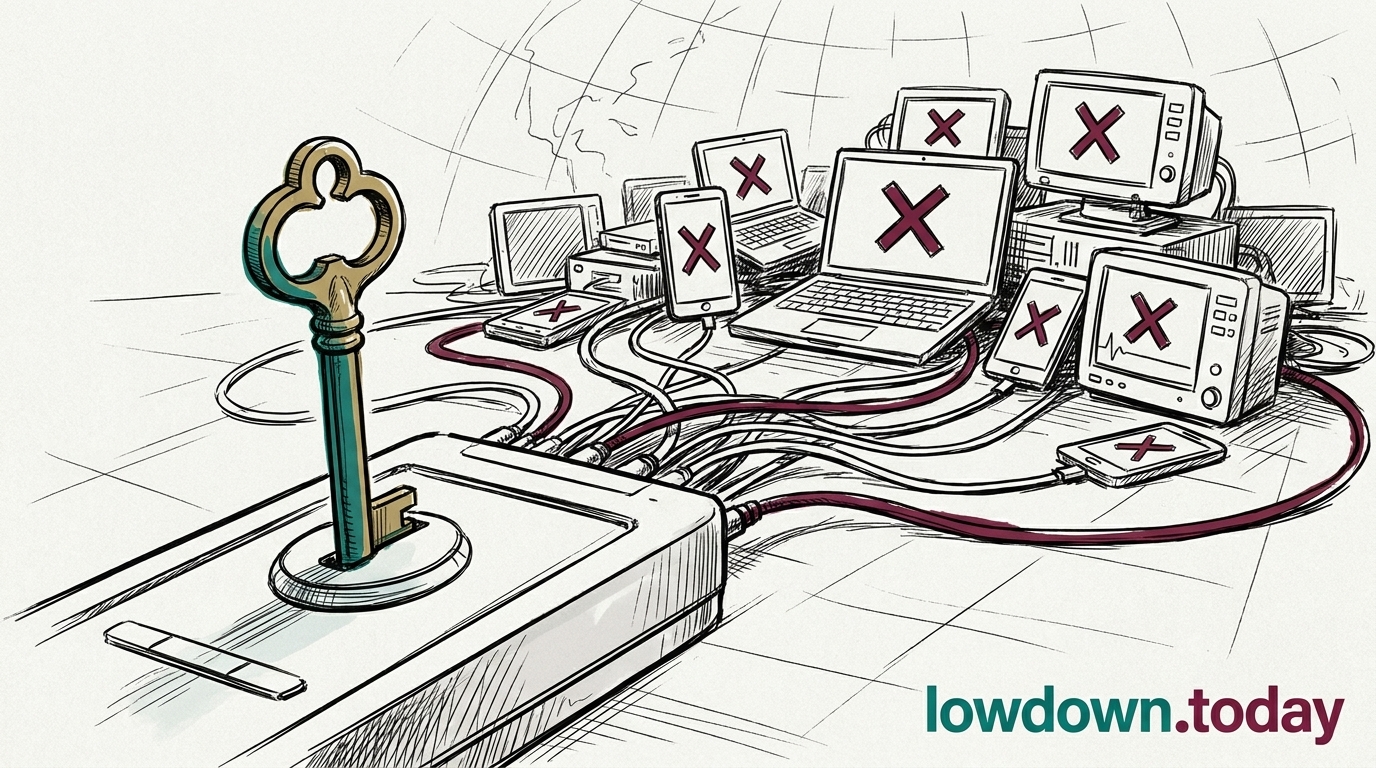
F5 reclassified CVE-2025-53521 in its BIG-IP Access Policy Manager (APM) on 28 March 2026 from a medium-severity denial-of-service (DoS) bug to an unauthenticated Remote Code Execution (RCE) vulnerability with a Common Vulnerability Scoring System (CVSS) v3.1 score of 9.8 1. BIG-IP APM is the module in F5's load-balancer line that handles identity-aware remote access, so exploitation gives the attacker code execution on the box sitting between the public internet and an organisation's internal applications. F5 simultaneously confirmed memory-only web shells were being deployed in the wild.

The Cybersecurity and Infrastructure Security Agency (CISA) placed the bug in its Known Exploited Vulnerabilities (KEV) catalogue on the same day, and the UK National Cyber Security Centre (NCSC) issued an advisory on 30 March urging UK operators to patch immediately. Data from Shadowserver, the Netherlands-based security research foundation that scans the public internet for exposed assets, showed more than 14,000 BIG-IP APM instances still unpatched at the point of reclassification despite F5 having released the fix months earlier.

Severity reclassification after patch is the structural problem the enterprise triage model was not built to handle. Most vulnerability-management programmes rank patches against the initial CVSS score, slot the work into a priority queue, and do not revisit the score once the patch is scheduled. An organisation that triaged the original DoS rating as a lower-tier issue and deferred the patch to the next maintenance window was, in effect, patched into the wrong queue by F5's own first call. For the CISOs running appliance-heavy edge estates, the lesson is blunter than the advisory: reclassification history now has to be a formal input to patch scheduling, because the vendor can move a bug from yellow to red after the board has already signed off the quarter's cyber plan.

Deep Analysis

In plain English

F5 makes network security equipment used by banks, telecoms companies, and governments to control who gets access to their systems. One of its products, BIG-IP APM, had a flaw that F5 initially described as a relatively minor problem, one that could cause the equipment to temporarily stop working but not much worse. In late March 2026, F5 updated its assessment: the flaw actually allows an attacker to run their own software on the device without any login credentials. That is about the most serious type of security flaw possible. By the time this reclassification was published, security researchers found that over 14,000 of these devices were still internet-facing and unpatched, and attackers were already installing hidden software on them.

Deep Analysis
Root Causes

BIG-IP APM is a network access control product that processes session tokens for VPN and application access. The attack surface is structurally similar to NetScaler: an appliance parsing complex authentication inputs in a privileged context, where memory handling errors produce RCE rather than crashes.

The 14,000+ exposed instances at the point of reclassification represents a specific patch-triage failure mode. Organisations that scored the CVE as a DoS risk allocated it to a lower-priority patching queue. By the time the reclassification arrived, those queues had not been cleared. This is a process problem as much as a technical one: organisations with no mechanism to re-triage already-assessed CVEs when their severity changes will repeatedly fall into this gap.

What could happen next?
  • Risk

    The 14,000+ exposed and unpatched BIG-IP APM instances identified by Shadowserver represent a near-term mass-compromise surface for initial access brokers, who can sell persistent access to organisations running the product.

  • Precedent

    The DoS-to-RCE reclassification pattern, seen here and in prior F5 CVEs, will pressure CISA to require vendors to publish complete root-cause analysis alongside initial CVSS scores, or to mandate re-notification to customers when severity is materially revised.

First Reported In

Update #1 · Stryker MDM wipe exposes identity perimeter

Help Net Security· 17 Apr 2026
Read original
Different Perspectives
CISA and FBI (US government)
CISA added nine KEV CVEs, confirmed Volt Typhoon in US CNI, and lost its counter-ransomware initiative under prior cuts; the FY27 budget proposes a further $707m cut and 860 jobs. An FBI official confirmed Salt Typhoon at 200+ companies across 80 countries is 'still very, very much ongoing'.
NCSC (UK)
NCSC (UK)
NCSC published attribution-backed advisories naming GRU Unit 26165 for SOHO router DNS hijacking and co-issued warnings with Dutch AIVD on FSB, APT31, and IRGC messaging-app targeting, in the same month the UK Cyber Security and Resilience Bill cleared its Public Bill Committee. The ICO's £14m Capita fine now treats NCSC guidance as the enforceable GDPR technical baseline.
European Commission
European Commission
The Commission published draft Cyber Resilience Act implementation guidance on 3 March with manufacturer reporting obligations beginning 11 September 2026, while running infringement proceedings against EU member states that have not transposed NIS2. Only 14 of 27 states had fully transposed by mid-2025; Germany's post-transposition registration compliance sat at roughly one-third.
Russian foreign ministry (GRU posture)
The Russian foreign ministry has issued no formal response to the NCSC advisory attributing the SOHO router DNS-hijacking campaign to GRU Unit 26165; its standard position is that Western attribution claims are politically motivated fabrications. Russia denies state sponsorship of any offensive cyber operations against NATO infrastructure.
People's Republic of China
Tsinghua University's Center for International Security and Strategy characterised US Volt Typhoon 'sabotage pre-positioning' assessments as misrepresenting standard state signals intelligence, framing the attribution narrative as a US strategic communication exercise rather than a conclusion grounded in confirmed adversary intent. Beijing formally denies state involvement in Salt Typhoon and Volt Typhoon.
Handala
Handala
Handala publicly claimed the Stryker MDM wipe as retaliation for a February 2026 Iranian school missile strike, asserting 200,000 devices wiped and 50 terabytes exfiltrated. The public framing positions the operation as proportionate non-lethal retaliation, a characterisation no Western agency has formally attributed to IRGC command-and-control.
