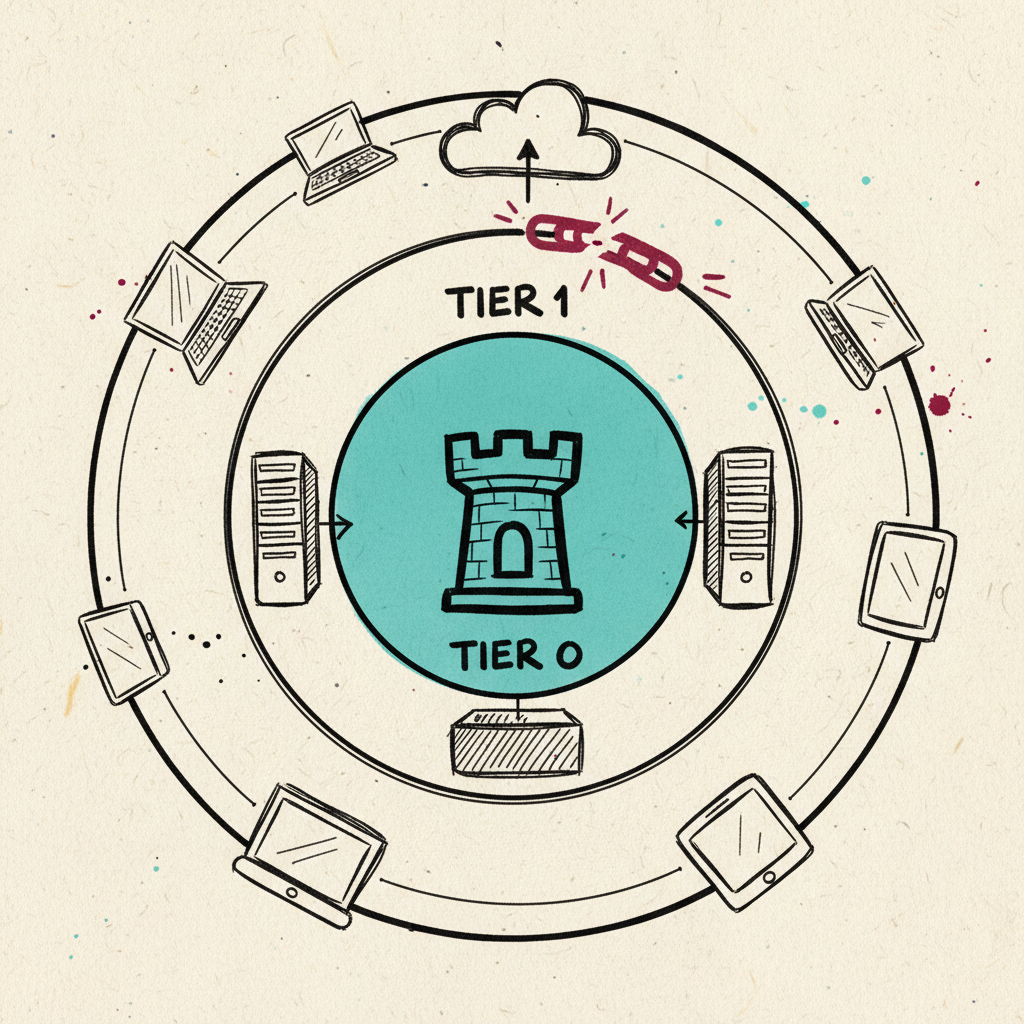
Active Directory tiering
Privilege-isolation model for AD; ICO-established GDPR Article 32 baseline after Capita £14m fine.
Last refreshed: 8 May 2026 · Appears in 1 active topic
What is AD tiering and why are UK companies being fined for not having it?
Timeline for Active Directory tiering
Mentioned in: ICO fines South Staffs Water £963,900
Cybersecurity: Threats and DefencesEnumerated by CL-STA-1132 using the firewall's own service account
Cybersecurity: Threats and Defences: CL-STA-1132 exploited PAN-OS since 16 April, log destruction confirmedMentioned in: UK 24-hour reporting bill at Report
Cybersecurity: Threats and DefencesBackground
Active Directory (AD) tiering is a security architecture model that isolates administrative accounts by function and privilege level: Tier 0 covers domain controllers and identity infrastructure; Tier 1 covers servers and applications; Tier 2 covers endpoints and standard workstations. Absent AD tiering was cited alongside absent PAM controls as a GDPR Article 32 failure by the ICO in both the Capita (£14m) and Advanced Computer Software (£3.07m) monetary penalty notices.
In both ICO enforcement cases, the lack of AD tiering allowed attackers to escalate privileges from a compromised lower-tier account to domain-controller-equivalent access, producing the impact that triggered the GDPR breach notification. NCSC guidance on AD tiering is the reference document the ICO applied as its Article 32 baseline in both decisions.
For enterprise security architects and compliance Teams, the ICO decisions mean that NCSC's AD tiering model is now a compliance obligation for UK-regulated organisations, not merely a security recommendation. The Stryker MDM wipe provides the complementary operational illustration: while Stryker's specific failure was at the MDM control-plane level, the underlying principle is identical — privilege levels within administrative tooling must be isolated and bounded to limit blast radius.
The UK Cyber Security and Resilience Bill — currently at Report Stage — will expand the mandatory incident-reporting regime to a wider set of operators. The ICO's Capita-Advanced enforcement template for AD tiering will apply to the expanded class of regulated operators, including data-centre operators, once the Bill receives Royal Assent. The Trellix 21-day disclosure delay disclosed in May 2026 (Trellix disclosed a source-code breach 21 days after the intrusion, against the Bill's proposed 24-hour initial-notification period) reinforces the policy momentum behind mandatory timelines. AD tiering is the specific architectural control the ICO will likely apply as its Article 32 baseline under the expanded regime.