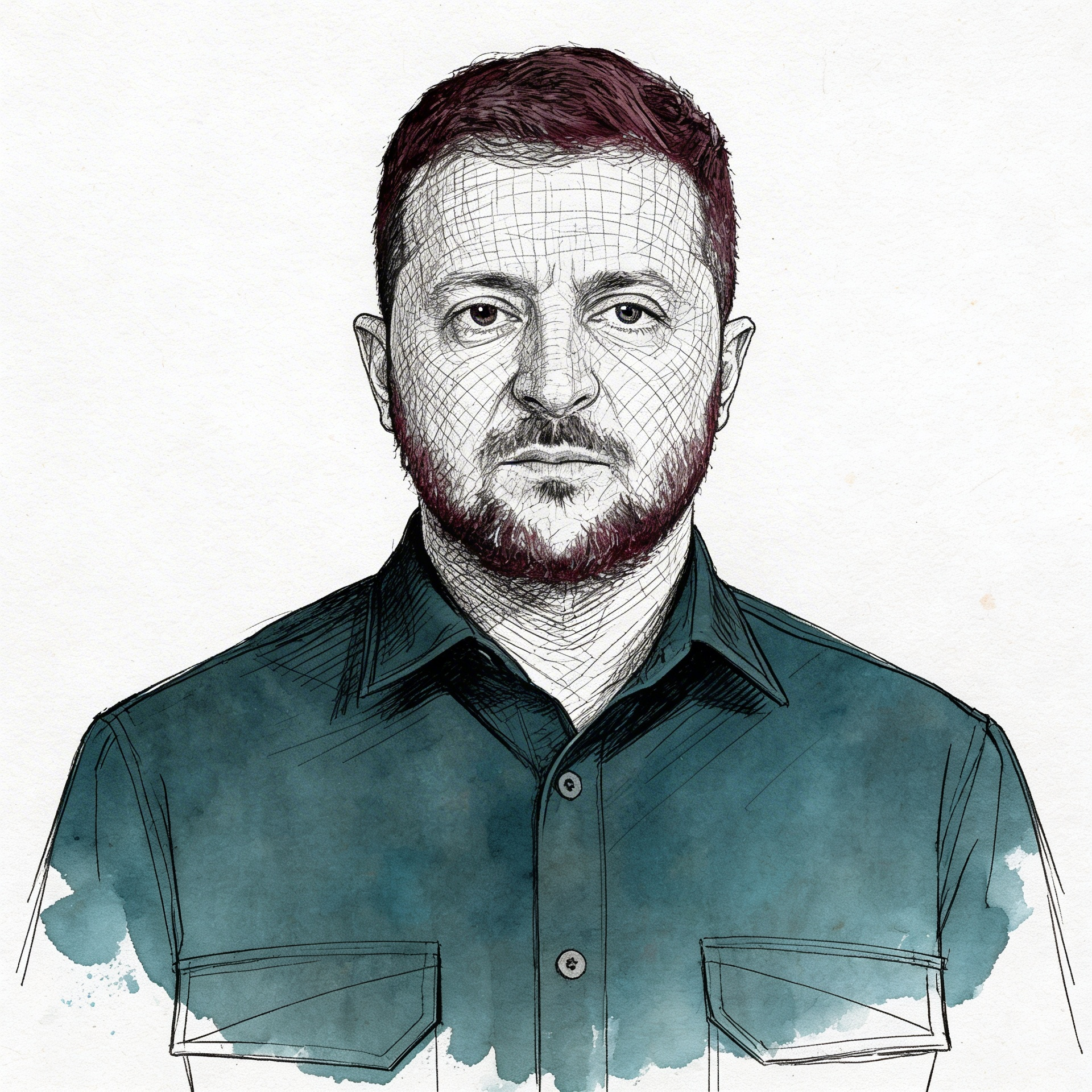
Volodymyr Zelenskyy
President of Ukraine; escalating deep strikes into Russia and Belarus as Putin summit hopes stall.
On 21 July, Volodymyr Zelenskyy replaced Ukraine’s commander-in-chief after a week of senior defence dismissals, placing the president at the centre of a wartime command reset.
Last refreshed: 1 October 2026 · Appears in 3 active topics
As Ukrainian drones reach 3,000km into Russia, can Zelenskyy force Putin back to the table?
Timeline for Volodymyr Zelenskyy
Mentioned in: EU ministers adopt 22nd Russia package
Russia-Ukraine War 2026Offered to halt refinery strikes and hold elections after a ceasefire
Russia-Ukraine War 2026: Zelenskyy ties elections to a ceasefireMentioned in: Witkoff's Miami talks end a day early
Russia-Ukraine War 2026Confirmed the Omsk and Ukhta strikes
Russia-Ukraine War 2026: Ukraine strikes Yandex AI data centresMentioned in: EU pays Kyiv €2.9bn with first budget-loan draw
Russia-Ukraine War 2026Background
Volodymyr Zelenskyy is President of Ukraine and its principal civilian political leader during Russia’s full-scale war. His office joins public diplomacy, decisions over senior wartime appointments and the case for foreign military support. On 21 July, his appointment of Mykhailo Drapatyi as commander-in-chief showed the presidency’s direct role in shaping Ukraine’s military leadership.
Zelenskyy also represents Ukraine in talks with Russia and foreign partners. At the Istanbul meeting on 2 June, Ukraine and Russia agreed a prisoner exchange while failing to agree a Ceasefire, illustrating the limits within which his diplomacy operates.
His role increasingly includes building Ukraine’s defence-industrial links abroad. In March, Ukrainian counter-drone crews were operating in Gulf states after his offer of assistance, drawing on experience gained defending Ukraine against Shahed attacks.
Zelenskyy reshapes wartime command
On 15 July, Zelenskyy dismissed Defence Minister Mykhailo Fedorov after meeting military leaders. The decision made the president the author of a wider change in Ukraine’s wartime leadership, rather than merely its political sponsor.
On 21 July, he removed Commander-in-Chief Oleksandr Syrskyi and appointed Mykhailo Drapatyi. A further change to the general staff followed on 22 July, after protests in eight cities had put public pressure on the command structure. The sequence tied Zelenskyy’s authority directly to the performance of the new military leadership.
Zelenskyy exports Ukrainian drone expertise
On 28 March, Zelenskyy said that about ten Ukrainian drone factories had been established abroad. His disclosure presented wartime production knowledge as a national asset that Ukraine could place beyond Russian strike range and turn into industrial partnerships.
On 1 June, he announced plans for ten Ukrainian weapons-export offices in EU states by the end of 2026. The proposal put Zelenskyy’s presidency behind a shift from seeking weapons alone to selling combat-tested systems and expertise to European partners.
Zelenskyy keeps summit diplomacy open
On 5 September, Zelenskyy offered to meet Vladimir Putin at the December G20 summit in Miami after US envoys met Putin in Moscow and Zelenskyy in Kyiv. The offer kept a leaders’ meeting available as a Ukrainian objective despite no announced result from the Moscow talks.
On 12 September, Russia said it would negotiate without pausing military operations. For Zelenskyy, the gap between an offered summit and Russia’s stated position left diplomacy open but without an agreed route to halt the fighting.
Reference
Who is Volodymyr Zelenskyy?
Recently resolved
What is Zelenskyy doing in the Gulf states?
Why did Zelenskyy replace Ukraine's chief of the general staff in July 2026?
Who replaced Mykhailo Fedorov as Ukraine's defence minister?
Why did Zelenskyy threaten to strike Belarus?
How far can Ukraine's drones reach into Russia now?
Is Ukraine building weapons factories in NATO countries?
What happened at the Istanbul Round 2 Zelenskyy sent his team to?
Why did Zelenskyy reject the Russian truce offer at Istanbul?
What did Zelenskyy ask Trump for after the Oreshnik attack?
What prisoner exchange deal did Ukraine sign in May 2026?
Is Ukraine gaining or losing territory in 2026?
Why did Zelenskyy not go to Istanbul peace talks?



