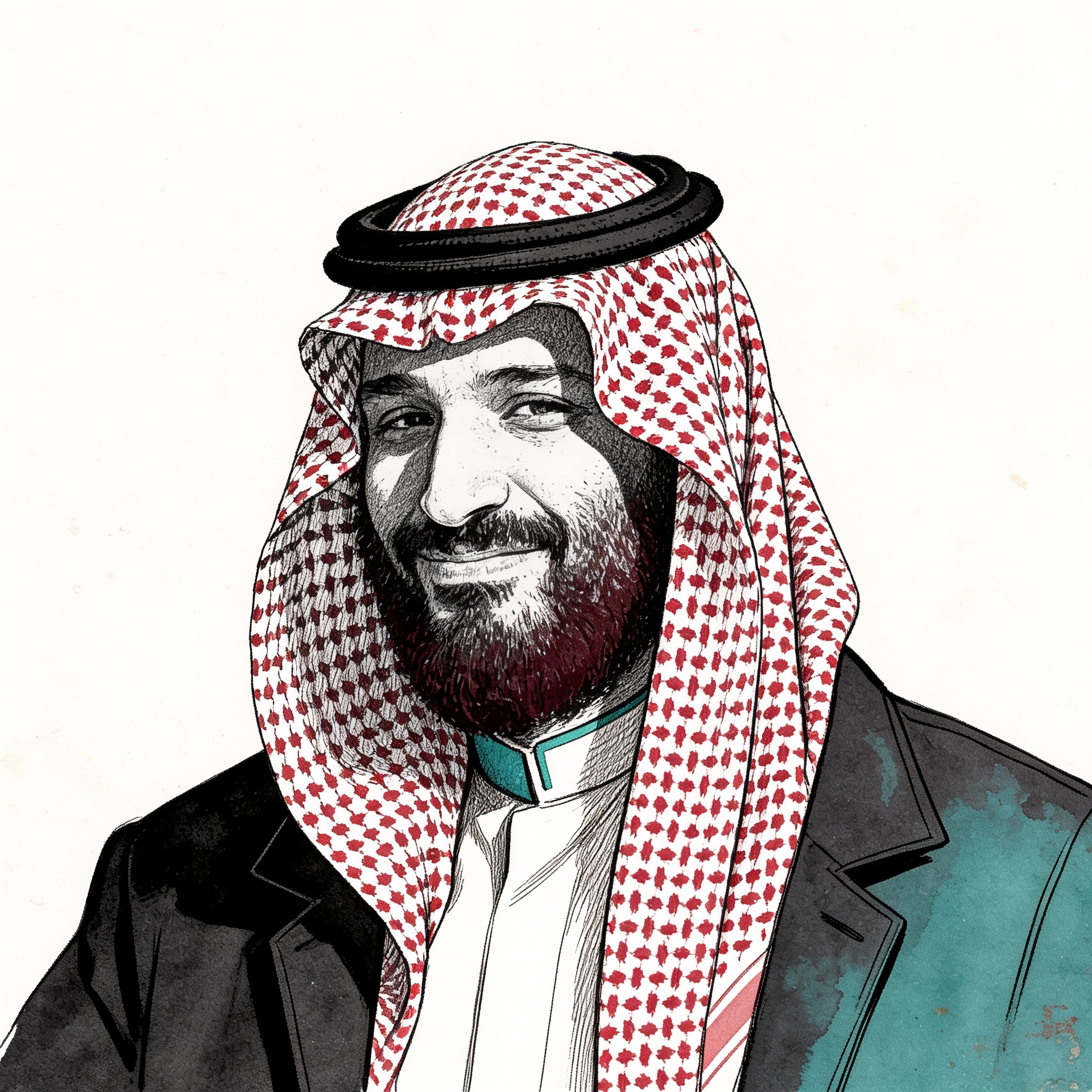
Mohammed bin Salman
Crown Prince and de facto ruler of Saudi Arabia since 2017.
Mohammed bin Salman persuaded Donald Trump to cancel a strike planned for 2 August 2026 on Iran, warning that retaliation would hit Gulf economies: the first pause in this war credited to a foreign leader rather than to Washington itself.
Last refreshed: 12 August 2026 · Appears in 2 active topics
Is Mohammed bin Salman's stand-down pressure on the US a sign of Riyadh's real red lines on the Hormuz toll?
Timeline for Mohammed bin Salman
Told US officials the blockade should stand until Iran signs a new agreement
Iran Conflict 2026: Qatar brings the US answer to AraghchiMentioned in: Gargash warns: neither war nor peace
Iran Conflict 2026Hosted the Jeddah talks
Iran Conflict 2026: Sharif, Munir and Dar land in JeddahArgued personally against the strike on economic grounds
Iran Conflict 2026: Trump calls off the Sunday strikeMentioned in: Brent reprices around Khamenei's uranium directive
Iran Conflict 2026Background
Mohammed bin Salman (MBS) has been Crown Prince of Saudi Arabia since 2017 and is The Kingdom's de facto ruler, overseeing Foreign Policy, defence and the Vision 2030 economic diversification programme. His consolidation of power has included the 2017 anti-corruption purge, the 2018 assassination of journalist Jamal Khashoggi, for which a CIA assessment held him responsible, and the displacement of the previous crown prince, Mohammed bin Nayef. Saudi Arabia under his leadership remains the world's largest oil exporter and the pivotal Gulf-Arab power in regional security arrangements.
Riyadh's posture in the Iran conflict reflects dual exposure: Saudi Arabia sits inside the Hormuz transit Coalition while also depending on oil revenue that any Hormuz disruption would hit directly. That dependence has made MBS a consistent advocate for de-escalation even as his government arms itself against Iranian attack.
The conflict has also drawn Saudi Arabia into an unrelated war: Zelenskyy called MBS in March 2026 offering Ukrainian counter-drone expertise against Iranian Shaheds in exchange for support on an Iran Ceasefire, and Ukrainian crews subsequently deployed in The Kingdom alongside Qatar and the UAE.
MBS persuades Trump to cancel a strike
Mohammed bin Salman, Qatar's Emir and the UAE President jointly asked Donald Trump to call off a strike planned for Sunday 2 August, warning that Iranian retaliation would land on Gulf economies rather than stay contained to the battlefield. Trump had posted hours earlier promising force unmatched since World War II; he stood the operation down instead.
Every earlier pause in this war traced back to Washington itself: a Senate vote, a general slowing the tempo, a lapsed licence. This is the first that credits a named foreign leader with stopping US action outright, and it extends a line MBS's government set in March, when his foreign minister warned that Gulf patience with Iranian escalation was 'not unlimited'.
What is Mohammed bin Salman's position on the Iran conflict and Hormuz tolls?
Did Zelenskyy contact Mohammed bin Salman during the Iran war?
What is Vision 2030 and is it affected by the Iran war?
Was Mohammed bin Salman responsible for Jamal Khashoggi's murder?
Did Mohammed bin Salman help stop a US strike on Iran?
Is Mohammed bin Salman still Saudi Arabia's crown prince?


