BRICS foreign ministers meet in New Delhi the same days Trump meets Xi in Beijing: who is building the rival order?
Timeline for BRICS
Mentioned in: Pezeshkian goes to COP17 in Yerevan
Iran Conflict 2026Adopted the New Delhi Declaration unanimously
Iran Conflict 2026: BRICS adopts the text May could not agreePezeshkian meets Abu Dhabi's crown prince in Delhi
Iran Conflict 2026Russia declines Cuba's BRICS upgrade bid
Cuba DispatchPABS talks reopen under a deadline
Pandemics and BiosecurityBackground
Founded in 2009 at its first formal summit in Yekaterinburg, BRICS was coined as a Goldman Sachs investment thesis in 2001 before becoming a diplomatic bloc. South Africa joined in 2010. The Johannesburg summit in August 2023 invited six new members: Egypt, Ethiopia, Iran, Saudi Arabia, the UAE, and Argentina (which declined), all effective January 2024. The bloc operates by consensus only, with no binding votes or enforcement powers.
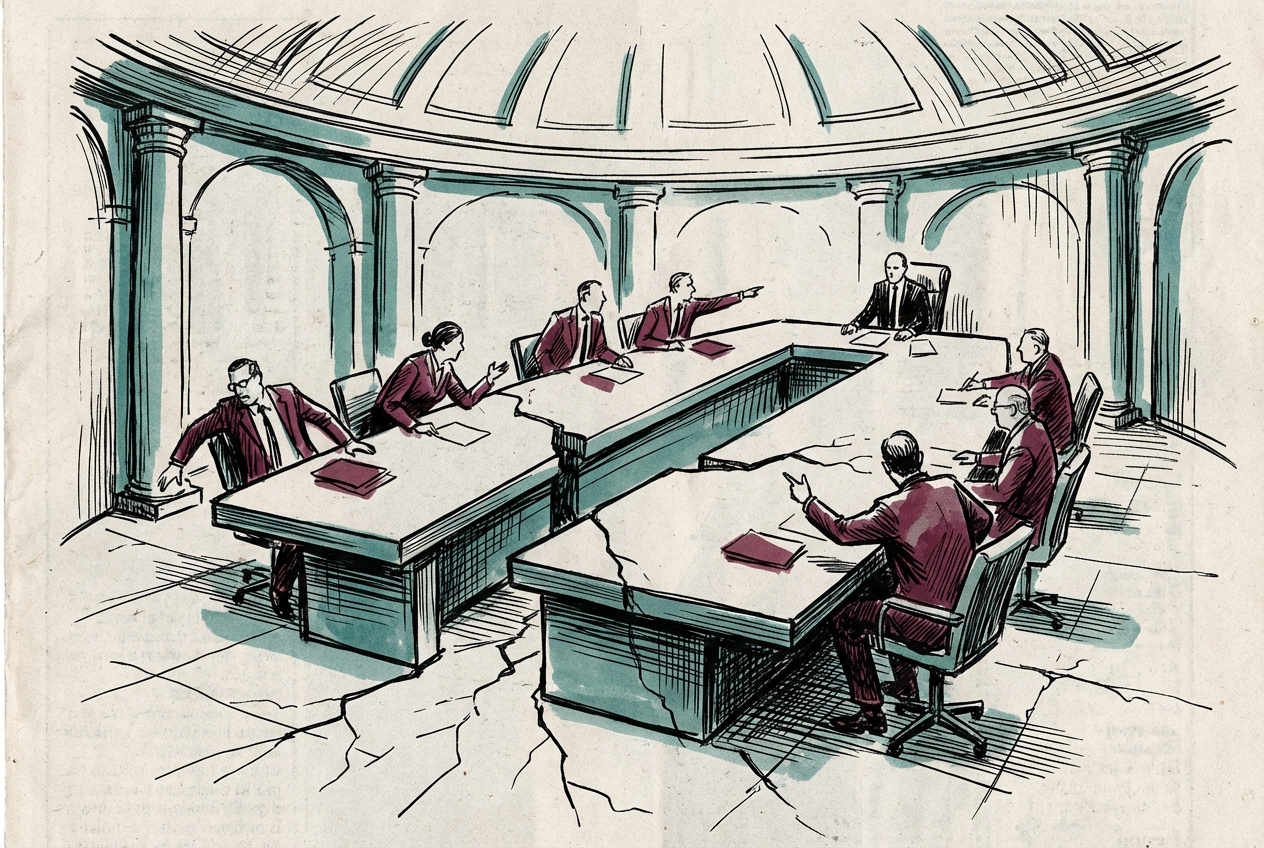
BRICS failed its first major military test when the bloc could not issue a unified statement on the Iran-Israel-US conflict. China, Russia, and Brazil condemned US-Israeli strikes; India, Saudi Arabia, and the United Arab Emirates (UAE) condemned Iranian missile attacks on Gulf states, producing two irreconcilable positions inside the same organisation. Iran has since filed legislation proposing a replacement nuclear treaty with SCO and BRICS member states should it leave the NPT.
The expansion meant to signal multipolarity has become the source of the bloc's paralysis: three new members, Iran, Saudi Arabia, and the UAE, sit on opposite sides of a live armed conflict. Brazil, holding the 2025 presidency, cannot Convene an emergency session without consensus, exposing how little procedural authority the rotating chair carries.
BRICS foreign ministers convened in New Delhi on 14-15 May 2026, with Iran's Araghchi, Russia's Lavrov, and India's Jaishankar as the central figures — all three governments holding fundamentally different positions on the conflict. The meeting is chaired by India, which condemned Iranian missile strikes on Gulf states and has 8 million workers and $40 billion in annual remittances at stake in the region. Iran is a full BRICS member following the January 2024 expansion, making this the first major bloc meeting where Tehran participates as a member-state at war.
At the session on 14 May, Araghchi told ministers that Iran 'has not created any obstacles in the strait of Hormuz' — a direct counter-narrative to the CENTCOM blockade framing. Deputy FM Ali Bagheri Kani called on BRICS states to act 'against US aggression', testing India's balancing posture as chair. South China Morning Post reported India's discomfort as the session's defining dynamic.
The meeting runs simultaneously with the Trump-Xi Beijing summit on the same two days, creating parallel tracks — the Western bilateral and the non-Western multilateral — operating without co-ordination. For Iran, New Delhi is a demonstration of its non-Western counter-architecture pivot: the bloc cannot issue a joint statement in Tehran's favour, but Araghchi's presence alongside Lavrov signals Russia-Iran diplomatic alignment and projects Iranian legitimacy to the Global South at a moment when Washington has refused direct talks. The de-dollarisation agenda — a permanent BRICS fixture — gains renewed urgency as the Hormuz blockade pushes more oil transit payments into yuan and stablecoins.
The 14-15 May 2026 New Delhi foreign ministers' meeting ended without a joint declaration — the second time BRICS has failed to produce unified text on the Iran conflict. The blocking issue was explicit: the UAE demanded any declaration condemn Iran for strikes on neighbouring states after Iranian drones hit UAE territory on 10 May 2026; Iran demanded the US and Israel be condemned. India as chair issued a Chair's Statement and Outcome Document only, citing 'differing views' on the Middle East.
Araghchi, without naming the UAE, said the blocker had 'its own special relations with Israel' — a reference to the Abraham Accords normalisation that links Abu Dhabi's BRICS veto to its prior Israel policy. The structural cause is the January 2024 expansion: admitting Iran and the UAE simultaneously without resolving the Tunb Islands dispute encoded a mutual veto from the beginning.
The no-joint-statement outcome removes BRICS as an active Mediation channel for the Iran conflict. The only surviving non-Western multilateral instruments are Pakistan's bilateral back-channel and Oman's maritime security consultation track. For Iran, New Delhi's failure is partially offset by Araghchi's bilateral with Jaishankar on 15 May, in which Iran disclosed its guidance architecture for Indian-flagged vessels — a state-to-state accommodation that does not require a BRICS joint statement to produce real-world effect.
BRICS was one of three blocs named, alongside the G7 and G20, in a 15 June 2026 open letter from Brazilian President Lula and WHO Director-General Tedros urging leaders to conclude the long-deadlocked Pathogen Access and Benefit Sharing (PABS) annex to the WHO Pandemic Agreement by 17 July. The seventh Intergovernmental Working Group session on the agreement opened in Geneva on 6 July, running to the deadline, for another attempt at the annex. For a bloc that has struggled to issue joint statements on the Iran conflict, the letter's inclusion of BRICS reflects less an expectation of unified action than an acknowledgement that several BRICS members, including India and Brazil, are central players in pathogen-sharing negotiations with pharmaceutical manufacturing capacity at stake.
What is BRICS?
Did BRICS condemn the US-Israeli strikes on Iran?
Why can't BRICS hold an emergency meeting on the Iran conflict?
How many members does BRICS have in 2026?
What is the difference between BRICS and the G7?
What is the BRICS foreign ministers meeting in New Delhi about?
Is Iran a member of BRICS?
Why can't BRICS issue a statement condemning the Iran war?
What does BRICS have to do with de-dollarisation?
Who chairs BRICS in 2026?
When did BRICS expand to include Iran and the UAE?
Why is Iran attending the BRICS foreign ministers meeting in New Delhi?
How does BRICS differ from the G7?
Why did BRICS fail to issue a joint statement on Iran in May 2026?
Who attended the BRICS foreign ministers' meeting in New Delhi in May 2026?
What is the BRICS consensus rule and why does it paralyse the bloc on Iran?
Which countries blocked BRICS action on the Iran conflict?


Written with AI from Lowdown's published reporting. Not individually reviewed by an editor. Updated 28 July 2026. Editorial standards.