Skip to content
Briefings are running a touch slower this week while we rebuild the foundations.See roadmap
Iran Conflict 2026
17MAY

Ghalibaf declares new world order, quoting Xi

4 min read
10:45UTC

Iranian Parliament Speaker Mohammad Bagher Ghalibaf said on Sunday the world is 'at the cusp of a new order', quoting Xi Jinping's 'transformation unseen in a century' and crediting Iran's '70-day resistance' with accelerating the shift.

ConflictDeveloping
Key takeaway

Ghalibaf is selling the war as Global South vindication while Araghchi still tries to keep a back-channel open.

Mohammad Bagher Ghalibaf, Speaker of Iran's Majlis, declared on Sunday 17 May that the world is "at the cusp of a new order", lifting Xi Jinping's formulation "transformation unseen in a century" and crediting Iran's "70-day resistance" with accelerating the shift 1. The declaration coincided with the morning Donald Trump's AI-generated storm image went up on Truth Social (Event 3). No bilateral instrument followed.

The framing is calibrated to the readout problem out of Beijing. The Trump-Xi summit on 14 May produced a Chinese readout that omitted the Iran specifics Trump had publicly claimed Xi pledged in person . Tehran has chosen to read that gap as a Chinese refusal to deliver the isolation Washington wanted. Ghalibaf, who sits inside the parliamentary bloc that suspended IAEA cooperation last year, is appropriating Xi's signature phrase to reframe Iran's 70 days of war as the operational accelerant of a global power shift Beijing is endorsing by silence.

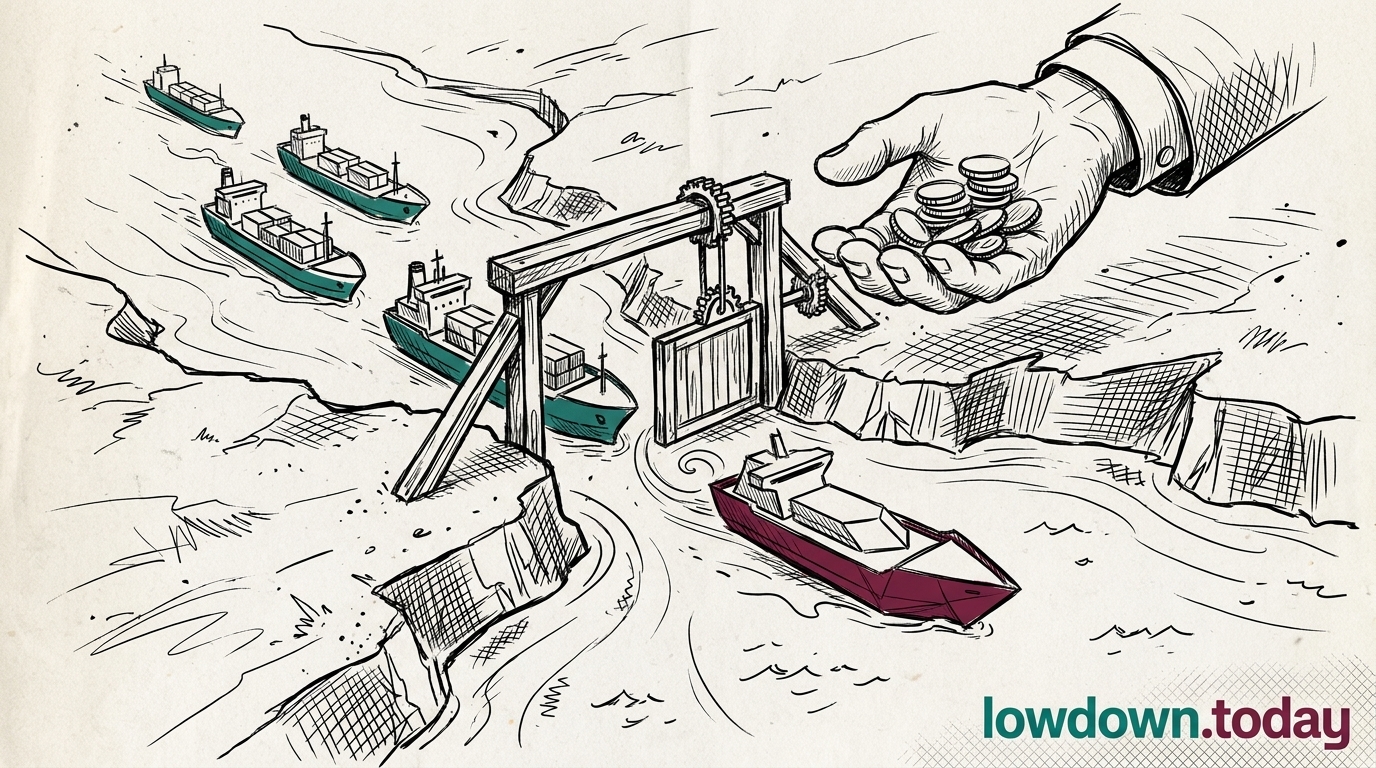
The declaration also exposes Iran's two-track Foreign Policy at its widest aperture this month. Abbas Araghchi's diplomatic channel runs through Islamabad on the assumption that civilian negotiation remains possible; Ghalibaf's pulpit broadcasts historical vindication on the assumption that it is unnecessary. The Western maritime mission Iran's Majlis just declared its toll regime over (Event 0, and the BRICS deadlock at Delhi (Event 4) both sit inside the framing Ghalibaf is inverting. Whether Tehran can run both registers simultaneously without the bounty-bill threshold (Event 6) collapsing the diplomatic side is the question the Foreign Ministry now has to answer.

Deep Analysis

In plain English

Mohammad Bagher Ghalibaf is the Speaker of Iran's parliament, a senior position in a country where parliament matters considerably more than in many authoritarian states. On 17 May he made a speech declaring that the world is on the verge of a 'new order', using a phrase that China's President Xi Jinping has used to describe the shift in global power away from the United States. Ghalibaf credited Iran's 70 days of resisting US and Israeli attacks with helping to cause this shift. This kind of rhetoric serves a domestic purpose, telling Iranians that their hardship during the war is historically meaningful, and an external one, claiming that China and the Global South support Iran's position even though Beijing has not said so explicitly.

Deep Analysis
Root Causes

Ghalibaf's declaration serves two structural functions simultaneously. Domestically, it repositions Iran's 70-day war from a catastrophic failure of deterrence, US and Israeli strikes destroyed Iran's air defences in the opening hours, into a historical pivot point that validates the hardliner wing of the Majlis. This framing is essential for the parliamentary bloc that suspended IAEA cooperation 221-0 and is now advancing the Hormuz toll bill and the Trump bounty bill simultaneously.

Externally, Ghalibaf is exploiting the Beijing readout gap . China's summit communique named only 'the Middle East situation' without Iran-specific language, which Iran's leadership has interpreted as Beijing refusing to endorse Washington's demands. Reading that refusal as Chinese endorsement of Iran's resistance is interpretively aggressive but internally consistent: if China will not say Iran is wrong, Iran can say China believes Iran is right.

Escalation

Ghalibaf's declaration that Iran's resistance is historically vindicated runs directly counter to any settlement that frames the war as a negotiated compromise. The parliamentary leadership is publicly committing to a narrative that makes ceasefire-as-capitulation domestically toxic, limiting Araghchi's flexibility in the Islamabad channel.

What could happen next?
  • Consequence

    Ghalibaf's public framing of the war as Global South vindication creates a domestic political cost for any ceasefire that does not include explicit US concessions on Hormuz sovereignty, extending the likely duration of the maritime disruption.

    Short term · Medium
  • Risk

    Tehran's annexation of Chinese rhetorical authority without Beijing's endorsement risks a Chinese public clarification that explicitly distances Xi's 'transformation unseen in a century' from the Iran-US conflict, producing a diplomatic humiliation at the worst possible moment.

    Short term · Low
  • Meaning

    The simultaneous Ghalibaf declaration and Araghchi negotiation represent the widest public divergence between Iran's legislative and diplomatic tracks since the war began, signalling institutional stress inside the Tehran policy framework.

    Immediate · High
First Reported In

Update #100 · Tehran prints the toll book; Delhi joins the queue

ANI News· 17 May 2026
Read original
Different Perspectives
IAEA
IAEA
Director General Rafael Grossi appeared in person at the UNSC on 19 May and warned that a direct hit on an operating reactor 'could result in very high release of radioactivity'. The session produced a condemnation record but no resolution, and the Barakah perimeter was already struck on 17 May.
Hengaw (Kurdish rights monitor)
Hengaw documented three judicial executions and the detention of Kurdish writer Majid Karimi in Tehran on 19 May, establishing Khorasan Razavi province as the newest geography in Iran's wartime judicial record. The organisation's Norway-based operation continues to surface a domestic repression track running in parallel with every diplomatic and military development.
India
India
Six India-flagged vessels conducted a coordinated cluster transit under PGSA bilateral assurances during the 17 May window, paying no yuan tolls. New Delhi's inclusion in Iran's state-to-state passage track insulates Indian energy supply without requiring endorsement of the PGSA's yuan-toll architecture or alignment with the US coalition.
Pakistan
Pakistan
Pakistan is the only functioning diplomatic bridge between Tehran and Washington. Its role is relay, not mediation in the settlement sense: it conveyed Iran's 10-point counter-MOU in early May, relayed the US rejection, and is now passing 'corrective points' in the third documented exchange of this sub-cycle without either side working from a shared text.
UK and France (Northwood coalition)
Twenty-six coalition members have published no rules of engagement eight days after the Bahrain joint statement; Lloyd's underwriters have conditioned war-risk reopening on written ROE from either Iran or the coalition. Italian and French mine-countermeasures deployments are operating on the in-water clearance task CENTCOM Admiral Brad Cooper's 90% mine-stockpile claim does not address.
Saudi Arabia
Saudi Arabia
Riyadh has not publicly commented on the Barakah strike or the 50-47 discharge vote. Saudi output feeds the IEA's $106 base case; the $5 Brent premium above that model reflects institutional uncertainty no Gulf producer can compress through supply adjustment alone.