Skip to content
Briefings are running a touch slower this week while we rebuild the foundations.See roadmap
Iran Conflict 2026
6JUN

IRGC salvo hits two Gulf states at once

3 min read
12:17UTC

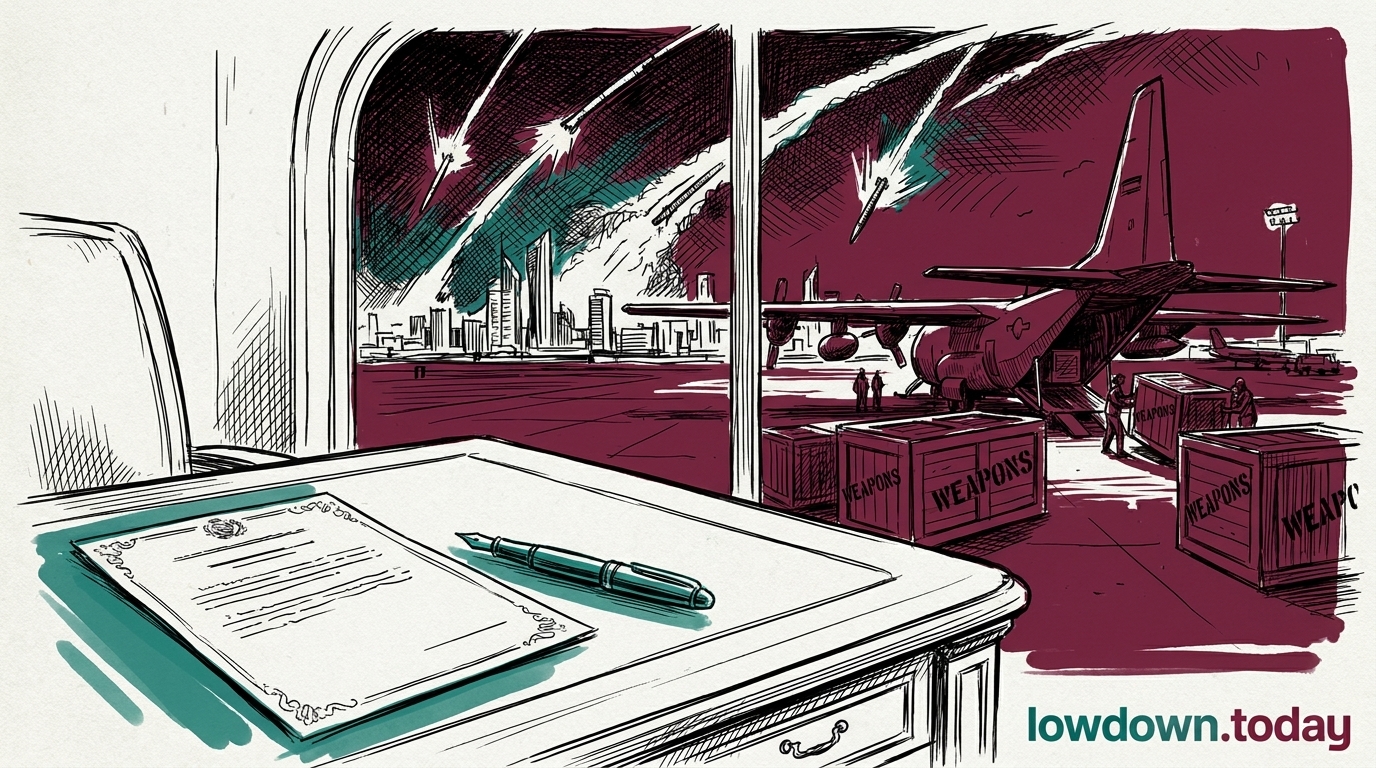
The IRGC fired seven ballistic missiles at US bases in Kuwait and Bahrain overnight 5-6 June, the largest simultaneous two-country launch of the war. CENTCOM reported intercepting six; the seventh missed.

ConflictDeveloping
Key takeaway

Iran's first two-country missile salvo widens the war as Gulf interceptor stocks run low.

The IRGC (Islamic Revolutionary Guard Corps) fired seven ballistic missiles at US bases in Kuwait and Bahrain in a single salvo overnight 5-6 June, the largest simultaneous two-country launch of the war, according to Iranian state media corroborated by The National and RFE/RL 1. CENTCOM (US Central Command) reportedly intercepted six; the seventh is said to have missed its target. Neither side confirmed casualties, and CENTCOM published no statement Lowdown could independently retrieve, so the count rests on Iranian-origin reporting.

The exchange ran in sequence. The IRGC first warned four tankers transiting Hormuz without coordination; CENTCOM then struck Iranian coastal radar at Goruk and on Qeshm Island and downed four one-way attack drones over the strait; the missile salvo followed.

This breaks the pattern of earlier strikes. The 3 June airport drone and the 31 May two-missile attack on Kuwait each hit a single state. Saturday's salvo hit two, and Bahrain hosts the US Fifth Fleet headquarters. The widening drains munitions as much as it sends a message: Bahrain is defending Fifth Fleet HQ on a PAC-3 (Patriot Advanced Capability-3) magazine reported at 87 per cent depletion with an 18-month resupply gap . Each larger salvo leaves fewer rounds for the next.

Deep Analysis

In plain English

In a single overnight operation, Iran's Revolutionary Guard (IRGC) fired seven ballistic missiles at US military bases in two separate Gulf countries simultaneously, Kuwait and Bahrain, while also warning four oil tankers in the Strait of Hormuz to get out and attacking radar stations on the ground. It is the most ambitious single military operation the IRGC has attempted since the war began. US forces, known as CENTCOM (US Central Command), intercepted six of the seven missiles. One missed its target without confirmed casualties. CENTCOM had also struck two Iranian radar stations beforehand, which appears to have been what triggered the salvo. No deaths from the missiles were confirmed by either side, but this does not mean the situation is under control: Bahrain's missile interceptors (PAC-3) are nearly exhausted, and resupply takes 18 months.

Deep Analysis
Root Causes

The IRGC's Decentralised Mosaic Defence, activated on 28 February 2026, devolves launch authority to 31 autonomous provincial units. This structural decentralisation means the Iranian Foreign Ministry's negotiating posture and the IRGC's operational tempo are institutionally decoupled. Araghchi can signal flexibility on the nuclear file while provincial IRGC commanders independently escalate the salvo count.

Bahrain's PAC-3 depletion and its exclusion from the 2 May emergency resupply authorisation created an identified target gap. The IRGC's intelligence on Gulf air-defence magazine levels has been consistent throughout the conflict; the timing of the two-country salvo, coming three days after the single-target airport drone, reflects deliberate magazine-exhaustion strategy.

Escalation

The seven-missile, two-country simultaneous salvo represents a step-change from the sequential attacks documented since 31 May . Each prior attack targeted a single state or single facility; this attack split the defensive problem.

The next escalatory threshold would be a salvo that exhausts Bahrain's remaining eight PAC-3 rounds or targets a facility where US personnel are present in numbers that preclude a no-casualty outcome. The combination of Bahrain's magazine depletion and the 18-month resupply lag means that threshold is reachable within weeks at the current salvo tempo.

What could happen next?
  • Risk

    Bahrain's PAC-3 magazine is near exhaustion; a second simultaneous two-country salvo within weeks could break through defences before resupply arrives.

    Immediate · Assessed
  • Consequence

    The two-country simultaneous format demonstrates the IRGC's Decentralised Mosaic Defence has recovered enough coordination to deliver complex multi-vector operations despite command attrition.

    Short term · Assessed
  • Risk

    IRGC provincial commanders operating under devolved launch authority may continue escalating independently of Tehran's negotiating track, making the deal timeline and the military timeline structurally uncoupled.

    Short term · Reported
First Reported In

Update #119 · Trump's Iran deal: 95% done, 0% signed

Press TV· 6 Jun 2026
Read original
Different Perspectives
Israel
Israel
The IDF struck a Lebanese army unit on 6 June, killing a colonel, and privately told Moscow that shelling near Bushehr was accidental, per Putin's SPIEF disclosure. Israel is advancing in Lebanon past an unenforced ceasefire text while maintaining a back-channel to Russia on nuclear-site deconfliction.
Lebanon
Lebanon
President Aoun told CNN on 5 June that Iran uses Lebanon as a bargaining chip and urged Hezbollah toward diplomacy; on 6 June an IDF strike killed a Lebanese army colonel on the Khardali-Nabatieh road. The Lebanese state is publicly rejecting Iranian tutelage while the army sustains casualties from Israeli fire and the Washington framework remains unenforced.
Bahrain
Bahrain
Bahrain's US Fifth Fleet headquarters was among the targets in the 5-6 June two-country salvo; its PAC-3 magazine stands at 87 per cent depletion with an 18-month resupply gap and no comparable arms sale has been announced. The state is defending a critical US regional command on a thinning interceptor stock.
Kuwait
Kuwait
Kuwait received a $1.98bn US counter-drone sale approval on the same day IRGC missiles targeted its bases; it expelled two Iranian diplomats on 4 June and filed a formal protest. The arms approval gives Kuwait a future capability but leaves a 6-18 month delivery gap that the salvo tempo is already pressing.
Russia
Russia
Putin reaffirmed Russia's offer to hold Iran's 440.9 kg HEU at SPIEF on 6 June, said Russia is not arming Iran, and disclosed that both the US and Israel privately told Moscow that shelling near Bushehr was accidental. The restatement casts Moscow as the only remaining mediator both sides call, a position serving Russian interests whatever the nuclear file produces.
Iran
Iran
The IRGC, per Iranian state media, fired seven ballistic missiles at US bases in Kuwait and Bahrain, the largest two-country salvo of the war, and framed the launches as lawful retaliation; Foreign Minister Araghchi rejected Aoun's bargaining-chip accusation and Velayati warned Beirut against diplomatic naivety. Tehran has sent no HEU counter-proposal since Araghchi confirmed no progress on 4 June.