Skip to content
Briefings are running a touch slower this week while we rebuild the foundations.See roadmap
Iran Conflict 2026
6APR

Pakistan Brokers First Ceasefire Framework of the War

3 min read
09:43UTC

The Islamabad Accord offers specific terms for the first time in six weeks of conflict, but Iran's military council holds the veto.

ConflictAssessed
Key takeaway

Pakistan produced the terms; Iran's military council holds the veto.

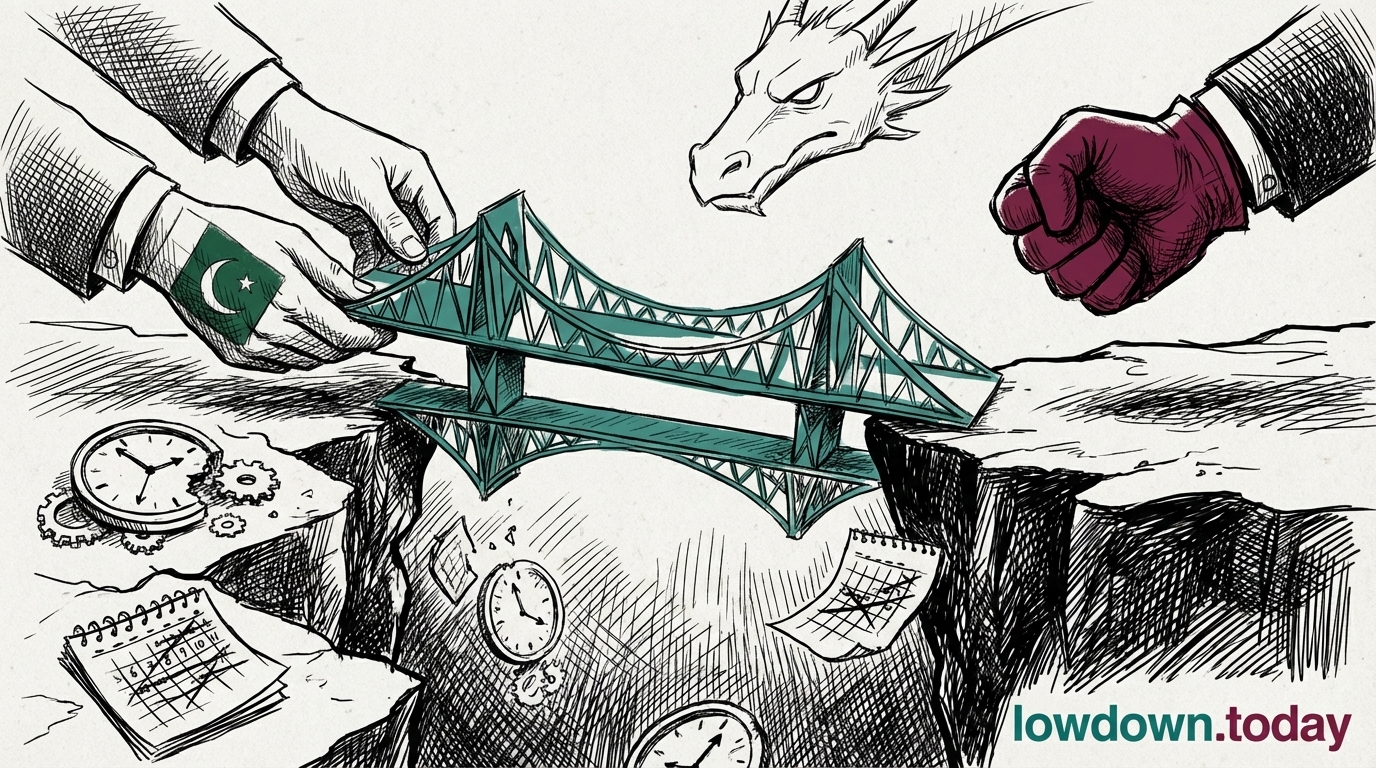
Pakistan has produced the first concrete ceasefire framework of the war . The two-tier plan, negotiated overnight by Field Marshal Asim Munir, calls for an immediate ceasefire followed by a 15-to-20-day comprehensive settlement period. Iran would commit to abandoning nuclear weapons pursuit. In return: sanctions relief, frozen asset releases, and immediate Strait of Hormuz reopening. The memorandum of understanding would be finalised electronically, with Pakistan as the sole channel.

The key players in the room: Vice President JD Vance, Special Envoy Steve Witkoff, and Foreign Minister Abbas Araghchi. Ynet News reported the ceasefire could take effect as early as Monday 7 April, though this is a single-source claim that should be treated with caution.

Iran's civilian government, which might accept terms, cannot reach the Supreme Leader . The IRGC military council that controls access to Mojtaba Khamenei benefits from continued conflict. The Islamabad Accord asks the IRGC to negotiate away its own wartime authority. No ceasefire framework in history has succeeded when the veto holders profit from the war it would end.

China pledged strategic coordination with Pakistan on the mediation effort. Beijing's backing gives the accord geopolitical weight that previous mediation attempts lacked. But weight is not leverage. The accord exists because five empty deadlines created a vacuum. Whether it can fill that vacuum depends on actors in Tehran who have spent six weeks proving they answer to no one.


Deep Analysis

In plain English

Pakistan put forward a peace plan with specific terms for the first time in six weeks of war. The plan says: stop fighting immediately, then negotiate a full deal over the next two to three weeks. Iran would give up its nuclear weapons programme and get sanctions lifted in return. The problem is that the people who would need to agree to it in Tehran are the same people whose power depends on the war continuing.

Deep Analysis
Root Causes

The ceasefire vacuum exists because US coercive diplomacy required credible escalation, which five deadline extensions destroyed.

Pakistan's mediation opportunity is a direct consequence of Washington's inability to enforce its own threats. The IRGC's wartime power consolidation means the actors who could accept peace are not the actors who hold the veto.

Escalation

De-escalatory in intent, but the framework's existence does not change structural barriers. Iran's non-response is itself an escalation indicator: silence preserves optionality for the IRGC while the civilian government lacks authority to commit. If the accord collapses, the diplomatic space it briefly opened closes harder than before.

What could happen next?
  • Pakistan-China axis becomes the primary mediation channel, displacing US bilateral leverage

    days · Assessed
  • Immediate Hormuz reopening, if achieved, could cut oil prices by $20 or more per barrel within a week

    weeks · Suggested
  • IRGC faces first external framework that offers Iran's civilian government a concrete alternative to war

    days · Assessed
First Reported In

Update #60 · Pakistan's Ceasefire Plan Fills the Vacuum

Al-Monitor / Reuters· 6 Apr 2026
Read original
Different Perspectives
Turkey (Shakarab consideration)
Ankara serves as one of two Western-adjacent Iran back-channels while Turkish national Gholamreza Khani Shakarab faces imminent execution on espionage charges in Iran. President Erdogan cannot deflect the domestic political crisis that a Turkish execution would trigger, which would force suspension of the mediating role.
Germany (Bundestag gap)
Belgium, Germany, Australia, and France committed Hormuz coalition hardware on 18 May. Germany's Bundestag authorisation for the coalition deployment remains pending, creating a constitutional gap between the commitment announced and the parliamentary mandate required to operationalise it.
IEA and oil market analysts
The IEA's $106 May Brent projection met the market in one session on 20 May as Brent fell 5.16% on diplomatic optimism. Goldman Sachs and Morgan Stanley's two-layer premium framework holds: the kinetic component compressed; the structural insurance component tied to Lloyd's ROE remains unresolved.
Hengaw
Hengaw
Documented the dual Kurdish execution at Naqadeh on 21 May, the two Iraqi-national espionage executions on 20 May, and Gholamreza Khani Shakarab's imminent execution risk. The 24-hour cluster covers two executions at one facility, the first foreign-national espionage executions, and a Turkish national whose death would suspend Ankara's mediation.
Lloyd's of London
Lloyd's of London
Hull rates stand at 110-125% of vessel value on the secondary market; the Joint War Committee has conditioned cover reopening on written ROE from the coalition or PGSA. The Majlis rial bill makes any compliant ROE structurally impossible to draft while the PGSA's yuan portal remains its operational mechanism.
United Kingdom and France (Northwood coalition)
The 26-nation coalition paper requires Lloyd's to see written rules of engagement before Hormuz war-risk cover reopens. The Majlis rial bill adds a second governance incompatibility on top of the unpublished PGSA fee schedule; coalition ROE cannot mention rial without conceding Iranian sovereignty over the strait.



