
Skip to content
Briefings are running a touch slower this week while we rebuild the foundations.See roadmap
Iran Conflict 2026
7MAR

Day 8: President orders halt; IRGC ignores him

9 min read
13:34UTC

Iranian President Pezeshkian apologised to neighbouring countries and ordered forces to halt Gulf strikes, but the IRGC's decentralised provincial commands continued attacking Dubai, Saudi facilities, and Bahrain within hours. Trump simultaneously threatened to expand targeting to previously unconsidered 'areas and groups of people,' while US crude futures posted their largest weekly gain (35.63%) since the contract's inception in 1983.

Key takeaway

The war now has three independent escalation drivers — military, political, and economic — and no single actor controls all three.

This briefing mapped
Loading map…
Diplomatic
Military
Domestic

Iran's civilian president filmed a hurried apology to neighbours his military had struck — an address that revealed less about Iran's diplomatic intentions than about who does and does not control its armed forces.

Sources profile:This story draws on centre-right-leaning sources from United States and United Arab Emirates
United Arab EmiratesUnited States

President Masoud Pezeshkian delivered a prerecorded televised address apologising to neighbouring countries struck by Iranian missiles and drones, announcing the Interim Leadership Council had agreed forces 'should not attack neighbouring countries or fire missiles at them, unless we are attacked' from their territory.

Iran's civilian president issued a ceasefire directive he has no constitutional authority to enforce, exposing a structural void in wartime command: the succession mechanism requires centralised authority that the Mosaic Defence Doctrine was designed to eliminate. No Iranian interlocutor can currently both negotiate terms and deliver compliance. 

Briefing analysis

When Ayatollah Khomeini died in June 1989, the Assembly of Experts selected Khamenei as successor within hours — a transfer managed in peacetime with the IRGC's full acquiescence. No precedent exists for Supreme Leader succession during active combat. The IRGC was created in 1979 as a parallel military force answerable only to the Supreme Leader, precisely to prevent civilian politicians from constraining it. Pezeshkian's failed ceasefire order on Day 8 is the first live test of whether Article 111's interim council can substitute for that singular authority — and the result, within hours, was that it cannot.

The oil parallel is also without modern precedent. Iraq's invasion of Kuwait in August 1990 produced a 67% crude price spike over several weeks. The current 35.63% weekly gain occurred in a single week, compounded by an insurance collapse that has no equivalent in the 1990 crisis — Lloyd's continued to cover Gulf shipping throughout the Kuwait war.

Hours after Pezeshkian's broadcast, Iranian missiles hit Dubai, Saudi oil facilities, and Bahrain. The 31 autonomous IRGC provincial commands — built to survive decapitation — cannot be halted by a president who never commanded them.

Sources profile:This story draws on mixed-leaning sources from United States and United Arab Emirates
United StatesUnited Arab Emirates

IRGC forces ignored Pezeshkian's ceasefire order. Within hours of the address, Iranian missiles and drones struck Dubai, Saudi oil facilities, and Bahrain. Pezeshkian attributed the defiance to 'miscommunication within the ranks' following Khamenei's death.

The IRGC's defiance within hours of the presidential halt order confirms that Iran's decentralised military architecture, built to survive external decapitation, has made the civilian government unable to control its own offensive operations. The system that kept Iran fighting after the loss of central command cannot be switched off from above. 

Gen. Abolfazl Shekarchi claimed Iran had only struck countries hosting US forces — contradicted by a week of documented strikes on Qatar, Kuwait, Oman, and the UAE, none of which provided launch platforms for the campaign.

Sources profile:This story draws on mixed-leaning sources from United Arab Emirates and Qatar
United Arab EmiratesQatar

Gen. Abolfazl Shekarchi claimed Iran had 'not hit countries that did not provide space for America to invade our country' — directly contradicted by the preceding week of strikes on Qatar, Kuwait, Oman, and the UAE, none of which hosted US launch operations.

A senior IRGC general publicly denied striking countries that had not hosted US forces, contradicted by documented strikes on four countries that provided no launch platforms. The information collapse mirrors the command collapse: no single Iranian voice speaks for both the civilian government and the military, and neither aligns its statements with the operational record. 

A Truth Social post expands stated US war aims to unnamed categories of targets — language without precedent in modern presidential rhetoric and with direct implications under the laws of war.

Sources profile:This story draws on centre-left-leaning sources from United States and Qatar
United StatesQatar

Trump posted on Truth Social threatening to target 'areas and groups of people that were not considered for targeting up until this moment in time' — rhetoric with no precedent in modern US presidential targeting statements, raising questions under the principle of distinction in International humanitarian law.

The statement extends a documented rhetorical escalation from military strikes through unconditional surrender demands to undefined targeting categories potentially encompassing civilian populations, creating legal obligations for US military commanders to evaluate resulting orders against the DoD Law of War Manual and the principle of distinction. 

An overnight Israeli wave hit Mehrabad International Airport — Tehran's domestic aviation hub — destroying Iran's last aerial refuelling tanker on the tarmac. Smoke rose over the airport complex for hours.

Sources profile:This story draws on mixed-leaning sources from United Kingdom, India and 1 more
United KingdomIndiaNetherlands
LeftRight

Israeli strike on Mehrabad International Airport — Tehran's primary domestic and regional aviation hub — destroyed Iran's last operational KC-747 aerial refuelling tanker. A Boeing 747 was filmed engulfed in flames on the tarmac. Large plumes of black smoke rose from the airport complex for hours.

The strike eliminates Iran's last aerial refuelling capability and degrades internal transport capacity, but the primary visible damage is to a civilian airport handling domestic flights, raising proportionality questions about military objectives versus civilian infrastructure destruction at a time when 330,000 people are already displaced. 

Sources:The Week India·ANP·Amnesty International·Army Recognition

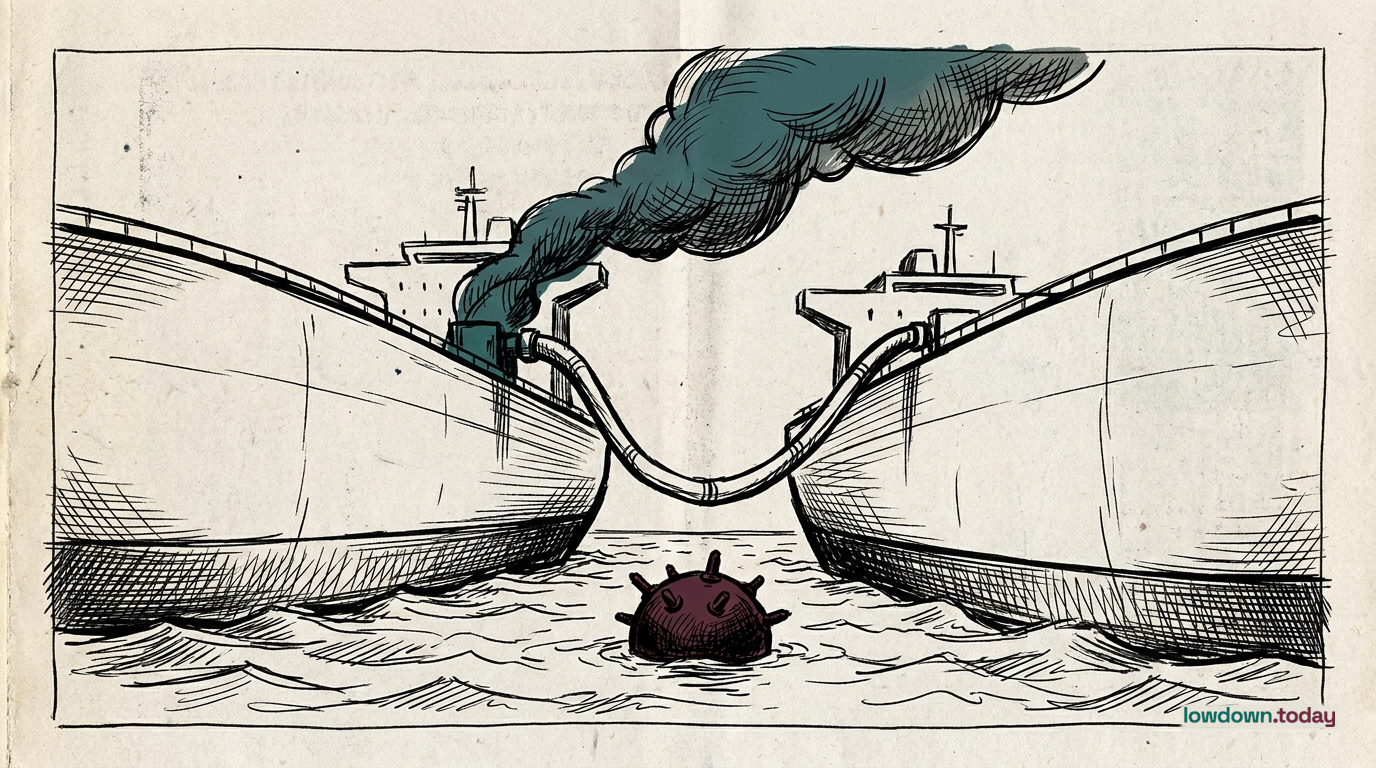
US crude futures gained 35.63% in a single week — the biggest move in the contract's 43-year history — while an insurance collapse beneath commercial shipping created a disruption floor that no ceasefire can quickly reverse.

Sources profile:This story draws on centre-left-leaning sources from United States
United States

US crude futures posted a 35.63% weekly gain — the largest in the history of the contract dating to 1983. Brent had already reached $92.69, and Qatar's energy minister had warned of $150/bbl if Hormuz remains closed.

The energy disruption now operates on two independent timelines: a military timeline that could end with a ceasefire and an insurance timeline that cannot, because every major P&I club's War risk coverage expired on 5 March and reassessments take weeks regardless of battlefield developments, creating a structural price floor independent of whether fighting stops. 

Sources:CNBC·Bloomberg

The bank raised its 2026 Brent forecast by 28% — and it was already $12 below the market when the revision published.

Sources profile:This story draws on mixed-leaning sources from United States
United States

Morgan Stanley raised its 2026 Brent Crude forecast to $80 from $62.50 — a revision already $12 below spot prices at time of publication.

Major institutional forecasters cannot model war-driven oil markets in real time. When revisions arrive pre-obsolete, they signal that downstream economic projections built on those forecasts — inflation estimates, consumer spending models, central bank rate guidance — are similarly outdated. 

VLCC freight rates nearly doubled in a single week to an all-time record — and the insurance collapse means the cost persists even after the shooting stops.

Sources profile:This story draws on mixed-leaning sources from United States and Serbia
United StatesSerbia

VLCC (Very Large Crude Carrier) freight rates hit an all-time high of $423,736 per day — a 94% increase from the prior Friday close. At these rates, shipping costs alone add approximately $3–4 per barrel before crude reaches a refinery.

Record supertanker rates expose the energy disruption's two-timeline problem: military hostilities could theoretically end with a ceasefire, but the P&I insurance collapse cannot. Freight markets are pricing in weeks of continued disruption regardless of the battlefield, and every day the strait stays closed shrinks the available global tanker fleet as vessels queue rather than cycle. 

Sources:Bloomberg·Balkan Insight

Saudi Arabia is working the backchannel China brokered in 2023 with increased urgency, but the Shaybah oilfield strike demonstrated that Iran's civilian government cannot stop the IRGC from hitting the targets Riyadh most needs to protect.

Sources profile:This story draws on centre-left-leaning sources from United States
United States

Saudi officials deployed their diplomatic backchannel to Iran with 'increased urgency' since mid-week, involving both security and diplomatic officials. The channel was established during the 2023 Saudi-Iran rapprochement brokered by China.

The backchannel's intensification reveals the central structural problem of this war's diplomacy: no individual or institution in Iran can currently both negotiate terms and enforce them on the IRGC. Saudi Arabia needs an interlocutor who controls the missiles. That person does not exist in Iran's present power structure. 

Sources:Bloomberg

Islamabad reminds Tehran of its Saudi defence pact while claiming — without evidence — that Iran has agreed to forswear nuclear weapons. The statement reveals a country conducting its own quiet diplomacy from an increasingly untenable position.

Sources profile:This story draws on mixed-leaning sources from Qatar and United States
QatarUnited States
LeftRight

Pakistan's Deputy PM Ishaq Dar told Parliament that Islamabad has reminded Tehran of the Saudi mutual defence pact and claimed Iran has 'agreed not to pursue nuclear weapons' — a statement that could not be independently verified.

Pakistan's public invocation of the Saudi mutual defence pact, combined with an unverifiable Iranian nuclear commitment, signals that Islamabad may be running a parallel backchannel with Tehran — extracting concessions in exchange for continued neutrality. A nuclear-armed state with a 900km Iranian border, a large Shia minority, and a binding Saudi defence obligation cannot remain neutral indefinitely if Iranian strikes on Saudi territory continue. 

Sources:Al Jazeera·Pakistan Today·NK News

Tehran's deputy foreign minister warns European states they would face Iranian retaliation if they enter the campaign — a threat aimed less at military planners than at parliaments still debating involvement.

Sources profile:This story draws on centre-left-leaning sources from France
France

Iran's Deputy Foreign Minister Majid Takht-Ravanchi told France 24 that European countries joining the US-Israeli campaign would become 'legitimate targets' for Iranian retaliation, noting Iran's Shahab-3 and Khorramshahr missiles can reach 2,000–2,500km — sufficient for Greece, Cyprus, and parts of the Balkans.

Iran's explicit threat to European states is a deterrence signal aimed at preventing the Coalition from widening. Germany had already declined to join the campaign but was reported to be 'seriously considering' participation. The threat's effectiveness depends less on Iran's remaining strike capacity than on European political calculations about a war that lacks UN authorisation. 

Sources:France 24

Protests spread across US cities and reach Athens, where demonstrators demand closure of a NATO base on Crete — the domestic and international opposition to an unauthorised war finding its voice on Day 8.

Sources profile:This story draws on centre-left-leaning sources from Qatar and United States
QatarUnited States

Anti-war protests held across multiple US cities (organised by A.N.S.W.E.R. Coalition, American Muslims for Palestine, CodePink, Black Alliance for Peace, and Democratic Socialists of America; Jane Fonda joined a Los Angeles rally) and in Athens (more than 1,300 demonstrators affiliated with the Communist Party of Greece, with banners reading 'Close Souda base').

The protests reflect a growing disconnect between the war's prosecution and its democratic legitimacy. Congress has voted against authorisation in both chambers. No supplemental funding has been requested for a campaign costing $891 million per day. The street opposition — spanning US anti-war coalitions and European NATO-sceptic movements — is the visible expression of a war being fought without the consent of the legislatures nominally responsible for approving it. 

Sources:Al Jazeera·ABC News·ANSWER Coalition

Iran's president apologised to Gulf neighbours and rejected Washington's surrender demand in the same address — offering de-escalation to countries Iran has bombed while telling the power bombing Iran its terms are 'a dream for the grave.'

Sources profile:This story draws on centre-left-leaning sources from United States
United States

Pezeshkian explicitly rejected Trump's unconditional surrender demand in his televised address, calling it 'a dream that they should take to their grave.'

Every branch of Iran's fractured post-Khamenei authority — foreign ministry, acting president, and now the civilian president — has rejected the only terms Washington has offered. The rejection confirms no diplomatic path exists on current terms, but the simultaneous Gulf apology suggests Pezeshkian is attempting to separate the regional front from the American one. 

Sources:NPR·Bloomberg

Iran has absorbed 85% of the conflict's dead. Three independent counts of Iranian casualties diverge by more than a thousand, and each day of bombardment degrades the country's ability to count its own losses.

Sources profile:This story draws on centre-left-leaning sources from Qatar
Qatar

Cumulative conflict toll as of Day 8: Iran 1,332 killed, Lebanon 217+, Israel 11, US 6 killed in action. No new fatality reports between 07:34 and 13:34 UTC on 07 March.

The casualty asymmetry — Iran 1,332, Lebanon 217+, Israel 11, US 6 — defines the military character of this conflict as a largely one-directional air campaign. The divergence between independent casualty counts and the absence of Gulf state civilian casualties from the consolidated tally suggest the true dead are substantially higher than any published figure. 

Sources:Al Jazeera
Closing comments

Three vectors point toward further escalation. First, Trump's targeting rhetoric has expanded in each successive statement — military targets, unconditional surrender, immunity-or-death ultimatums, now unnamed 'areas and groups of people' — with no indication of a ceiling. Second, the IRGC's provincial commands are operationally independent and have no mechanism to receive or implement a ceasefire even if one were agreed at the political level. Third, Pakistan's mutual defence pact with Saudi Arabia creates a legal obligation that grows harder to defer with each Iranian strike on Saudi territory. The Saudi backchannel is the sole countervailing force, but it runs into the same structural problem: Riyadh would be negotiating with a government that cannot deliver what it promises.

Emerging patterns

  • Civilian government attempting to assert authority over military forces it does not constitutionally command
  • IRGC autonomous provincial commands operating independently of civilian government — command fragmentation post-Khamenei
  • Iranian military officials issuing false justifications for strikes that do not match operational reality
  • Sequential expansion of stated US war aims without corresponding diplomatic framework — from unconditional surrender to immunity-or-death ultimatums to unnamed new target categories
  • Israeli strikes degrading Iranian internal transport and logistics capacity beyond purely military targets
  • Energy price escalation driven by dual military and insurance disruption timelines — ceasefire alone cannot restore shipping
  • Analyst forecasts lagging actual price movements as conflict disruption outpaces modelling assumptions
  • Shipping cost spiral compounding crude price increases — dual disruption from combat risk and insurance collapse
  • Saudi Arabia seeking direct de-escalation with Iran to protect energy infrastructure after Shaybah strike
  • Nuclear-armed Pakistan navigating between Saudi mutual defence obligations and Iran border exposure
Different Perspectives
Carnegie Endowment for International Peace
Published two analyses on 7 March assessing that the pre-2026 Gulf-Iran rapprochement is 'functionally destroyed' regardless of how the war ends, framing the Gulf monarchies as 'caught between Iran's desperation and the US's recklessness.'
President Masoud Pezeshkian
Publicly apologised to neighbouring countries struck by Iranian weapons — the first such apology by an Iranian head of state during an active conflict. Filmed hurriedly without professional broadcast equipment, the address positioned the civilian government openly against the IRGC's continued strikes on Gulf states.
Gen. Abolfazl Shekarchi
Claimed Iran had 'not hit countries that did not provide space for America to invade our country' — directly contradicted by documented strikes on Qatar, Kuwait, Oman, and the UAE, none of which hosted US launch operations. The statement attempted to impose a strategic rationale on strikes the civilian president had just apologised for.
Deputy PM Ishaq Dar
Deputy PM Ishaq Dar
Told parliament that Iran has 'agreed not to pursue nuclear weapons' — a claim with no independent verification and no corresponding Iranian confirmation. This is the first time a Pakistani official has publicly asserted Iranian nuclear restraint commitments during the conflict.
