Article 111
Iranian constitutional succession mechanism invoked for the first time in March 2026 after Khamenei's death.
Article 111 was invoked for the first time in its 37-year history on 1 March 2026 after Khamenei's death, and by 5 July his named successor, Mojtaba Khamenei, had still not appeared on video.
Last refreshed: 2 October 2026 · Appears in 1 active topic
Can a constitutional council hold Iran together when the IRGC ignores its orders?
Timeline for Article 111
Mentioned in: AI Act fines land on a stale register
European Tech SovereigntyMentioned in: Iran's new leader wounded, sources say
Iran Conflict 2026Mentioned in: Mojtaba's first named directives via IRIB
Iran Conflict 2026Remained operative while CIA and Mossad searched for Mojtaba Khamenei
Iran Conflict 2026: CIA and Mossad hunt for KhameneiMentioned in: Trump floats leaving NATO after rebuff
Iran Conflict 2026Background
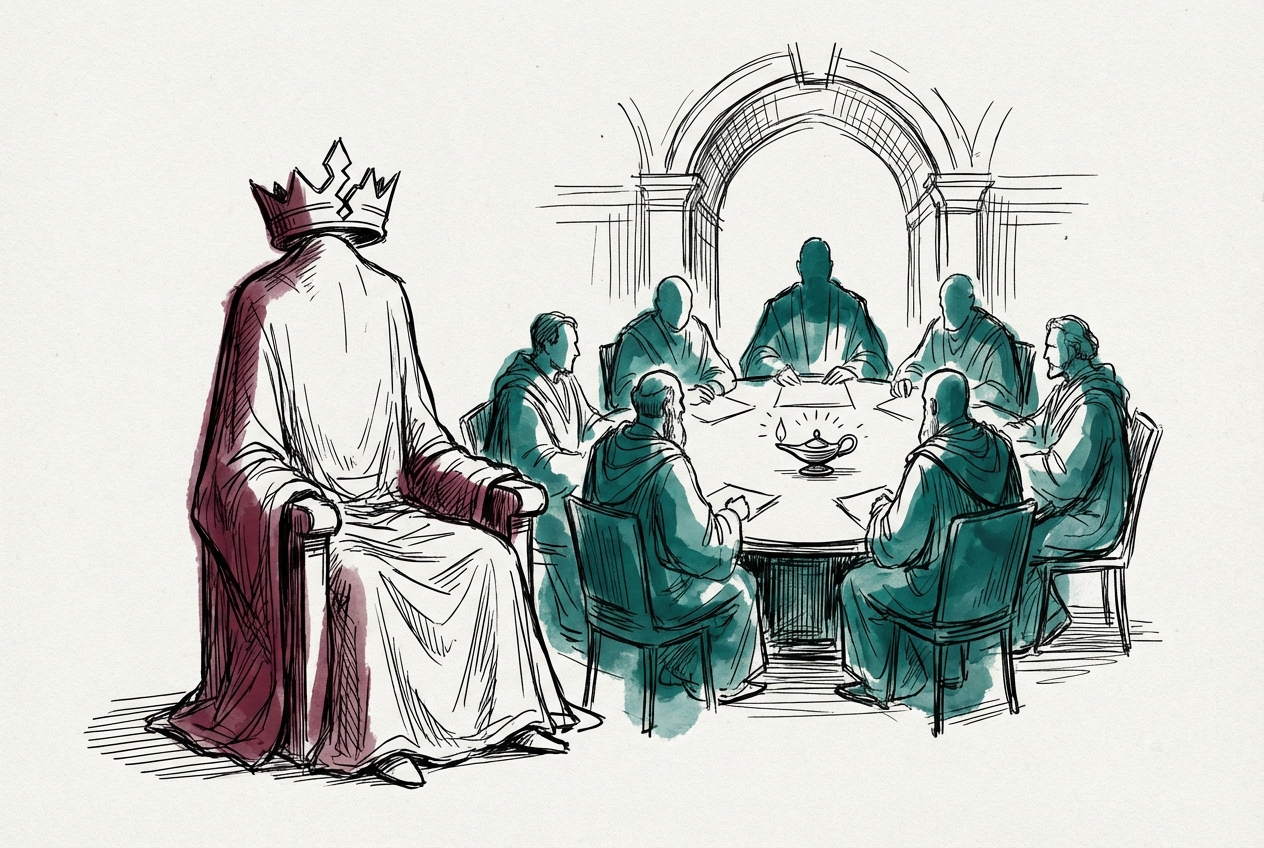
Article 111 sits in Chapter VIII of Iran's constitution, revised in 1989. It creates a fixed council of three, the President, the Chief Justice and a jurist elected by the Guardian Council, to hold The Supreme Leader's powers collectively while the Assembly of Experts selects a permanent successor. The clause existed for 37 years without ever being used.
It was invoked for the first time on 1 March 2026, when Ali Khamenei's death triggered its provisions and Iran's remaining constitutional apparatus named Arafi, Pezeshkian and Mohseni-Ejei to the transitional council. Its authority was contested within days, and Khamenei's funeral was postponed indefinitely, keeping the succession in legal limbo under Shia tradition.
A common misreading holds that any successor named under Article 111 must be a marja-e taqlid, a senior source-of-emulation cleric. The same 1989 amendment that created the article also removed that requirement, the change that let the elder Khamenei, then a mid-ranking cleric, take the POST.
Mojtaba Khamenei's claim stays unproven
Mojtaba Khamenei was named successor when Article 111's transitional council formed on 1 March 2026, yet by 14 May state broadcaster IRIB was still attributing directives to him only by name, without footage. Reuters reported on 5 July that he had been disfigured and suffered a serious leg injury in the strike that killed his father, explaining the absence US and Israeli intelligence agencies had spent months trying to account for. The Assembly of Experts must still confirm any permanent successor against Article 109's criteria of scholarship, justice and political capability, a bar his continued invisibility makes harder to test.
The IRGC ignored its own council
Iran's remaining constitutional apparatus named a three-member transitional council under Article 111 on 1 March 2026: Ayatollah Alireza Arafi as the Guardian Council's jurist, President Masoud Pezeshkian, and Chief Justice Gholamhossein Mohseni-Ejei. Within days its authority was already contested from inside the state: Iran's own foreign minister acknowledged that military units were acting outside central government direction. A council built to hold The Supreme Leader's powers collectively could not compel the IRGC to obey a Ceasefire order it issued in its first days, exposing the gap between constitutional authority on paper and command of Iran's armed forces in practice.
Reference
Does Iran's Supreme Leader have to be a marja, a top Shia cleric?
What happens after Iran's Article 111 council — who picks the next Supreme Leader?
What is Article 111 of the Iranian constitution?
Why did Mojtaba Khamenei not attend his father's funeral?
Does Iran's Article 111 council have real power?
Who is on Iran's Article 111 transitional council?
Has Article 111 ever been used before?


