Skip to content
You can now search across every topic, entity and event.What's new
Iran Conflict 2026
11JUN

Trump floats leaving NATO after rebuff

3 min read
09:17UTC

After every ally he named for a Strait of Hormuz escort coalition formally refused, Trump said leaving NATO is 'something to think about.' Germany's foreign minister answered for the continent: 'We will not participate in this conflict.'

ConflictDeveloping
Key takeaway

Trump has exhausted both the NATO lever and the China lever without producing compliance, leaving no visible diplomatic middle option.

Trump said leaving NATO is "something to think about" after Australia, Japan, the United Kingdom, Germany, and France — every country he named for a Strait of Hormuz escort coalition — formally declined to send warships 1. He warned the Alliance faces a "very bad future." Germany's foreign minister responded: "We will not participate in this conflict" 2.

The threat came one day after Trump warned he might delay his summit with Xi Jinping over Hormuz , and three days after all five named allies formally refused his escort call . Three leverage attempts — against European allies, against China, against NATO as an institution — have produced zero warship commitments.

Trump questioned NATO's value during his first term, but those threats concerned burden-sharing within a shared strategic framework. Allied capitals are refusing Hormuz duty not out of free-riding but because they regard the campaign against Iran as an American choice they had no part in making. Five of them said as much when they jointly opposed Israel's ground offensive in Lebanon — the sharpest Western diplomatic break with Israel since the war began.

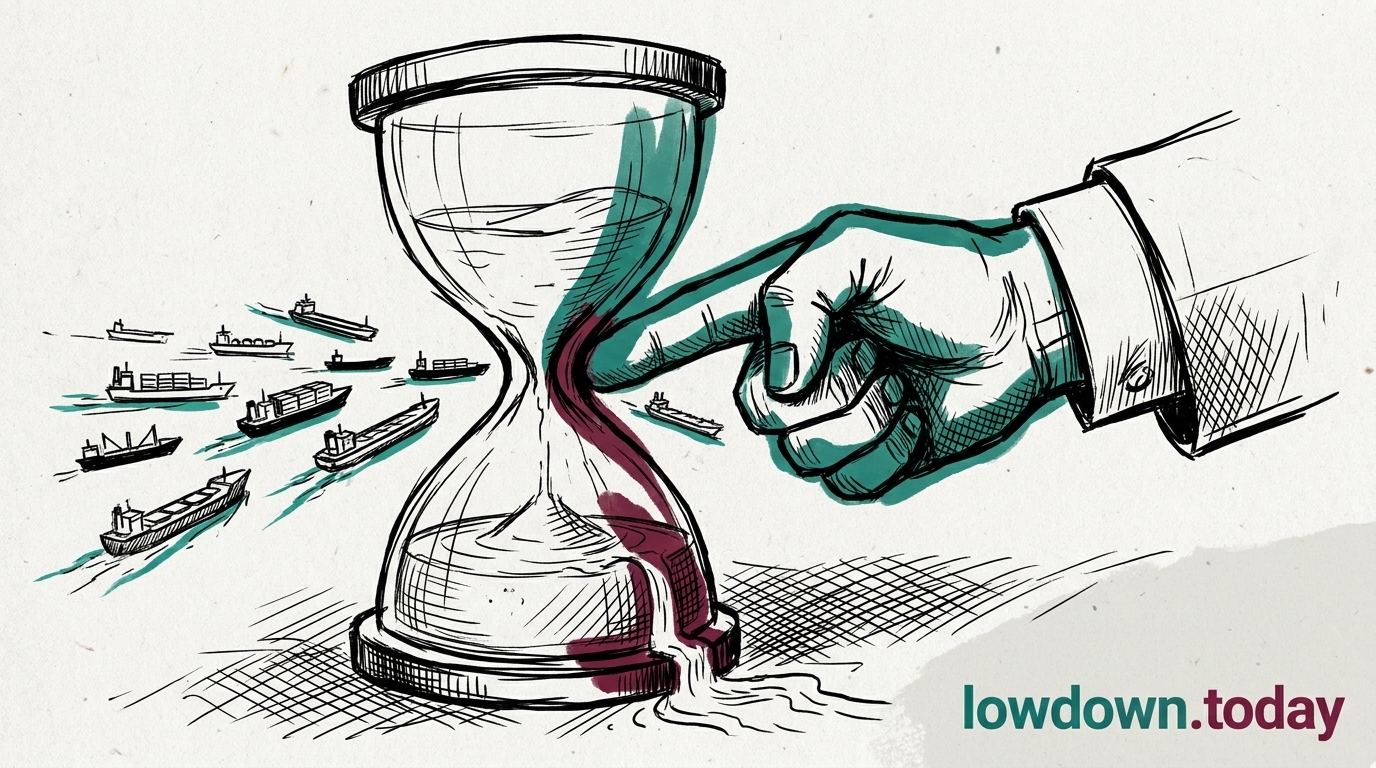
The practical consequence: the strait of Hormuz stays closed. US Navy officials described it as an Iranian "kill box" with more than 300 ships stranded . Energy Secretary Wright acknowledged the US is "simply not ready" for escorts . Without allied warships, Washington must degrade Iran's maritime threat enough to escort tankers alone — on no stated timeline — or accept that 20% of the world's seaborne oil stays blocked. Threatening to leave NATO does not produce frigates.

Deep Analysis

In plain English

The US asked its European NATO allies to join a naval patrol protecting oil tankers in the Strait of Hormuz — a critical chokepoint for global energy supplies. Every ally refused. Trump responded by suggesting the US might leave NATO entirely. NATO is the 75-year military pact that guarantees European security. The threat is partly frustration, partly negotiating tactic. But even an idle threat reshapes how European governments plan: they now have to build defences assuming US backing may not be permanent, which costs money and changes how the whole Western security system works.

Deep Analysis
Synthesis

The simultaneous failures of the NATO lever and the Xi/China lever — Trump has now publicly threatened both relationships without extracting compliance — suggests the administration has exhausted its primary coercive diplomatic tools. Having made both threats publicly, the next move is either concession or further unilateral action; there is no face-saving middle diplomatic option remaining without one of the threatened parties reversing course.

Root Causes

The structural divergence is rooted in treaty scope: European economies depend on Gulf energy stability but face no Article 5 obligation to support offensive operations in third-party conflicts. Allies calculate that participation exposes them to Iranian retaliation — port closures, cyber attacks, energy disruption — with no binding legal requirement to follow the US into an elective war it launched without NATO consultation.

What could happen next?
1 precedent1 consequence2 risk1 opportunity
  • Precedent

    First explicit presidential threat to leave NATO during an active military operation the alliance formally declined to join.

    Immediate · Assessed
  • Consequence

    European governments will accelerate autonomous defence planning regardless of whether Trump follows through, as the threat itself demonstrates the credibility gap.

    Short term · Assessed
  • Risk

    NATO credibility erosion may create a window for Russian opportunism in Eastern Europe while Western political and military attention is concentrated on the Gulf theatre.

    Medium term · Suggested
  • Risk

    China may calculate that a US-NATO fracture reduces the cost of pressure on Taiwan, particularly if the US military is simultaneously engaged in the Gulf.

    Medium term · Suggested
  • Opportunity

    European defence industrial base expansion accelerates, potentially reducing long-term dependence on US systems and creating a more autonomous European security capacity.

    Long term · Suggested
First Reported In

Update #40 · Larijani dead; Israel hunts the new leader

PBS· 18 Mar 2026
Read original
Different Perspectives
Oil markets / Lloyd's underwriters
Futures markets priced CENTCOM's strikes-complete statement as a de-escalation signal and pushed Brent down 1.7 per cent to $94.71, even as the IRGC declared Hormuz closed. Lloyd's war-risk premiums held elevated because institutional de-listing requires a UN Security Council resolution that Russia and China have just shown they will block.
Pakistan (mediator)
Pakistan (mediator)
Interior minister Mohsin Naqvi carried dual civilian and military letters to Mojtaba Khamenei in Tehran on 6-7 June with no public response. The IRGC's Hormuz closure on 11 June shows the corps is acting independently of the channel Pakistan is using, making the mediation structurally unable to produce a binding commitment without direct IRGC access.
Russia and China
Russia and China
Russia and China voted against GOV/2026/40 at the IAEA Board, following through on the blocking position coordinated with Grossi in Geneva on 5 June; both states continue to oppose Western institutional pressure on Iran at every multilateral venue.
E3 and IAEA (UK, France, Germany)
The E3 co-sponsored IAEA resolution GOV/2026/40, adopted 21-3-10 on 10 June, demanding Iran disclose 440.9 kg of unaccounted HEU and admit inspectors to four denied facilities. The 10 abstentions and Russia-China noes leave any Security Council referral without a viable enforcement path.
IRGC / Iran military command
The corps declared Hormuz closed to all traffic on 11 June and claimed two vessels struck, overriding the MoU its own civilian negotiators were pursuing through Pakistan. The closure order used the Persian Gulf Strait Authority apparatus to convert a toll mechanism into a military prohibition.
Trump administration / CENTCOM
CENTCOM completed a second day of strikes on Tehran, Sirik and Minab, rejected the IRGC Hormuz closure as inconsistent with observed transit, and said strikes were complete. Hegseth framed the bombing explicitly as the negotiation: the method is coercive deal-making with no stated pause threshold.