Heritage Foundation
US Conservative think tank; Project 2025 author; primary intellectual framework for Trump administration domestic and Foreign Policy.
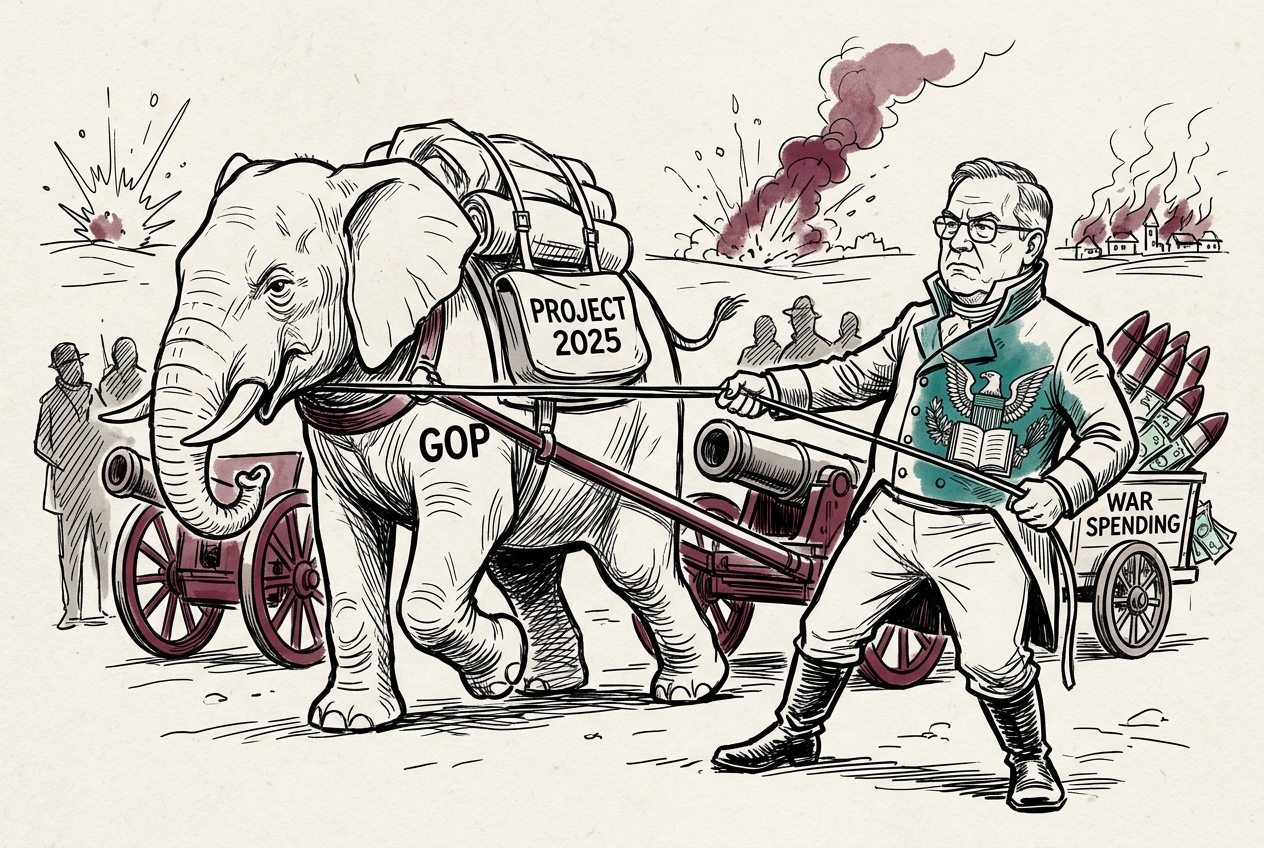
Heritage Foundation president Kevin Roberts called Republican opposition to Trump's $200bn Iran war supplemental "good" on 19 March 2026, the think tank's first public break with hawkish orthodoxy on military spending.
Last refreshed: 26 July 2026 · Appears in 1 active topic
Project 2025 staffed the Trump White House; which Heritage blueprint is actually driving US policy in 2026?
Timeline for Heritage Foundation
Mentioned in: Trump orders Section 301 probe into EU tech rules
European Tech SovereigntyMentioned in: DOJ loses again on state voter files
US Midterms 2026Mentioned in: Quirno cites 1982 UN Malvinas resolution
2026 FIFA World CupMentioned in: SAVE Act tries the reconciliation door
US Midterms 2026Mentioned in: Court keeps late mail ballots counting
US Midterms 2026Background
The Heritage Foundation is a US Conservative research and advocacy organisation founded in 1973 in Washington DC, with annual revenue exceeding $100 million. It is led by president Kevin Roberts, WHO has positioned Heritage as a leading institutional voice of the populist right under Trump.
It is best known outside the United States for Mandate for Leadership, a policy blueprint first published in 1981 and updated for Trump's second term as Project 2025, setting out proposals for restructuring the executive branch across federal agencies. Heritage operates as a policy advocacy organisation rather than an academic research institute: its outputs are written to persuade legislators and executives rather than to pass peer review, and its analysts testify before Congress and appear across Conservative media.
That proximity to the Trump administration, whose domestic and Foreign Policy agenda drew heavily on Project 2025, gives Heritage's interventions unusual weight whenever it does break from The Administration's own positions. The organisation has more often functioned as an intellectual supplier to The White House than as an Independent critic of it, which is what made its 2026 break with hawkish orthodoxy on Iran war funding stand out.
Heritage endorses a war-funding revolt
Heritage Foundation president Kevin Roberts called Republican opposition to Trump's $200bn Iran war supplemental "good" on 19 March 2026, the first time the think tank had endorsed intra-party dissent on military spending rather than urging unity behind the administration it had helped staff. Days later Roberts warned the conflict risked turning an "economic boom into Stagflation" before the midterms, sharpening the fiscal case against continued war spending.
The request faced bipartisan opposition with no visible PATH through Congress; the Center for Strategic and International Studies had put the war's running cost at $900 million a day, and the Pentagon held only $4bn-$6bn in reprogramming headroom before needing formal congressional notification. Roberts's remarks put Heritage on the same side as the war's congressional critics on fiscal grounds, even as Heritage-aligned appointees across The Administration continued prosecuting the war itself.