Skip to content
Briefings are running a touch slower this week while we rebuild the foundations.See roadmap
Iran Conflict 2026
8JUN

Peskov reopens uranium off-ramp to Iran

4 min read
09:58UTC

Lowdown Newsroom

ConflictDeveloping
Key takeaway

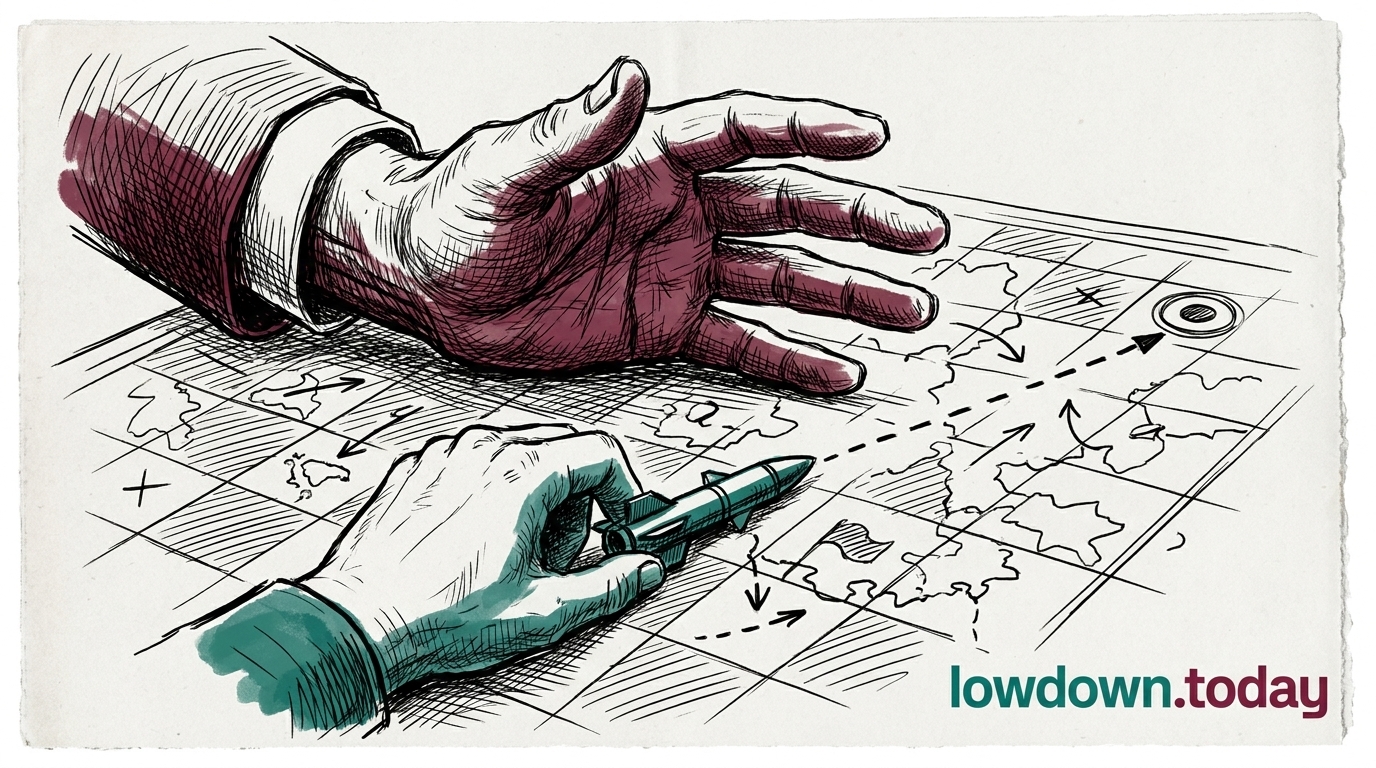
A physical off-ramp for Iran's enriched uranium is on the table and both capitals are walking past it.

Dmitry Peskov, the Kremlin spokesman, confirmed this week that Russia's offer to take custody of Iran's enriched uranium 'still stands but has not been acted upon.' Alexei Likhachev, chief executive of Rosatom, the Russian state nuclear energy corporation, has tabled three physical options: transfer the material to Russia and dilute it there before return, deliver equivalent natural uranium, or pay Iran the financial value. The offer sits alongside new Supreme Leader Mojtaba Khamenei's written statement that nuclear weapons are 'a matter of life and not a matter for negotiation' .

The architecture is familiar. Rosatom's three options mirror the stockpile provisions written into the JCPOA (Joint Comprehensive Plan of Action) signed in Vienna, the deal that took ninety-seven per cent of Iran's low-enriched uranium out of the country and sent most of it to Russia. Iran's current stockpile is roughly sixty per cent above that JCPOA ceiling by mass. The deadlock at Islamabad last week was over an enrichment right Foreign Minister Abbas Araghchi confirmed Iran cannot currently exercise at any site due to strike damage . Both Iranian statements are simultaneously true: Tehran holds a maximalist political position it has no physical means to act on.

The Russian proposal is the geometry that lets both sides keep their public positions while the material question resolves physically. Tehran could continue insisting enrichment rights are non-negotiable in principle; Washington could continue insisting no enrichment is taking place in fact; the uranium would leave the country through a Russian transfer neither party would have to call a surrender. Peskov's confirmation that the offer has not been acted upon is pressure signalling aimed at Washington, not Tehran. European governments heading into Friday's summit gain a concrete proposal to push Tehran towards. The shape of a deal is on the table; what is missing is anyone willing to pick it up.

Deep Analysis

In plain English

Russia has offered to take charge of Iran's stockpile of enriched uranium. Enriched uranium is the material that, if refined further, could be used to make a nuclear weapon; and Iran has been building up more of it than the last nuclear deal, the 2015 JCPOA, allowed. The Russian offer is a practical workaround: move the stockpile out of Iran, and the weapons risk disappears for now, without either side having to admit defeat. Iran could say it hasn't surrendered anything; just lent it to a friend. The US could say Iran no longer has the material. But Iran's new Supreme Leader just publicly declared nuclear weapons are 'not a matter for negotiation.' And Iran's foreign minister confirmed the country can't actually enrich uranium right now anyway, because US and Israeli strikes destroyed the facilities. So Iran is in the strange position of holding a non-negotiable position on something it cannot currently do.

Deep Analysis
Root Causes

The deadlock's structural root is the enrichment-right / physical-capacity gap that makes both sides' stated positions simultaneously true and incompatible. Iran insists on its enrichment right confirmed: Araghchi stated Iran cannot enrich at any site but the right is non-negotiable. The US insists on zero enrichment. The gap appears unbridgeable in print; the Russian transfer is the geometry that dissolves it physically without resolving it politically.

Khamenei's 14 April statement declaring nuclear weapons 'a matter of life and not a matter for negotiation' is addressed to the IRGC and the Assembly of Experts, not to Washington or Moscow. It sets the ceiling for what a new Supreme Leader who lacks theological legitimacy can concede domestically. It does not prevent a Russian-mediated physical transfer; it prevents calling that transfer a concession.

What could happen next?
  • Opportunity

    Russian-mediated uranium transfer provides the only currently available geometry that preserves both sides' public positions while resolving the material question physically

    Short term · 0.65
  • Risk

    If IAEA's 'movement near stockpile sites' reflects undisclosed transfers, any Russian-custody agreement based on declared inventory leaves a residual weapons-material risk that cannot be verified

    Medium term · 0.7
  • Consequence

    Khamenei's non-negotiable declaration creates a domestic political ceiling preventing Tehran from characterising any transfer as a concession, which means acceptance requires a face-saving framing Moscow would need to provide

    Short term · 0.8
First Reported In

Update #69 · Cooper joins the instrument gap

Moscow Times· 15 Apr 2026
Read original
Different Perspectives
Gulf shipping and insurance markets
With Hormuz and Bab el-Mandeb both hostile at once, war-risk underwriters face their first dual-chokepoint pricing problem; the rerouting hedge that absorbed one closure is gone for Israeli-linked hulls. Any deal that reopens Hormuz without a Houthi stand-down clause delivers only partial shipping relief.
Russia and China
Russia and China
Russia and China met IAEA chief Grossi jointly in Geneva on 5 June to coordinate an advance blocking position against Washington's censure resolution, the first documented instance of proactive pre-session obstruction rather than reactive post-vote dissent. Beijing's move came four days after OFAC designated Shanghai Qianye Energy under Iran energy sanctions.
Saudi Arabia
Saudi Arabia
Saudi Arabia was left out of the emergency $4.01 billion Patriot waiver Qatar received on 2 May as its own PAC-3 stocks ran near-empty from intercepting Iranian salvoes over Aramco facilities. Riyadh is on a standard 18-month FMS queue behind a production line booked through 2030, with no equivalent priority to Qatar's Al Udeid basing role.
Houthis (Ansar Allah)
The Houthis declared a complete ban on Israeli Red Sea navigation on 8 June and struck Jaffa, their first attack on Israeli territory since April, seven days after the Tasnim authorisation to activate other fronts including Bab el-Mandeb. The declaration put both chokepoints under hostile authority simultaneously.
Iran
Iran
Iran agreed the 9 June mutual halt after the Mahshahr exchange and coordinated with Russia and China to block Washington's IAEA censure resolution, using the Board as a second front while the bilateral pause held on the military one. Tehran's acceptance of the Lebanon carve-out contradicts the linkage position it stated on 1 June.
Benjamin Netanyahu and the IDF
Israel struck the Karun Petrochemical plant at Mahshahr on 8 June over Trump's explicit objection, then agreed a halt with Iran the following day scoped on Israeli terms with Lebanon carved out. Netanyahu's posture is that the IDF will not accept Iranian missile factories as off-limits regardless of US diplomatic timelines.