Skip to content
You can now search across every topic, entity and event.What's new
European Oil Markets
16JUL

Iran and Oman claim the strait

3 min read
09:39UTC

Sultan Haitham bin Tariq signed a joint statement with Iran's foreign minister in Muscat on 23 June, creating a standing committee to set fees on the Strait of Hormuz, hours after Rubio said Washington will not accept tolls.

EconomicDeveloping
Key takeaway

Iran and Oman signed a Hormuz fee committee the same day Washington said no state may charge.

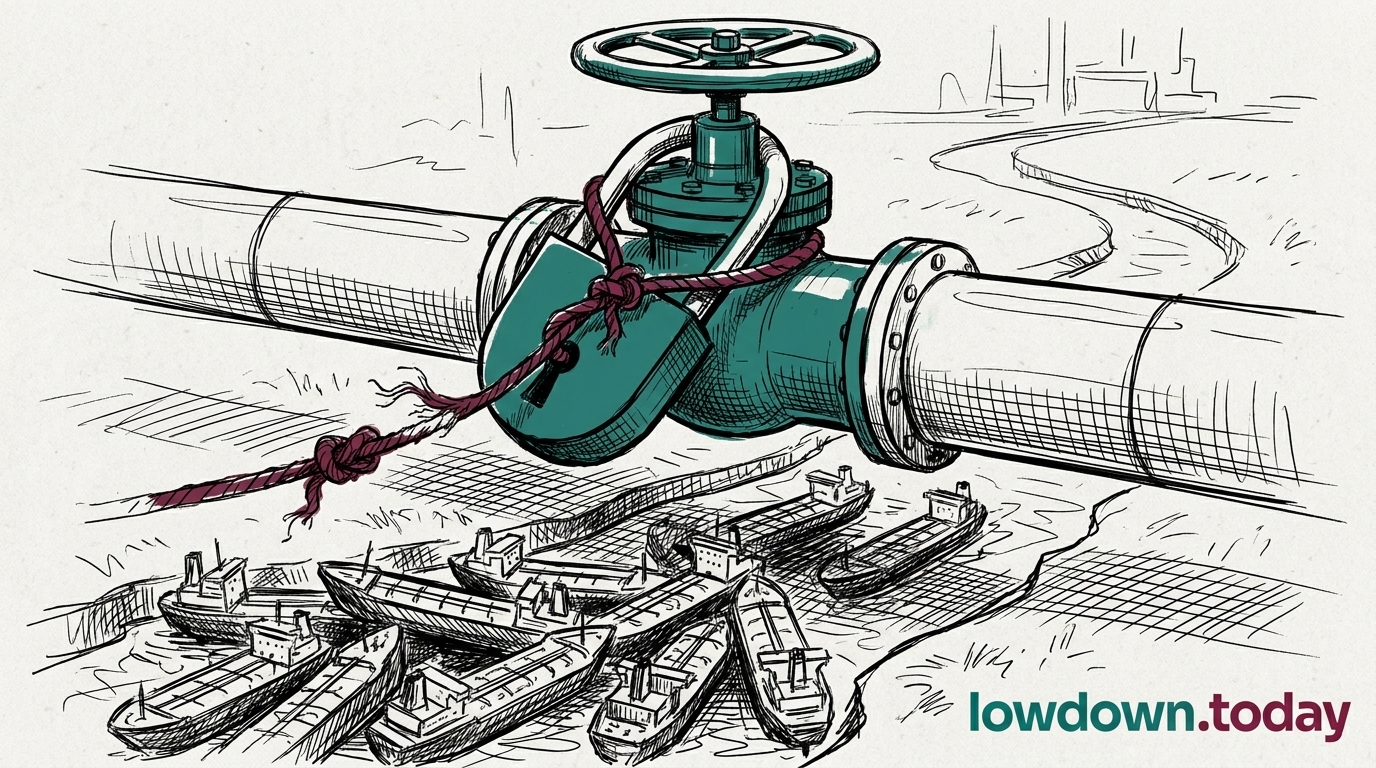
Iran and Oman signed a joint statement in Muscat on 23 June creating a standing committee between their foreign ministries to administer Strait of Hormuz shipping and determine transit fees "in alignment with international standards" 1. Sultan Haitham bin Tariq, Omani Foreign Minister Badr Albusaidi, Iran's Foreign Minister Abbas Araghchi and parliament speaker Mohammad Bagher Ghalibaf put their names to it in person. the strait is the 33-kilometre chokepoint through which roughly a fifth of the world's seaborne oil passes, and the question of who may charge to use it has run unresolved since the war began.

The Sultan's personal signature, head-of-state level rather than ministerial, escalates the consultations Baghaei first announced on 18 May into a formal institution with named signatories and fee-determination authority. The founding language, "the sovereignty and sovereign rights of the two coastal nations" 2, positions the pair as co-governing authorities over a waterway Washington insists no state may charge to use.

That framing carries weight beyond the rhetoric. A coastal-state body that sets fees pre-empts both the US position and the European multilateral framework drafted at the UK's Northwood Headquarters. It also routes around Iran's own unilateral Persian Gulf Strait Authority (PGSA), the body that mandated transit insurance and reserved fees from 17 August , while Oman simultaneously reaffirmed its backing for the Islamabad MOU and gave Tehran the Arab cover The Gulf monarchies have withheld.

Deep Analysis

In plain English

The Strait of Hormuz is a 33-kilometre shipping lane between Iran and Oman through which roughly one-fifth of the world's oil passes every day. Until now, every country agreed that no single nation owned it; ships could pass freely under international maritime rules. On 23 June, Iran and Oman signed a document creating a joint committee that can set fees for using the strait. They are two of the three countries whose coasts border the strait, so together they claim the right to govern it. This matters because the United States and most shipping nations argue no country can charge for passage through an international strait. If Iran and Oman enforce fees, every tanker carrying oil from the Gulf; including those supplying Europe and Asia; faces a new toll. The US Secretary of State arrived in the region the same day and said America will never pay those fees, leaving a direct standoff between the two positions.

Deep Analysis
Root Causes

The Iran-Oman committee reflects a specific structural gap in the 1982 UN Convention on the Law of the Sea (UNCLOS): transit passage rights through international straits bind the 169 states that ratified UNCLOS, but Iran never ratified it.

Tehran instead relies on its own 1934 and 1959 maritime boundary treaties with Oman, which pre-date the transit-passage doctrine. The 23 June committee grounds its fee authority in those bilateral treaties rather than UNCLOS, giving the arrangement domestic legal standing in both states even if it conflicts with international maritime law as the US and EU interpret it.

Oman's co-signature also reflects the failure of Bessent's 28 May threat to sanction Oman over toll facilitation . Muscat backed down verbally then, but the 23 June signing shows the retreat was tactical: Sultan Haitham waited until the Islamabad MOU gave the committee a treaty hook ('navigation services' charges permitted after 60 days) before committing his personal signature.

Escalation

The committee's signing escalates the Hormuz governance dispute from an IRGC unilateral toll claim to a bilateral state instrument backed by a head-of-state signature. The IRGC's own PGSA is now supplemented, not replaced, by a civilian-diplomatic vehicle. This makes it harder for Washington to dismiss the toll question as Iranian extremism and harder for moderate Gulf states to oppose it without directly challenging Oman.

What could happen next?
  • Precedent

    If no international body invalidates the committee before it begins operating, two coastal states will have established that joint governance of an international strait can override transit-passage norms, creating a template replicable in the Bab el-Mandeb (Djibouti-Eritrea-Yemen) and the Turkish Straits.

    Medium term · Reported
  • Risk

    The GCC session in Bahrain on 25 June faces a split between Oman (co-signatory) and the four Gulf monarchies that formally rejected the PGSA in May. Any GCC communique that fails to name the committee risks legitimising it by omission.

    Immediate · Assessed
  • Consequence

    Rubio's no-tolls declaration, issued hours after the signing, now requires a concrete enforcement mechanism; either sanctions on Omani toll-facilitation or naval interdiction; neither of which Washington has signalled it will use against a fellow US partner state.

    Short term · Reported
First Reported In

Update #137 · Iran and Oman claim the strait; US says no

WANA (West Asia News Agency)· 24 Jun 2026
Read original
Causes and effects
Different Perspectives
Indian refiners
Indian refiners
Indian refiners kept lifting discounted Urals as the India/Baltic price split widened past $9-10 a barrel, a gap that only grows as GL X1's Iranian wind-down cuts an alternative discounted grade off the market by 17 July. Cheaper Russian feedstock is being locked in while it lasts.
Chinese refiners
Chinese refiners
Chinese refiners gain leverage as the Urals-Brent discount widens, since Beijing's state buyers already source discounted Russian barrels near the fiscal floor unaffected by Western insurance costs. A wider discount, if it holds past 23 July, lets them lock in cheaper term contracts regardless of the cap's outcome.
US money managers (CFTC-tracked)
Managed money trimmed WTI net length into the rally, positioning that reflects doubt the Hormuz premium survives without freight or war-risk confirmation. The Brent-WTI spread widening almost entirely on the Brent leg supports that scepticism about a broad-based repricing.
OPEC+ (Saudi-led subgroup)
Saudi Arabia is defending market share through a fourth straight 188kbd August hike even as OPEC's own July MOMR cut 2026 demand growth for the fourth consecutive month. At a $108-111 fiscal breakeven, every added barrel costs Riyadh revenue it cannot recoup, so the hike reads as a positioning signal, not a demand bet.
Greek shipping registries
Greece, backed by Cyprus and Malta, is pushing a three-month cap-freeze compromise against the Commission's freeze to January 2027 ahead of the 23 July vote. Athens' and Valletta's combined tanker registrations mean a shorter review gives their insurers more frequent chances to reprice risk on Russian cargoes.
Russia (Deputy PM Alexander Novak)
Novak extended the diesel export restriction to producers on 8 July, the first producer-binding curb of the war, protecting the domestic pump price ahead of any refinery repair timeline. Urals still trades below Russia's $59 budget floor even as Brent gained, so the ban trades export revenue for fiscal stability at home.
