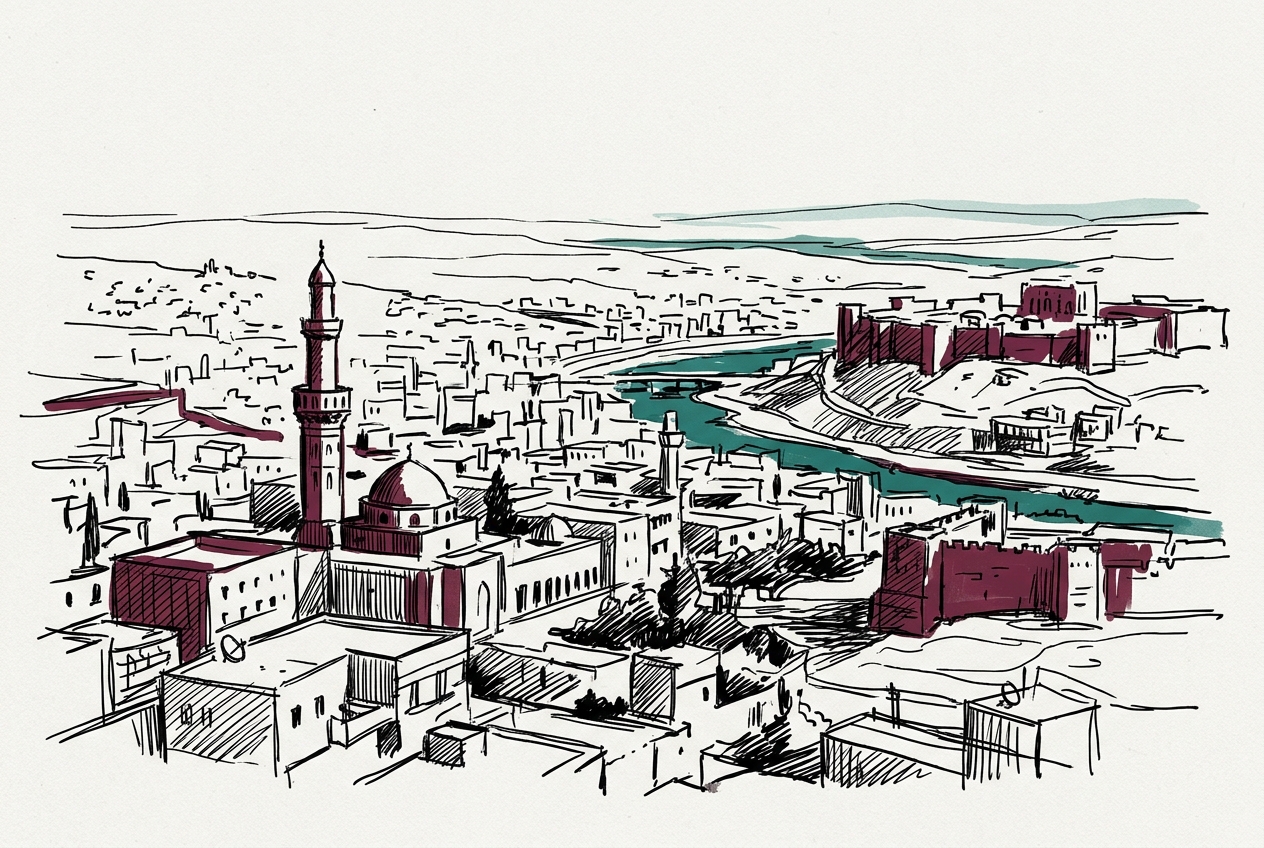
Syria
Arab republic under transitional rule since December 2024; IDF occupies a border security zone.
On 1 July 2026, Syria joined CENTCOM's regional defence dialogue in Bahrain, its first such session since Assad's fall, while Israeli forces remained in the south.
Last refreshed: 22 September 2026 · Appears in 1 active topic
Can Syria's transitional government hold together as foreign armies operate on its soil?
Timeline for Syria
Mentioned in: US flies its last troops out of Erbil
Iran Conflict 2026Mentioned in: Three seized tankers near American ports
Iran Conflict 2026Mentioned in: Jordan stops 18 of 20 Iranian missiles
Iran Conflict 2026Mentioned in: Washington reached for the weaker law
Iran Conflict 2026Mentioned in: White House signs nothing on Iran
Iran Conflict 2026Background
Syria is an Arab republic in the Levant under a transitional authority led by President Ahmad al-Sharaa. The state is rebuilding after thirteen years of civil war and the end of Assad family rule. Damascus remains the political centre, while millions of Syrians displaced during the conflict remain abroad. Syria's participation in CENTCOM's dialogue on 1 July 2026 signalled a government seeking wider regional security contacts.
Syria's position between Turkey, Iraq, Jordan, Lebanon and Israel gives its territory regional weight. The Assad government's fall closed Iran's former overland supply route to Hezbollah, and the transitional authorities have taken an anti-smuggling, anti-Hezbollah stance. Turkey operates in the north, US forces support the Syrian Democratic Forces in the north-east, and Israel holds a southern security zone. On 14 June 2026, Israel's defence minister described its Syrian presence as open-ended.
Syria joins regional defence dialogue
On 1 July 2026, Syrian officers joined Lebanese counterparts at CENTCOM's regional defence dialogue in Bahrain. For Damascus, the meeting created a public security contact beyond the networks that dominated under Assad. It placed the transitional government in a regional forum while it still seeks to restore authority across Syria.
The opening does not alter Syria's constrained position. Israeli forces remain in the south, and Israel's defence minister said on 14 June 2026 that Israeli troops would stay in Syria for an unlimited period. Damascus can widen its diplomatic options, but it cannot yet turn regional engagement into control of all its territory.
Why did Syria join a US-led defence dialogue?
How many refugees crossed from Lebanon into Syria in 2026?
What is happening in Syria in 2026?
Why did Iran lose access to Hezbollah after Assad fell?
Is Israel occupying part of Syria in 2026?
Who is running Syria after Assad fell in December 2024?


