
Skip to content
Briefings are running a touch slower this week while we rebuild the foundations.See roadmap
Russia-Ukraine War 2026
18MAR

Day 1484: Trump frees 124m barrels; Russia earns €6bn

7 min read
11:41UTC

The US Treasury granted sanctions waivers for approximately 124 million barrels of Russian oil at sea, while CREA data showed Moscow earned €6 billion in fossil fuel revenues in the Iran war's first fortnight. The EU approved a €90 billion loan for Ukraine after breaking Hungary's Druzhba pipeline blockade, and Zelenskyy claimed Ukrainian forces had disrupted Russia's planned March offensive.

Key takeaway

Russia is earning more from oil now than before the Iran conflict began while the sanctions designed to constrain it are being waived by Washington and evaded by shadow fleets, and Ukraine's main counter-leverage is its combat-proven drone technology, not its territorial position.

This briefing mapped
Loading map…
Economic
Diplomatic
Military
Legal

The US Treasury permitted any country to purchase Russian oil already at sea, drawing sharp rebukes from European leaders who warned Washington was dismantling the sanctions regime it built.

Sources profile:This story draws on centre-left-leaning sources from United States, United Kingdom and 1 more (includes Russia state media)
United StatesUnited KingdomRussia

The US Treasury issued 30-day sanctions waivers on 12 March for approximately 124 million barrels of Russian oil already at sea, permitting any country to purchase them through 11 April. The waivers were first issued on 5 March for Indian refineries, then expanded globally a week later. Treasury Secretary Scott Bessent called the measure 'narrowly tailored' but acknowledged Russian gains were 'an inevitability.' Zelenskyy warned Russia could earn '$10 billion' over a fortnight. German Chancellor Merz stated 'Easing sanctions now, for whatever reason, is wrong.' European Council President Costa said the move 'impacts European security.' RDIF head Kirill Dmitriev pushed for further easing, arguing the global energy market 'cannot remain stable' without Russian oil.

The waivers reverse the financial pressure sanctions imposed on Russia, arriving when high oil prices mean each exempted barrel generates far more revenue than the sanctions regime was calibrated to prevent. 

Sources:NBC News·Sky News·TASS
1 NBC News2 Sky News3 International Energy Agency4 TASS
Briefing analysis

Russia's shadow fleet — carrying 56% of its crude exports in February — mirrors the tanker networks Iran built between 2012 and 2015 to evade oil sanctions, when Iranian crude moved on vessels with falsified flags, transponder manipulation, and ship-to-ship transfers. Iran's evasion networks took three years to reach full scale; Russia achieved comparable throughput within eighteen months of the EU oil ban.

The US sanctions waiver itself echoes the Obama administration's 180-day waivers issued to major Iranian oil importers — India, China, South Korea, Japan — between 2012 and 2015, a mechanism that maintained sanctions architecture in name while permitting continued trade. In both cases, buyer dependence on sanctioned supply created irresistible pressure for formal exceptions.

Zelenskyy promised to repair the Druzhba pipeline within weeks. In return, Budapest dropped a veto that had frozen the EU's largest wartime loan since February.

Sources profile:This story draws on mixed-leaning sources from Ukraine
Ukraine

The EU approved a €90 billion loan for Ukraine on 17 March. Hungary had blocked the package since February, with Foreign Minister Szijjártó conditioning consent on Druzhba pipeline repairs after Russian strikes damaged it in January. The breakthrough came after Zelenskyy wrote to the European Commission promising repairs within 1–1.5 months and accepted EU-funded inspections. von der Leyen and Costa issued a joint statement. Zelenskyy called the Hungarian pressure 'blackmail' and said restoring Druzhba was 'no different to lifting sanctions on Russia.' Orbán countered that the pipeline was operational and kept shut by Zelenskyy 'for political reasons to influence upcoming Hungarian elections on 12 April.'

The €90 billion release is the EU's largest single wartime loan to Ukraine. Hungary's repeated use of EU unanimity rules to extract concessions on Russian energy infrastructure — three times since 2023 — exposes a structural vulnerability in European decision-making that will recur with every major Ukraine vote. 

Sources:EU Council·Brussels Signal·Ukrainska Pravda

Paris is transferring anti-missile systems its own air force received weeks ago, betting Ukraine's front line will prove what no test range can: whether Europe has a viable alternative to America's Patriot.

Sources profile:This story draws on neutral-leaning sources from United States
United States

France will transfer eight SAMP/T NG (next-generation) anti-aircraft systems to Ukraine for battlefield testing against Russian ballistic missiles. The French Air and Space Force accepted the first operational unit in late February. Its Ground Fire radar provides 360-degree coverage with a 400 km detection range. Ukraine negotiated priority access to the system if tests confirm Ballistic missile interception capability, positioning it as a European Patriot alternative.

Europe's first combat test of an indigenous Ballistic missile defence system could reduce dependence on American Patriot interceptors, which the Iran war has revealed are consumed faster than they can be manufactured. 

Sources:Defense News·Army Recognition
1 SIPRI

Russian fossil fuel revenues hit €510 million per day in the first two weeks of the Iran conflict — enough to fund thousands of combat drones daily at current manufacturing costs.

Sources profile:This story draws on centre-left-leaning sources from United States
United States

CREA data analysed by German NGO Urgewald showed Russia earned €6 billion in fossil fuel revenues in the first two weeks of the Iran conflict, with daily earnings up 14% above February's average to €510 million per day. At reported Shahed-136 manufacturing costs of $20,000–$50,000 per unit, that daily revenue could theoretically fund thousands of drones.

Russia's daily fossil fuel revenue has surged 14% above pre-conflict levels, restoring the financial capacity to sustain drone and ammunition production at rates that would otherwise be unsustainable for a sanctioned wartime economy. 

Zelenskyy says the Zaporizhzhia counteroffensive disrupted a planned Russian March operation. The territorial maths favour him — for now.

Sources profile:This story draws on mixed-leaning sources from Ukraine
Ukraine

Zelenskyy stated on 16 March that Ukrainian forces had 'disrupted a Russian strategic offensive operation that the enemy had planned for this March,' crediting the southern counteroffensive in Zaporizhzhia. Ukraine's Air Assault Forces alone recaptured 285.6 sq km in February — more than the approximately 120 sq km Russia seized that month.

If accurate, this is the first time since the 2023 counteroffensive that Ukrainian forces have seized the operational initiative and forced Russia to alter its campaign timeline. The claim rests on verifiable territorial data and a corroborating Institute for the Study of War assessment, but the underlying assertion about Russian intentions cannot be independently confirmed. 

Sources:Ukrainian Ministry of Defence (mod.gov.ua)·Kyiv Independent
1 Kyiv Independent

Eighteen of twenty storage tanks destroyed at Labinsk in Krasnodar Krai — the deepest strike in a week of systematic Ukrainian attacks on Russia's southern fuel network.

Sources profile:This story draws on mixed-leaning sources from United States
United States
LeftRight

Ukrainian forces struck the Labinsk oil depot in Krasnodar Krai on 16 March, destroying 18 of 20 storage tanks — nine gasoline, nine diesel — plus seven fuel tankers. Fire engulfed approximately 3,000 square metres. The facility sits 500 km from the front line.

Extends Ukraine's demonstrated deep-strike interdiction range to 500 km from the front line, targeting fuel distribution infrastructure feeding Russian troop concentrations in Zaporizhzhia at the moment Russia has designated it as its primary operational axis. 

Sources:Ukrainian Ministry of Defence (mod.gov.ua)·Military Times
1 Militarnyi

Shadow tankers moved 56% of Russian crude in February while every Yamal LNG cargo reached the EU — one channel illegal, the other lawful under rules that expire in five weeks.

CREA found 56% of Russian crude moved on sanctioned shadow tankers in February 2026, with 23 false-flag vessels delivering €800 million of crude. Separately, 100% of Yamal LNG cargoes reached EU ports that month — 1,543,347 tonnes worth approximately €690 million — the first time every cargo made delivery since the Arctic project began in 2018. Glasgow-based Seapeak and Greek-registered Dynagas transported 17 of 21 shipments, which remained lawful under existing EU rules.

Russia is moving the majority of crude exports outside the sanctions framework through shadow tankers while maximising legal LNG deliveries to Europe before the 25 April ban, delivering an estimated €1.49 billion in maritime energy revenue in February alone. 

Starmer and Zelenskyy signed a defence industrial declaration committing to joint drone manufacturing — formalising a wartime partnership already operating across the Gulf.

Sources profile:This story draws on centre-leaning sources from Georgia
Georgia
LeftRight

UK PM Starmer and Zelenskyy signed an enhanced security and defence industrial declaration in London on 17 March. NATO Secretary General Rutte attended. The pact commits to joint drone manufacturing, combining 'Ukraine's expertise and the UK's industrial base.' The UK pledged £500,000 to establish an AI Centre of Excellence within Ukraine's Ministry of Defence. Provisions for third-country defence cooperation build on reported UK counter-drone operations in The Gulf region.

Creates an industrial and legal framework for UK-Ukrainian drone production and third-country exports, potentially enabling Ukraine to fulfil Gulf state orders for thousands of interceptor drones through joint ventures while its domestic weapons export ban remains in place. 

Sources:GOV.UK·OC Media
1 GOV.UK2 UNITED24 Media

Russian forces take Hryshyne on what ISW calls the last defensible terrain before open steppe. Reserves are massing for a fresh offensive — even as Ukraine's Zaporizhzhia counteroffensive was meant to draw them south.

Sources profile:This story draws on neutral-leaning sources from United States
United States

Russian forces seized Hryshyne, northwest of Pokrovsk. The Pokrovsk-Dobropole section is 'increasingly tense.' ISW and CEPA described this as among the last defensible terrain before open steppe in the Donbas. Russia is massing reserves near Pokrovsk and Myrnohrad for a fresh push, according to Ukraine's Operation Task Force East.

Russia's seizure of Hryshyne and reserve concentration near Pokrovsk approaches what ISW and CEPA assess as the last defensible terrain before open Donbas steppe. If this line breaks, Ukraine loses the terrain advantage that has anchored its eastern defence since Pokrovsk fell in December 2025. 

Sources:Ukrainian Ministry of Defence (mod.gov.ua)·ISW / Critical Threats
1 ISW / Critical Threats2 UNITED24 Media

The EU sanctioned Colonel General Chayko — the most senior Russian military commander in Ukraine when forces entered Bucha — four years after an occupation that killed more than 1,400 civilians.

Sources profile:This story draws on neutral-leaning sources

The EU Council sanctioned nine individuals for the Bucha massacre on 16 March, alongside four for information manipulation. The most senior was Colonel General Aleksandr Chayko, former commander of the Eastern Military District and the most senior Russian military commander in Ukraine when forces entered Bucha. Troops under the sanctioned commanders are accused of looting, torture, and forcing civilians to remove bodies of dead Russian soldiers during a 33-day occupation that killed more than 1,400 people.

The first EU sanctions targeting senior Russian military commanders for Bucha establish a documented chain of command responsibility, though criminal prosecution — the accountability mechanism that matters most to victims' families — remains absent four years after the killings. 

Sources:EU Council

Syrskyi reports Russian troop and resource concentration around Huliaipole at intensity levels exceeding all other frontline sectors — a reactive shift forced by Ukraine's February gains.

Sources profile:This story draws on mixed-leaning sources from Ukraine
Ukraine

Commander-in-Chief Syrskyi visited frontline units on 15 March and reported that Russia has made Zaporizhzhia its primary axis of operations, concentrating 'large numbers of troops and resources.' Offensive intensity around Huliaipole was 'significantly higher compared to other directions.'

Russia's designation of Zaporizhzhia as its primary axis breaks with the Donetsk-first posture Moscow maintained throughout 2024 and most of 2025. The redeployment confirms Ukraine's counteroffensive achieved operational effect, but the force concentration will determine whether Ukraine can hold its February territory while defending Pokrovsk simultaneously. 

Sources:Ukrainian Ministry of Defence (mod.gov.ua)·Kyiv Independent
1 Ukrainian Ministry of Defence (mod.gov.ua)2 UNITED24 Media

Russia held the world's second-largest arms export market for three decades. SIPRI data shows it has lost 64% of that trade while EU exports outpace even America's growth.

Sources profile:This story draws on neutral-leaning sources from Sweden
Sweden

SIPRI data released 9 March confirmed Russian arms exports fell 64% over the most recent five-year period. EU member states' exports grew 36%, outpacing the US at 27% and China at 11%.

The collapse of Russia's arms export market removes a revenue stream for military modernisation, weakens Moscow's leverage over client states built through equipment dependency, and opens market share for European and Ukrainian competitors. 

Sources:SIPRI
1 SIPRI2 SIPRI

Ukraine's SBU claimed two strikes on a Krasnodar Krai pumping station in four days, completing a week of attacks across four fuel facility types in a single Russian region.

Sources profile:This story draws on mixed-leaning sources from United States
United States
LeftRight

The Tikhoretsk oil pumping station in Krasnodar Krai was struck twice — on the nights of 11–12 March and 15 March — destroying two storage tanks. Ukraine's SBU claimed the strikes. Combined with the earlier Afipsky refinery and Port Kavkaz hits on 14 March, Ukraine is executing a sustained interdiction campaign against southern Russia's fuel logistics network.

Repeated strikes on the same facility within days demonstrate a reconnaissance-strike cycle capable of sustaining pressure on logistics infrastructure, while the campaign's scope — refinery, pumping station, port, depot — indicates systematic targeting of a distribution network rather than opportunistic attacks. 

Sources:Ukrainian Ministry of Defence (mod.gov.ua)·Military Times
1 Ukrainska Pravda

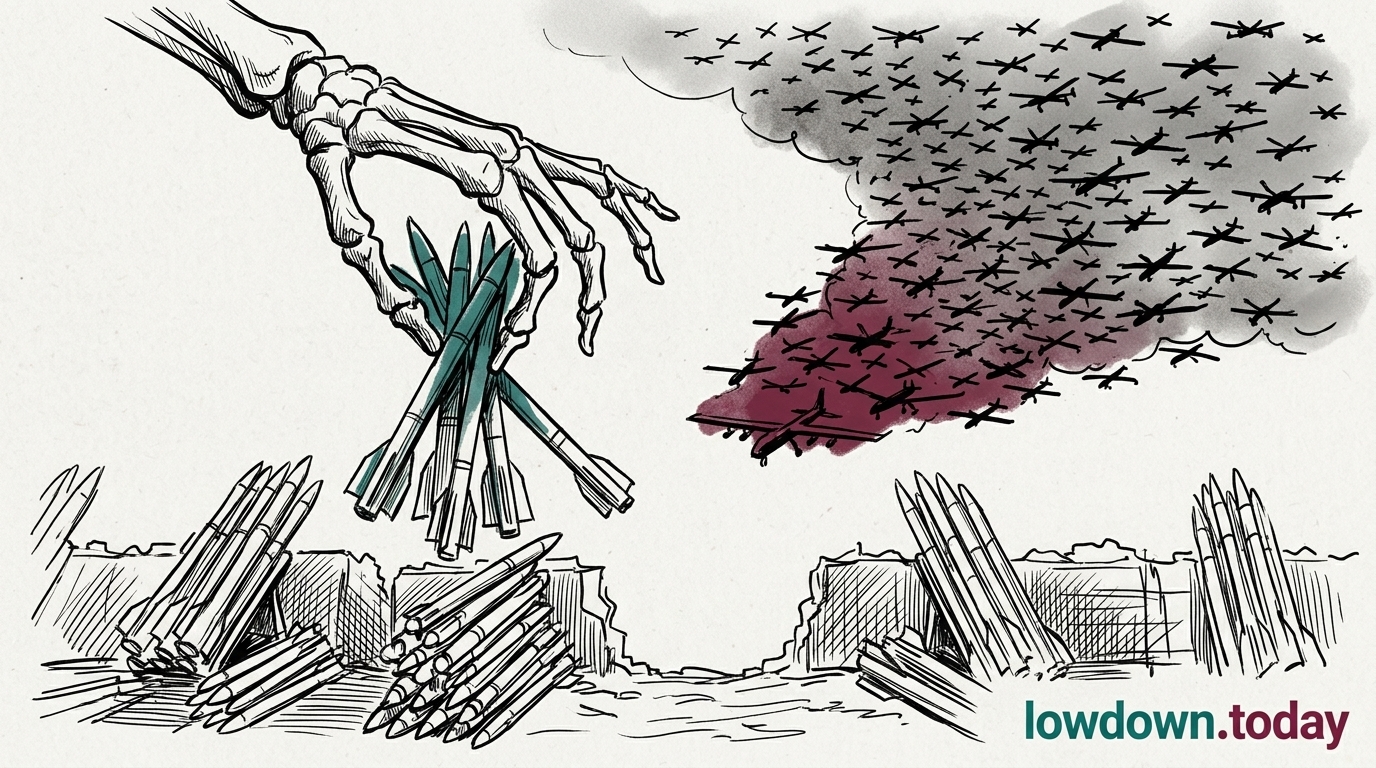
Russia launched 9,616 kamikaze drones in a single day on 17 March — a 9% increase over early March, confirming that last year's surge capacity is now the daily operating tempo.

Sources profile:This story draws on neutral-leaning sources

The front recorded 171 combat engagements on 17 March, with 9,616 kamikaze drones, 200 guided aerial bombs in 70 airstrikes, and 3,715 shellings including 98 MLRS attacks. At least 11 people were killed and 55 injured in Russian attacks that day.

Daily kamikaze drone volumes have settled above 9,000 as routine rather than surge, while 200 guided aerial bombs per day represent the one weapon category Ukraine cannot reliably intercept — establishing a sustained attritional bombardment rate that both military positions and civilian infrastructure must absorb indefinitely. 

Sources:Ukrainian Ministry of Defence (mod.gov.ua)
1 Ukrainian Ministry of Defence (mod.gov.ua)

Mediazona's independently verified count of Russian military dead passes 200,000 while Russia loses 9,000 more soldiers per month than it can recruit — a deficit compounding into a question of how long offensive tempo holds.

Sources profile:This story draws on mixed-leaning sources from Georgia
Georgia
LeftRight

Mediazona confirmed 203,300 Russian deaths by 13 March from publicly verifiable sources, including 6,912 officers. The Ukrainian General Staff's cumulative estimate reached approximately 1,282,570 Russian casualties by 18 March. Commander-in-Chief Syrskyi reported Russia lost an estimated 31,700 personnel in January against roughly 22,700 recruited — a net monthly deficit of 9,000.

The crossing of 200,000 verified Russian dead — alongside a confirmed net recruitment deficit of 9,000 per month — raises concrete questions about how long Russia can sustain current offensive intensity without general mobilisation or a fundamental change in force generation. 

Sources:Mediazona / BBC Russian·OC Media
1 Mediazona / BBC Russian2 UNITED24 Media

Approximately 2,600 individuals and entities remain designated, with the extension covering the critical months when the EU's phased Russian gas ban is scheduled to take full effect.

Sources profile:This story draws on neutral-leaning sources

The EU separately extended sanctions on approximately 2,600 individuals and entities related to Russia through 15 September 2026.

The extension maintains the legal framework for Europe's economic pressure campaign through the period when the LNG and gas bans are being implemented, reducing opportunities for individual member states to extract concessions. 

Sources:EU Council
Closing comments

The next four to six weeks concentrate several escalation vectors. Russia's force concentration in Zaporizhzhia, combined with reserves massing near Pokrovsk and Myrnohrad, suggests a dual-axis offensive push before rasputitsa fully constrains armoured movement. Ukraine's four strikes on Krasnodar Krai fuel infrastructure in one week target the logistics sustaining those forward concentrations. Russia's net personnel deficit of 9,000 per month means concentrated forces cannot be sustained indefinitely without mobilisation, creating pressure to commit them before attrition degrades offensive capacity. The political calendar compounds the military one: the 11 April sanctions waiver expiry, 12 April Hungarian elections, and 25 April EU gas ban launch create a compressed decision window where economic, political, and military pressures converge simultaneously.

Emerging patterns

  • Iran war creating economic leverage for Russia against sanctions regime
  • EU unity under strain but holding on major financial commitments to Ukraine
  • European air defence alternatives to US Patriot system emerging
  • Iran war reversing Russian revenue decline from early 2026
  • Ukrainian southern counteroffensive disrupting Russian operational plans
  • Ukrainian deep-strike campaign against southern Russian fuel logistics
  • Sanctions evasion through shadow fleet and compliant EU-legal carriers
  • European defence industrial partnerships with Ukraine expanding
  • Continued Russian territorial gains on Pokrovsk axis toward open steppe
  • Delayed accountability for Russian occupation atrocities
Different Perspectives
US Treasury
US Treasury
Issued sanctions waivers for 124 million barrels of Russian oil, initially for Indian refineries then expanded globally within a week — the first US-initiated relaxation of Russian energy sanctions since the full-scale invasion.
France
France
Committed eight SAMP/T NG anti-aircraft systems — accepted by the French Air and Space Force only in late February — directly to a combat zone for battlefield testing. Untested next-generation systems are rarely deployed to active theatres.
Hungary
Hungary
Dropped its blockade of the €90 billion EU loan after Zelenskyy committed to Druzhba pipeline repairs, ending a standoff that froze the package since February. The concession was transactional, not a shift in Budapest's stance toward Kyiv.
