
Skip to content
Briefings are running a touch slower this week while we rebuild the foundations.See roadmap
Russia-Ukraine War 2026
15MAR

Day 1481: Ukraine pivots to drone exporter

6 min read
06:46UTC

Ukraine deployed counter-drone crews to four Gulf states and fielded arms requests from eleven countries within a fortnight, pivoting from aid recipient to exporter. Storm Shadow cruise missiles struck Kremniy El, a key Iskander guidance chip manufacturer in Bryansk. Russia sustained over 9,000 weekly drone launches against Ukrainian cities as trilateral peace talks remained frozen.

Key takeaway

Ukraine's counter-drone expertise has become a tradeable strategic asset linking the Iran and Ukraine conflicts into a single economic and military circuit, altering the incentive structure for all parties.

This briefing mapped
Loading map…
Military
Economic
Diplomatic

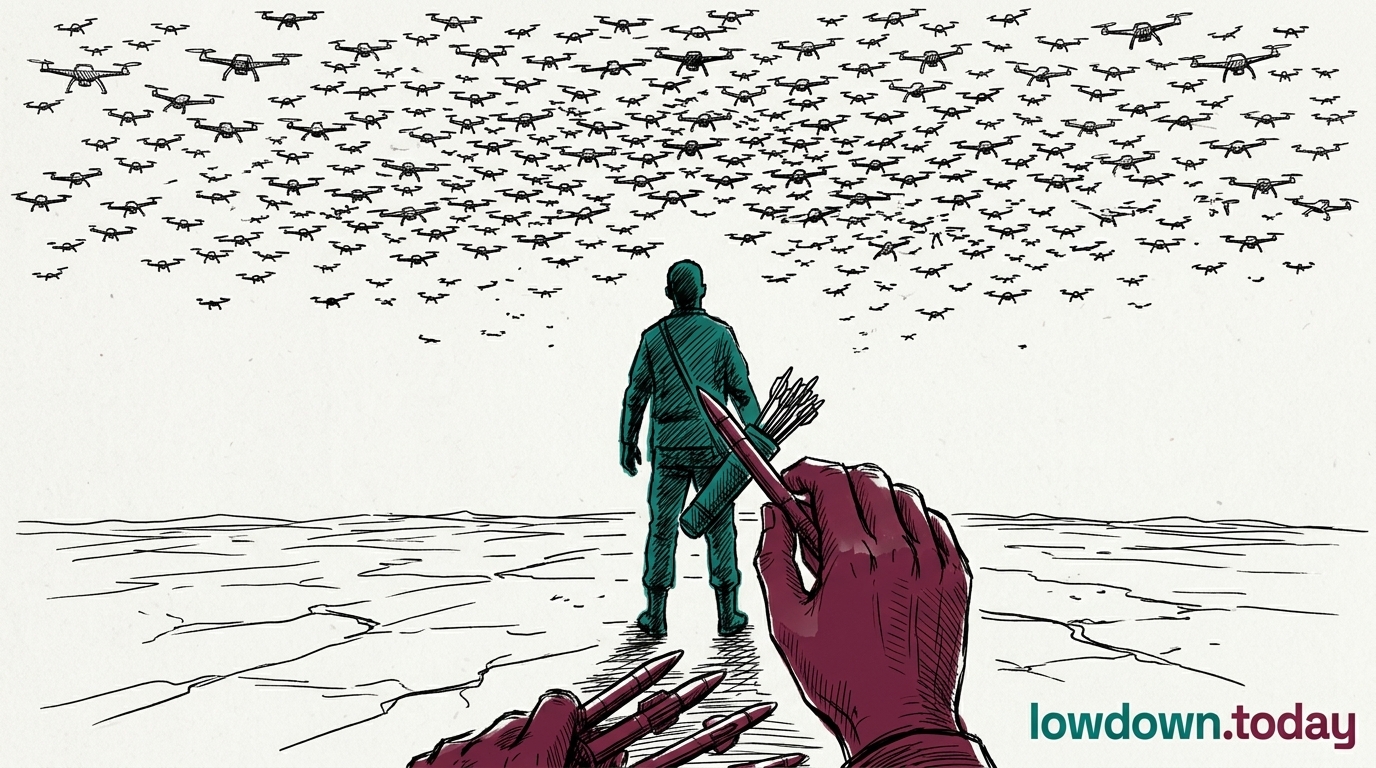
The country that spent three years asking for Patriot batteries is now running counter-drone operations across four Gulf states — against the same drones Russia fires at its own cities.

Sources profile:This story draws on centre-left-leaning sources from Qatar, Ukraine and 1 more
QatarUkraineUnited States
LeftRight

Ukrainian counter-drone crews physically deployed in Qatar, Saudi Arabia, the UAE, and at a US base in Jordan, operating interceptor systems against Iranian drone attacks on the same targets that Russian satellite intelligence is helping Iran strike.

Ukraine has moved from requesting air defence to providing it, deploying crews in four Gulf States where they defend targets that Russian intelligence helps Iran attack — creating a direct military intersection of the two wars. 

Briefing analysis

After the 1973 Yom Kippur War, Israel — then heavily dependent on foreign arms — accelerated domestic weapons development and within a decade became one of the world's top ten defence exporters. The catalyst was identical: a besieged state refined technology under live combat conditions, then found export markets among nations facing similar threats. Israel's defence exports reached $13 billion annually by 2023, accounting for roughly 2% of GDP.

Ukraine's trajectory differs in one respect: Israel built its export industry over decades of post-war stability, while Ukraine is attempting the same pivot mid-conflict, with active combat consuming its production capacity.

Storm Shadow cruise missiles struck one of Russia's few domestic military semiconductor plants, targeting the guidance chips for Iskander missiles and Pantsir air defence — systems Russia cannot replace under Western sanctions.

Sources profile:This story draws on centre-left-leaning sources from Ukraine and United States
UkraineUnited States
LeftRight

Ukrainian forces struck the Kremniy El microelectronics plant in Bryansk on 10 March with Storm Shadow cruise missiles. The plant is one of Russia's largest military microelectronics manufacturers, producing semiconductor components for Iskander missile guidance and Pantsir air defence systems. Zelenskyy confirmed the target was hit and production facilities significantly damaged. Six people were killed and 42 wounded in Bryansk across seven Storm Shadow impacts. Whether Russia holds redundant fabrication capacity will become apparent from satellite imagery in coming weeks.

The strike targeted Russia's semiconductor supply chain rather than expendable launchers or ammunition. Military-grade chip fabrication equipment is Western-made and embargoed; confirmed destruction of Kremniy El's production lines would constrain Iskander and Pantsir manufacturing within months. 

Their first call of 2026 produced proposals on Iran from Putin, a redirect to Ukraine from Trump, and agreement on nothing.

Sources profile:This story draws on centre-left-leaning sources from United States, Latvia and 1 more (includes China state media)
United StatesLatviaChina

Putin and Trump held their first phone call of 2026 on 9 March, lasting one hour. Putin offered proposals for ending the Iran war. Trump responded that Putin could be more helpful by ending the war in Ukraine. Putin stated Russian forces were 'advancing quite successfully,' framing Kyiv as the party that should concede. No commitments were made on either conflict. Beijing's Global Times framed the exchange as the US needing Russia's help to stabilise energy markets.

The call demonstrated that neither leader will offer concessions on the conflict the other prioritises, leaving both the Ukraine war and the Iran conflict without an active diplomatic track. 

Eleven governments — from Iran's neighbours to the United States — have formally asked Kyiv for counter-drone help, a demand curve that barely existed a fortnight ago.

Sources profile:This story draws on mixed-leaning sources from Qatar and United States
QatarUnited States
LeftRight

Zelenskyy confirmed on 9 March that 11 countries — including neighbours of Iran, EU member states, and the United States — have formally requested Ukrainian counter-drone assistance.

The breadth and speed of formal requests reveal a structural gap in Western and Gulf air defences that Ukraine's low-cost interceptor technology can fill, giving Kyiv new diplomatic leverage as peace talks remain frozen. 

Russia is feeding Iran satellite targeting data precise enough to guide strikes on US installations — the same installations Ukrainian counter-drone crews are now defending.

Sources profile:This story draws on mixed-leaning sources from United States and Qatar
United StatesQatar

The Foundation for Defense of Democracies reported on 12 March that Russia is providing Iran with satellite targeting data from Moscow's satellite constellation, imagery detailed enough to guide strikes on US command posts, radar sites, and what FDD described as a CIA station in Riyadh. The underlying intelligence transfer is corroborated by Al Jazeera and Kyiv Independent. FDD is a hawkish Washington institution; specific characterisations should be read as advocacy.

Russia's satellite intelligence support to Iran directly links both wars' operational theatres. Moscow helps target the same installations that Ukrainian crews — using expertise built by enduring Russian Shahed attacks — are now defending across the Gulf. 

Sources:FDD·Al Jazeera

Ukrainian forces reclaimed 460 square kilometres in Zaporizhzhia — the first net territorial gain since 2023 — forcing Russia to pull elite units from its Donetsk offensive.

Sources profile:This story draws on mixed-leaning sources from Russia, Ukraine and 1 more (includes Ukraine state media)
RussiaUkraineUnited States
LeftRight

The Institute for the Study of War assessed that Ukrainian counterattacks in the Zaporizhzhia sector have 'significantly complicated Russia's plans' for a spring offensive toward Orikhiv. Ukrainian forces advanced 10–12 km in two drives through Dnipropetrovsk Oblast, reclaiming 460 sq km and eight settlements since late January — the first net territorial gain since the 2023 counteroffensive. Russia redeployed elite airborne and naval infantry away from the eastern Donetsk axis to counter the southern advance.

Ukraine's first net territorial gain since 2023 forces Russia to redeploy from its Donetsk offensive, creating a strategic trade-off Moscow's shrinking force cannot easily absorb. 

Sources:RBC·Ukrinform·ISW

Russia launched 430 drones and 68 missiles at Ukraine's energy grid in a single night — the heaviest combined strike in months, with ceasefire talks frozen and no restraint in sight.

Sources profile:This story draws on mixed-leaning sources from United States
United States

Russia launched 430 drones and 68 missiles at Ukraine on the night of 13–14 March — the heaviest combined barrage in months — including one Zirkon hypersonic, 7 Iskander-M ballistic, 25 Kalibr cruise, and 24 Kh-101 cruise missiles. Ukrainian air defences intercepted 402 drones and 58 missiles. Four people were killed and 15 wounded in Kyiv region. Energy infrastructure was the primary target across four districts. Weekly Russian drone volumes now exceed 9,000.

Russian drone and missile volumes have tripled year-on-year, and the heaviest combined barrage in months struck Energy infrastructure with no diplomatic process imposing restraint. The interceptor cost asymmetry — cheap drones against expensive defensive missiles — compounds supply pressures the Iran war has already created for Western air defence stocks allocated to Ukraine

Sources:NPR·ISW
1 NPR2 NPR

At $1,000 per interceptor versus $13.5 million for a Patriot round, the economics are doing the diplomacy's work for it.

Sources profile:This story draws on centre-left-leaning sources from Ukraine
Ukraine

A Saudi arms company signed a deal for Ukrainian interceptor missiles. Kyiv Independent reported a separate 'huge deal' under negotiation between Saudi Arabia and Ukraine.

Saudi Arabia's arms purchases from Ukraine signal the emergence of a wartime defence export market that could generate independent revenue for Kyiv and reduce its dependence on Western financial aid, though the 2022 export ban remains formally in place. 

Three Gulf states have approached a Ukrainian manufacturer for thousands of interceptor drones costing $1,000–$2,000 each — against $13.5 million for a single Patriot round.

Sources profile:This story draws on mixed-leaning sources from Ukraine and United States
UkraineUnited States
LeftRight

TAF Industries received direct purchase requests from three Gulf States: the UAE requested 5,000 interceptor drones, Qatar requested 2,000, and Kuwait expressed interest. Ukrainian interceptor drones cost $1,000–$2,000 per unit versus $13.5 million for a PAC-3 MSE round.

The cost disparity between Ukrainian interceptor drones and legacy Western air defence rounds is generating commercial demand that could reshape Ukraine's wartime economy and the global counter-drone market. 

A facility processing 2% of Russia's refining output caught fire as Kyiv's drone campaign compounds a 32% year-on-year collapse in Russian energy revenues.

Sources profile:This story draws on centre-left-leaning sources from Ukraine
Ukraine

Ukrainian drones struck the Afipsky refinery in Krasnodar Krai on the night of 14 March. The refinery is one of southern Russia's largest, processing 6.25 million tonnes annually — approximately 2% of national refining output. Fire was confirmed. Russia's Ministry of Defence claimed 87 Ukrainian drones were intercepted during the operation, including 31 over the Sea of Azov.

The Afipsky strike compounds a 32% year-on-year decline in Russian energy revenues five weeks before the EU's phased ban on Russian gas begins on 25 April, further degrading the refining infrastructure Russia needs to export higher-margin products. 

Russia lost 30,600 personnel in January against 22,000 recruited — a net monthly deficit that constrains multi-front operations without a second formal mobilisation.

Sources profile:This story draws on mixed-leaning sources from Ukraine and United States (includes Ukraine state media)
UkraineUnited States

The Ukrainian General Staff estimates 1,278,430 cumulative Russian casualties as of 14 March. In January 2026, Russia lost an estimated 30,600 personnel against roughly 22,000 recruited — a net deficit of approximately 8,600 per month. Figures sourced from Ukrainian Unmanned Systems Forces via Kyiv Independent.

Russia's monthly casualty deficit of approximately 8,600 raises the question of whether Moscow can sustain three-axis operations without a second mobilisation — a step the Kremlin has avoided since September 2022 because of the domestic political cost. 

Sources:Ukrinform·ISW

The same drone operation that set Afipsky refinery ablaze also hit Port Kavkaz — the ferry crossing that grew more critical after two attacks on the Kerch Bridge.

Sources profile:This story draws on centre-left-leaning sources from Ukraine
Ukraine

Ukrainian drones struck Port Kavkaz on the Chushka Spit in the Kerch Strait on the night of 14 March. Three people were wounded and a vessel was damaged. The port services the Crimea ferry crossing and is a logistics artery for the Russian occupation of Crimea.

Port Kavkaz is the primary ferry alternative to the twice-damaged Kerch Bridge for resupplying Russian forces in Crimea. Coordinated with the Afipsky refinery strike, the attack pressures both economic and military logistics targets in a single operation. 

An 11-year-old and her mother died when a Russian aerial bomb struck their apartment building — part of a daily bombardment that dropped 264 such weapons across Ukraine in a single day.

Sources profile:This story draws on centre-left-leaning sources from Qatar and Ukraine
QatarUkraine

Three Russian guided aerial bombs struck central Sloviansk on 10 March, one hitting an apartment building. Four people were killed — including a mother and her 11-year-old child — and 16 were wounded. Six residential buildings were damaged. Russia dropped 264 guided aerial bombs across Ukraine on 9 March alone.

Sustained glide-bomb bombardment of the KramatorskSloviansk defensive anchor — 264 bombs in a single day — is destroying the urban infrastructure of the cities Russia demands as ceasefire preconditions, at volumes that exceed Ukrainian interception capacity. 

Ukraine banned weapons exports in 2022 to keep every round for its own survival. Gulf demand and fiscal pressure are now forcing a rethink.

Sources profile:This story draws on mixed-leaning sources from Ukraine and United States
UkraineUnited States
LeftRight

Ukraine is discussing the creation of a state-regulated arms export market. The National Security and Defence Council will determine what weapons can be exported without weakening domestic air defence. No formal lifting of the 2022 weapons export ban has occurred.

A state-regulated Ukrainian arms export market would generate revenue, reduce dependence on Western aid, and strengthen Kyiv's negotiating position — but risks weakening domestic air defence while Russian strike volumes are at record levels. 

The General Assembly voted 107–12 for an immediate ceasefire on the war's fourth anniversary. The United States — which had previously voted in favour — abstained.

Sources profile:This story draws on neutral-leaning sources

The UN General Assembly adopted a ceasefire resolution on 24 February — the war's fourth anniversary — demanding an immediate ceasefire in Ukraine. The vote was 107 in favour, 12 against, 51 abstentions. The United States abstained.

The US abstention signals a shift in Washington's diplomatic posture on Ukraine, while the suspended trilateral and the approaching EU gas ban on 25 April leave the conflict without a functioning negotiation track. 

Closing comments

Three escalation vectors are converging. First, Ukraine's deep strikes on Russian production infrastructure (Kremniy El, Afipsky) represent a shift from attrition to strategic interdiction — degrading Russia's capacity to wage war rather than defending against attacks. Second, Russia's drone volumes have tripled year-on-year with no diplomatic brake; the 9,000-per-week rate is industrialised bombardment that consumes Ukrainian air defence stocks faster than they are replenished. Third, Ukraine's physical military presence in Gulf states opposing Russia's ally Iran creates a new escalation surface — Moscow may treat Ukrainian crews intercepting Iranian drones as a proxy confrontation requiring a response beyond the Ukrainian theatre. The frozen trilateral means none of these vectors has a diplomatic off-ramp.

Emerging patterns

  • Ukraine transitioning from aid recipient to active security provider in the Gulf, defending the same positions Russia is helping Iran target
  • Ukrainian deep interdiction targeting Russian military-industrial production capacity rather than launchers
  • Great-power diplomatic stalemate across simultaneous conflicts with no convergence on either
  • Rapid internationalisation of Ukrainian counter-drone expertise beyond initial bilateral offers
  • Russia-Iran military-intelligence integration deepening, with Russian satellite assets serving dual use across the Ukraine and Iran theatres
  • Ukrainian operational initiative in the south forcing Russian defensive redeployment and disrupting spring offensive plans — Russia cannot advance everywhere with a shrinking force
  • Sustained Russian escalation of combined drone-missile barrages targeting energy infrastructure, with no active diplomatic process imposing restraint on strike tempo
  • Gulf states diversifying air defence supply chains away from exclusive reliance on Western systems
  • Ukrainian defence industry commercialising wartime counter-drone innovation for export
  • Ukrainian targeting of Russian energy refining infrastructure to compound revenue pressure ahead of EU gas ban
Different Perspectives
Gulf states
Gulf states
Saudi Arabia, the UAE, Qatar, and Kuwait are purchasing weapons from Ukraine — a country they have no defence alliance with — breaking decades of near-exclusive reliance on American and European arms suppliers.
United States
United States
The US abstained on UNGA Resolution 107-12-51 demanding an immediate ceasefire in Ukraine. Its representative stated: 'Ending the war is the right thing to do, but no one is suggesting it will be easy.'
Ukraine
Ukraine
Officials are discussing a state-regulated arms export market, reversing the 2022 ban enacted to preserve domestic stocks. Physical crew deployments in four Gulf states are already underway before any formal legislative change.