Skip to content
Briefings are running a touch slower this week while we rebuild the foundations.See roadmap
Russia-Ukraine War 2026
18MAR

Russian arms exports down 64% — SIPRI

4 min read
11:41UTC

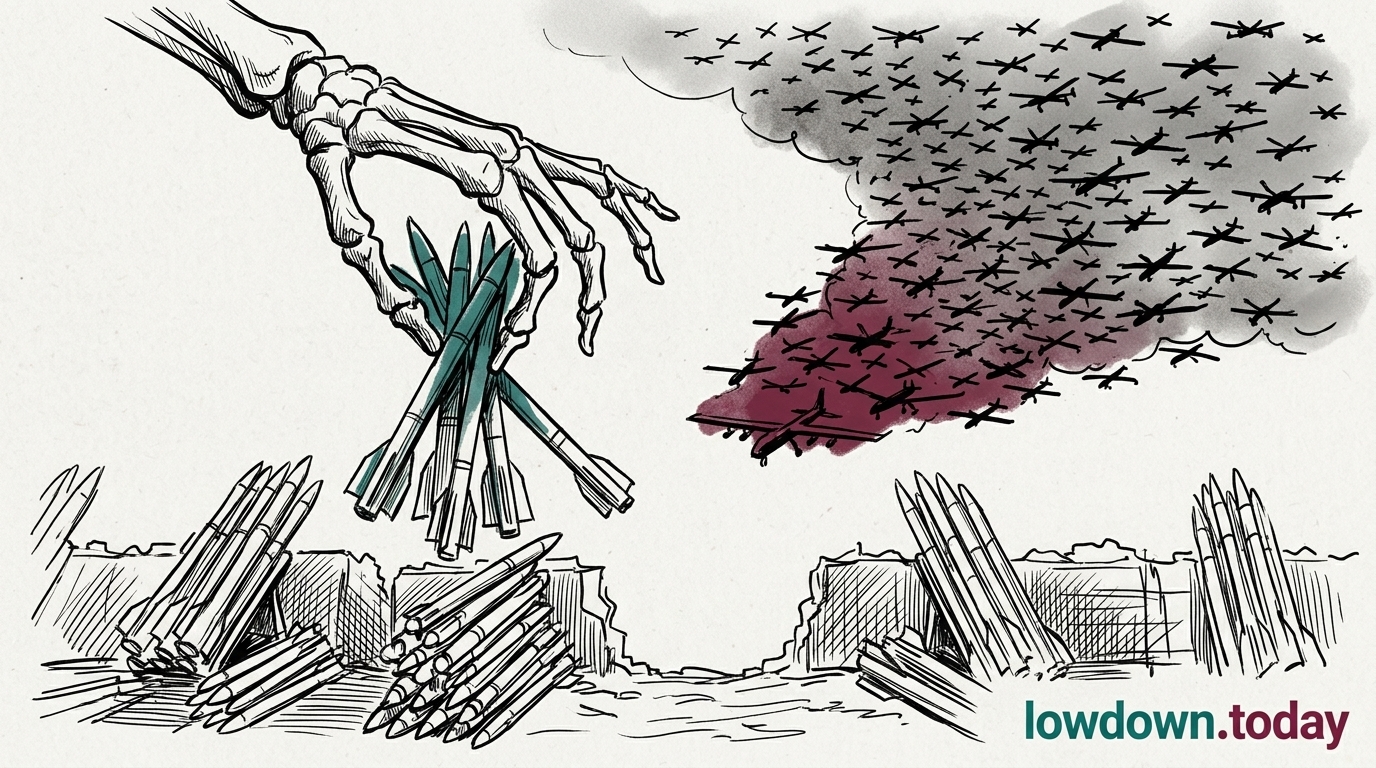
Russia held the world's second-largest arms export market for three decades. SIPRI data shows it has lost 64% of that trade while EU exports outpace even America's growth.

ConflictDeveloping
Key takeaway

Russian arms exports have structurally collapsed — demand destruction, not production failure, is the primary driver.

SIPRI data released on 9 March confirmed that Russian arms exports fell 64% over the most recent five-year measurement period 1. The decline ends three decades in which Russia held the world's second-largest arms export market, supplying India, Algeria, Egypt, Vietnam, and dozens of states that chose Soviet-legacy platforms for cost, strategic autonomy, or both.

Three forces drove the collapse. The war in Ukraine consumes domestic production — armoured vehicles, artillery systems, and precision munitions that would fill export contracts are absorbed by a front line that has destroyed thousands of platforms. Western sanctions on microelectronics and machine tools have constrained manufacturing; the strike on the Kremniy El semiconductor plant in Bryansk hit one of Russia's few remaining domestic sources of military-grade microelectronics. And battlefield performance has eroded buyer confidence — Russian air defence systems, armour, and electronic warfare equipment have failed against Ukrainian countermeasures in conditions prospective customers can observe through open-source intelligence.

India, historically Russia's largest arms customer, has accelerated diversification. New Delhi now flies French Rafale fighters, operates American Apache helicopters, and is expanding domestic Tejas production. The S-400 system — once Russia's flagship export programme — has faced repeated delivery delays. When a supplier's own military consumes output faster than factories can produce, commercial reliability erodes regardless of price.

EU member states' arms exports grew 36%, outpacing the US at 27% and China at 11% 2. Gulf States that historically purchased American or Russian systems are now buying Ukrainian interceptor drones at $1,000–$2,000 per unit , and Saudi Arabia has signed a separate deal for Ukrainian interceptor missiles . The global arms market is reorganising around the two active wars consuming its inventory — and Russia is losing customers to competitors whose equipment those wars are simultaneously validating.

Deep Analysis

In plain English

Russia was one of the world's top arms sellers for decades, exporting fighter jets, tanks, and air defence systems to customers across Asia, Africa, and the Middle East. The war in Ukraine changed that in two distinct ways. First, customers watching Russian equipment — tanks, helicopters, missiles — fail against Ukrainian forces concluded that Russian arms were less effective than advertised. Second, the threat of US and EU sanctions on buyers of Russian military equipment made procurement politically risky even for governments that wanted to buy. The combined result is a 64% fall in Russian arms exports over five years. Meanwhile, European defence companies that were minor global exporters before 2022 are now growing faster than either the US or China — absorbing orders that would previously have gone to Moscow.

Deep Analysis
Synthesis

The SIPRI data marks the structural end of Russia as a peer competitor in the global arms market. More significantly, EU export growth of 36% — outpacing both the US and China — signals the emergence of a genuinely competitive European defence industrial base. This was a stated goal of the EU Strategic Compass adopted in 2022 but was not expected to materialise within a single procurement cycle. The Ukraine war has compressed a generation of industrial development, validating EU platforms in combat conditions and creating order backlogs that will sustain European defence industries into the 2030s regardless of how the conflict ends.

Root Causes

Three structural forces drive the decline, none addressed in the body. First, demonstrated battlefield performance failures — T-72 and T-80 tank losses at scale, Kinzhal missile intercepts by Patriot, Ka-52 helicopter attrition — destroyed the export marketing value of Russia's flagship platforms; arms buyers purchase on combat reputation. Second, US and EU secondary sanctions on purchasers of Russian military equipment made procurement politically costly even for non-aligned states, with India's S-400 purchase triggering CAATSA scrutiny and deterring subsequent buyers. Third, Russia diverted export-designated inventory to domestic use, breaching delivery contracts with India, Algeria, and Egypt — permanently impairing its reliability as a supplier in ways that outlast any single political calculation.

What could happen next?
  • Consequence

    Countries with deep maintenance dependencies on Russian platforms — India, Algeria, Vietnam — face progressively costly fleet transitions as spare-parts sanctions ground existing inventories.

    Medium term · Assessed
  • Precedent

    EU export growth at 36% establishes European defence industry as a genuine third tier in global arms markets, ending the effectively bipolar US-Russia structure that dominated from 1991 to 2022.

    Long term · Suggested
  • Opportunity

    Countries cancelling or deferring Russian contracts — particularly in fighter aircraft and integrated air defence — represent an immediate sales opportunity for EU manufacturers before Chinese alternatives consolidate those markets.

    Short term · Suggested
  • Risk

    EU export acceleration to conflict-adjacent regions could draw Brussels into secondary proliferation accountability debates currently focused on Russian and Chinese transfer patterns.

    Medium term · Suggested
First Reported In

Update #5 · Trump frees 124m barrels; Russia earns €6bn

SIPRI· 18 Mar 2026
Read original
Different Perspectives
NATO eastern flank (B9 + Nordics)
The B9+Nordic Bucharest joint statement on 13 May reaffirmed Ukraine's sovereignty within internationally recognised borders and backed NATO eastern flank reinforcement; the summit accepted Zelenskyy's bilateral drone deal proposal as a structural alternative to the stalled US export approval pathway, treating it as a European defence architecture question rather than aid delivery.
IAEA / Rafael Grossi
Grossi is still negotiating a sixth ZNPP repair ceasefire with no agreement after 50 days of 750 kV line disconnection; the 3 May ERCL drone strike that destroyed environmental monitoring equipment represents a qualitative escalation in infrastructure degradation that the IAEA has documented but cannot compel either party to halt.
Péter Magyar / Hungary
Magyar's incoming foreign minister pledged on 12 May that Hungary will stop abusing EU veto rights; the pledge is a statement of intent rather than a binding legal commitment, and Magyar's MEPs voted against the €90 billion loan as recently as April, while a planned referendum on Ukraine's EU accession preserves a downstream blocking lever.
EU Council and European Commission
The Magyar cabinet formation on 12 May removes the Hungary veto that had blocked the €9.1 billion first tranche since February; the Commission is now coordinating the three-document disbursement package for an early-June vote. The structural blocker is gone; the disbursement question is now scheduling, not politics.
Donald Trump / White House
Trump announced a 9-11 May three-day ceasefire with a 1,000-for-1,000 prisoner exchange attached, then called peace 'getting very close' on 11-13 May while Russia's 800-drone barrage was under way; his public framing adopted Russian diplomatic language without securing any Russian operational concession or verifying the exchange was agreed.
Vladimir Putin / Kremlin
Putin told reporters on 9 May the war is 'coming to an end' while Peskov confirmed on 13 May that territorial demands are unchanged and Russia requires full Ukrainian withdrawal from all four annexed regions; the verbal accommodation costs Moscow nothing and conditions any summit on a pre-finalised treaty Kyiv cannot accept.
