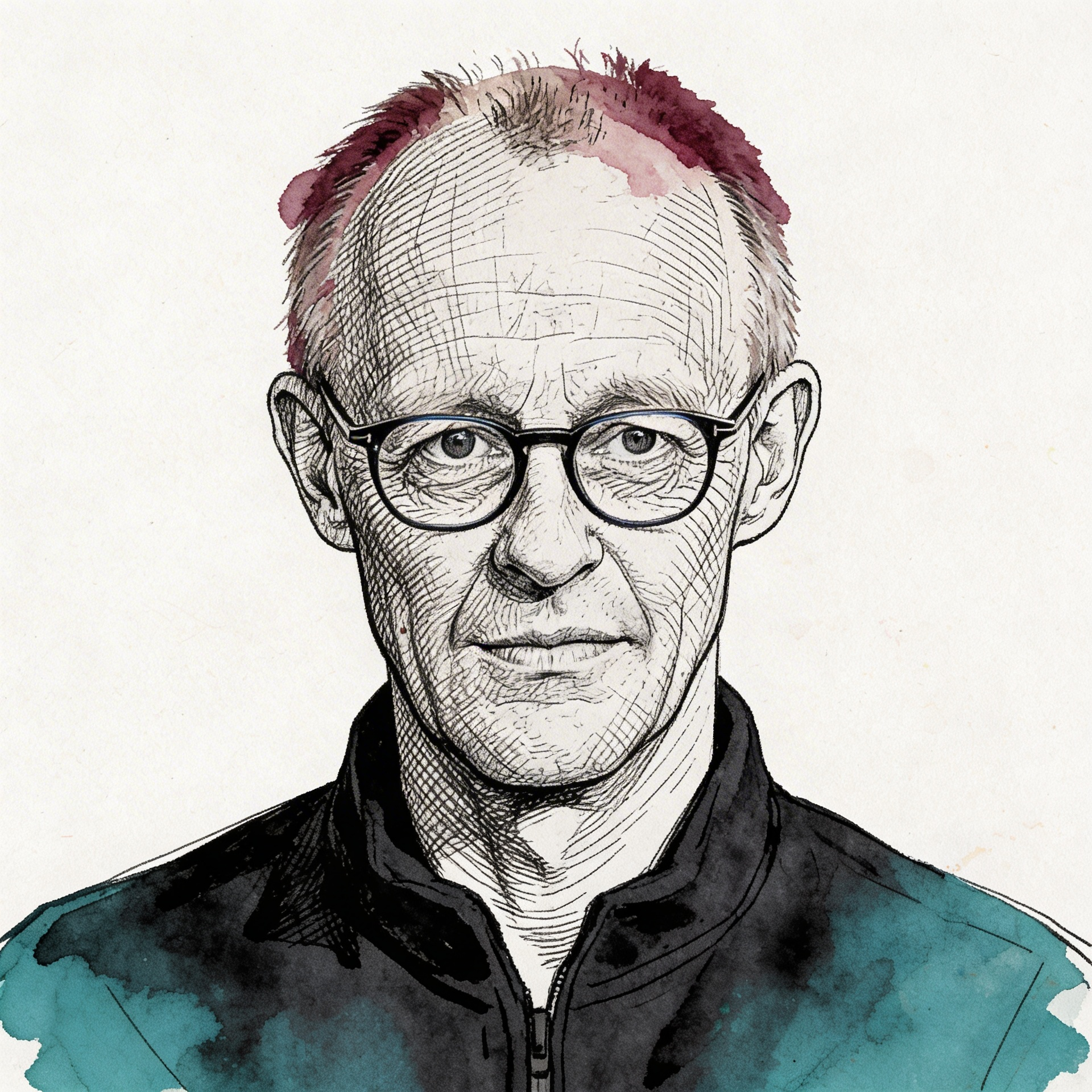
Friedrich Merz
German Chancellor since May 2025 and leader of the CDU since January 2022.
Merz was in Kyiv on 4 October 2026, where the German ground-robot maker ARX Robotics widened its partnership with Ukraine's Roboneers. The trip extends a Ukraine policy built on joint arms production, from the €4bn package he hosted in Berlin on 14 April.
Last refreshed: 7 October 2026 · Appears in 4 active topics
The E3 framework accepts Russia's current contact line; did Merz just concede Ukrainian territory?
Timeline for Friedrich Merz
Mentioned in: ARX delivers first GEREONs to Ukraine
Autonomous Systems: Land & SeaPutin says no as Europe draws a line
Russia-Ukraine War 2026Attended the 40-nation Hormuz conference in Paris
Iran Conflict 2026: Paris conference, 40 nations, no USMentioned in: SPD threatens to block German 10 GW gas plant law
European Energy MarketsAttended the Berlin signing alongside Zelenskyy
Russia-Ukraine War 2026: Germany signs €4bn for Ukraine, routes Raytheon directlyBackground
Friedrich Merz became Chancellor of Germany on 6 May 2025 at the head of a CDU/CSU-led Coalition with the SPD, and has led the Christian Democratic Union since 31 January 2022. War in Ukraine, European rearmament and Coalition friction over energy have shaped his chancellorship.
On Russia he holds a hard line on sanctions. When the US Treasury issued 30-day waivers on Russian oil sanctions in March 2026, he said: 'Easing sanctions now, for whatever reason, is wrong.' He argues that Europe, which funds more of Ukraine's war effort than the United States, must take part in any settlement, while the US-Russia-Ukraine trilateral format leaves the EU outside.
His own Coalition partner has also pushed back at home: on 16 April 2026 the SPD-led Environment Ministry threatened to block his government's 10 GW gas-plant law. German combat deployments need Bundestag approval, so his weight in Ukraine diplomacy rests on money, sanctions and arms production, including the €4bn package signed in Berlin on 14 April 2026. In March 2026 he called Iran 'a terrorist regime' but declined any German role in the US military campaign against it.
Merz backs joint production with Kyiv
Merz travelled to Kyiv on 4 October 2026. During the visit ARX Robotics and the Ukrainian maker Roboneers signed a wider technology partnership, on top of the joint venture the two formed in June. ARX had delivered its first GEREON ground robots to Ukraine on 29 September, 12 weeks after production began in Ulm.
For Merz, the visit put a German industrial deal at the centre of a diplomatic trip. His government had already tied its support to output: the €4bn package signed in Berlin on 14 April 2026 centred on a roughly €3.2bn Raytheon contract for GEM-T Patriot interceptors, bought as a direct commercial sale outside the US military sales queue, and included joint production of 5,000 mid-range strike drones.
Merz demands a European seat
On 3 March 2026 Merz used a White House visit to set two conditions: Europe would not accept a Ukraine deal concluded without it, and Ukraine's territory must be preserved. He has no troops to offer, because the Bundestag must approve any combat deployment, so his leverage runs through sanctions relief and European reconstruction money.
On 7 June he co-signed, with the British and French leaders, an E3 five-point framework whose second point takes the current line of contact, not Ukraine's 1991 borders, as the starting point for talks. Putin had rejected direct talks with Zelenskyy two days earlier. The contact-line clause sits uneasily beside his March insistence on territorial Integrity, and Kyiv treats it with more caution than his sanctions record.
His coalition splits over gas plants
Merz's government answered the Iran war's fuel shock with a €1.6bn relief package approved on 13 April 2026: a 17-cent-a-litre petrol tax cut for two months, an employer fuel bonus and limits on price changes at petrol stations. It was the first European fiscal response tied directly to the war's fuel prices.
The package left gas storage untouched. On 16 April the SPD-led Environment Ministry threatened to block his Economy Ministry's draft law for a 10 GW auction of hydrogen-capable gas plants by 2032, three years into its preparation. The dispute set his Coalition partner against the long-term fix for Germany's gas-import dependence, while Reden, the country's largest storage site, had only 21 MMCM booked for the following winter.
Who is Friedrich Merz?
What did Germany do about fuel prices in April 2026?
What did Friedrich Merz say at the White House in March 2026?
What is Germany's position on Russian sanctions?
Can Germany send troops to Ukraine under Merz?
What did Friedrich Merz agree to at the E3 Ukraine summit on 7 June 2026?
What is Germany's position on Ukraine peace talks in 2026?
Is Friedrich Merz still Chancellor of Germany?
When did Friedrich Merz visit Kyiv in 2026?


