Skip to content
Briefings are running a touch slower this week while we rebuild the foundations.See roadmap
Russia-Ukraine War 2026
15MAR

Afipsky refinery hit in drone strike

3 min read
06:46UTC

A facility processing 2% of Russia's refining output caught fire as Kyiv's drone campaign compounds a 32% year-on-year collapse in Russian energy revenues.

ConflictDeveloping
Key takeaway

Afipsky supplied the Southern Military District with fuel, making this strike simultaneously economic and operational.

Ukrainian drones struck the Afipsky refinery in Krasnodar Krai on the night of 14 March. The facility is one of southern Russia's largest, processing 6.25 million tonnes of crude annually — approximately 2% of national refining capacity 1. Fire was confirmed at the site. Russia's Ministry of Defence claimed 87 Ukrainian drones were intercepted during the wider operation, including 31 over the Sea of Azov 2.

Afipsky is the latest target in a systematic Ukrainian campaign against Russian refinery infrastructure running since mid-2023. Russian oil and gas revenues had already fallen roughly 32% year-on-year by January 2026, with Urals crude trading below $38 per barrel . Damaged refineries force Russia to export crude at a discount rather than higher-margin refined products. The EU's phased ban on Russian gas imports begins with LNG on 25 April — five weeks from this strike . Russia's energy revenues are contracting from both directions: Western sanctions restricting market access, Ukrainian drones degrading the infrastructure that converts crude into exportable product.

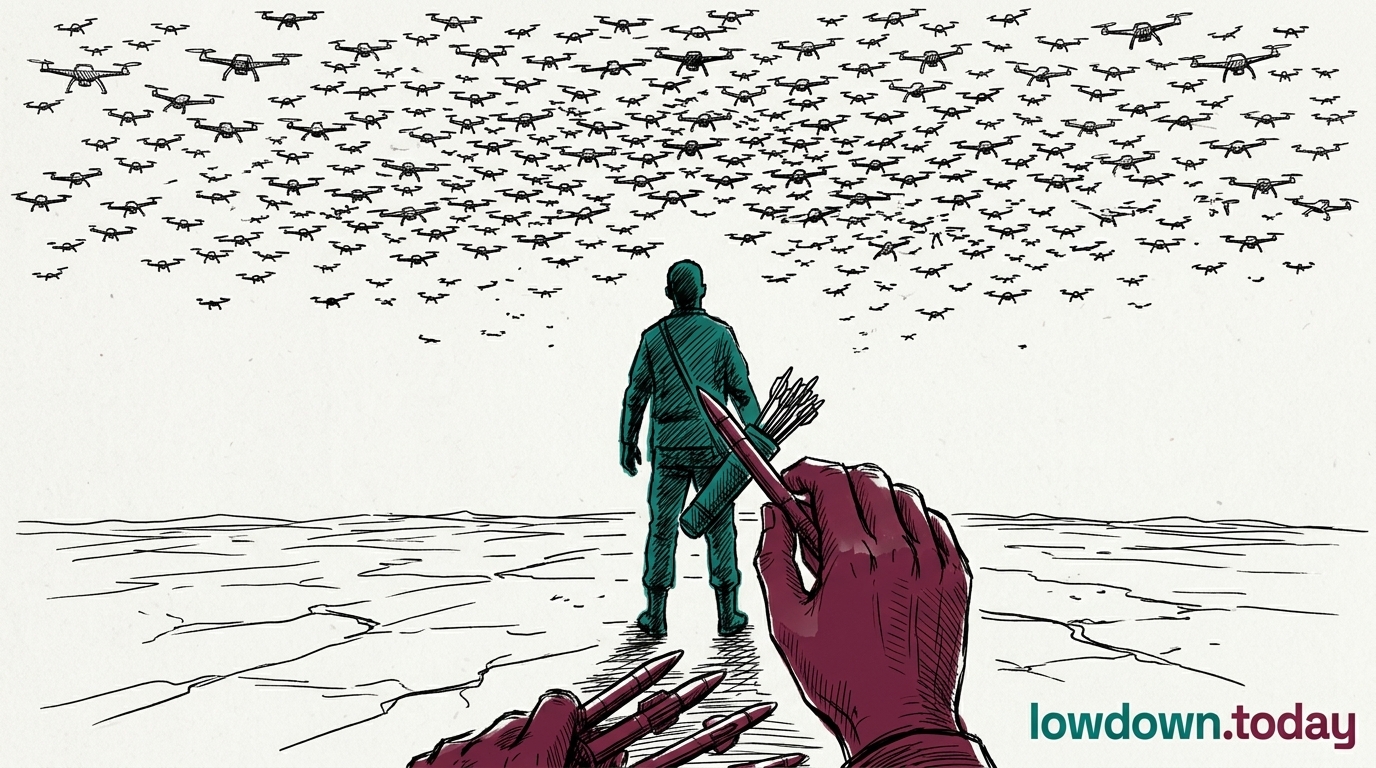
The MoD's claim of 87 intercepts — even if inflated — reveals the scale of the drone swarm Ukraine deployed. The campaign's logic is attritional: each drone costs orders of magnitude less than the refinery infrastructure it targets, and Russia cannot relocate a refinery. It can only attempt to defend it, absorbing air-defence resources that might otherwise protect forward military positions.

Deep Analysis

In plain English

Ukraine struck one of the largest oil refineries in southern Russia, setting it on fire. This matters in two distinct ways. First, it reduces the money Russia earns from refined petroleum products — revenues that fund the war. Second, this specific refinery in Krasnodar Krai supplies fuel to Russian military operations in the Black Sea region and Crimea corridor. Think of it as attacking both the cashbox and the fuel pump of the Russian war machine in the south at the same time.

Deep Analysis
Synthesis

The same-night strikes on Afipsky refinery and Port Kavkaz constitute a deliberate two-vector interdiction of the Crimea logistics corridor: severing fuel supply at the production node while simultaneously choking the primary ferry transport artery. Considered individually, each strike is significant; considered together, they reveal a coherent operational design.

What could happen next?
  • Consequence

    Military fuel supply to Southern Military District operations may face short-term disruption pending rerouting from alternative refineries in the Volga region.

    Immediate · Suggested
  • Consequence

    Cumulative refinery strikes compound the 32% year-on-year oil revenue decline, reducing fiscal resources available for Russian military procurement.

    Short term · Assessed
  • Risk

    If Russia repairs Afipsky within weeks — consistent with the resilience pattern observed after 2024 strikes — the strategic impact is bounded by a temporary production gap rather than sustained capacity loss.

    Short term · Suggested
  • Opportunity

    Coordinated Afipsky-plus-Port Kavkaz targeting creates a window to assess whether Crimea occupation forces experience measurable supply degradation when both fuel production and ferry transport are struck simultaneously.

    Short term · Suggested
First Reported In

Update #4 · Ukraine pivots to drone exporter

Kyiv Independent· 15 Mar 2026
Read original
Causes and effects
This Event
Afipsky refinery hit in drone strike
The Afipsky strike compounds a 32% year-on-year decline in Russian energy revenues five weeks before the EU's phased ban on Russian gas begins on 25 April, further degrading the refining infrastructure Russia needs to export higher-margin products.
Different Perspectives
North Korea / DPRK
North Korea / DPRK
ISW confirmed the first mounting of DPRK Type-75 MLRS on Russian autonomous UGVs near Kharkiv on 7 June, the latest step in a supply axis that escalated from shells in 2023 to troops in 2024. Pyongyang gains live battlefield data on its ordnance and on Russia's uncrewed-systems programme.
IAEA / Rafael Grossi
Grossi confirmed Chornobyl structural damage with nuclear material metres away and could not attribute the ZNPP 15-hour blackout during the agreed repair window. Six ceasefires brokered and broken at ZNPP, compounded by Rosatom's May attack on IAEA neutrality, have eroded his ability to enforce the windows he negotiates.
Emmanuel Macron / France
Macron co-signed the E3 framework whose line-of-contact baseline marks Europe's first formal acceptance that 1991 borders are not the opening position. France's role carries weight because Macron had previously proposed a European force for Ukraine, and the framework's multinational force point is the vehicle for that.
Keir Starmer / E3
Keir Starmer / E3
Starmer, Macron and Merz met Zelenskyy on 7 June and backed a five-point framework taking the line of contact as the talks baseline, conceding roughly one fifth of Ukraine in exchange for a multinational force and frozen assets. With US mediation ended, the NATO Ankara summit on 7-8 July is the next test.
Vladimir Putin / Kremlin
Putin used SPIEF to reject Zelenskyy's summit letter, citing 'elements of rudeness', and repeated the pre-agreed treaty precondition that has frozen every diplomatic round since May. The SPIEF platform's message of investor confidence was punctured by naval fires visible from St Petersburg, which Moscow declined to dispute in scale.
Ukraine / Unmanned Systems Forces
Commander Brovdi confirmed USF units tracked and set fire to Boikyi at Kronstadt, while Code 9.2 struck the Chonhar Bridge the following day. Ukraine is sequencing strikes for rear-area interdiction and political timing rather than ground gains, trading the Baltic Fleet's home base for the logistics squeeze Russia cannot absorb without rationing its own occupied territory.