Skip to content
Briefings are running a touch slower this week while we rebuild the foundations.See roadmap
Russia-Ukraine War 2026
11APR

CEPA scale check: 0.46% of Russian oil

3 min read
16:48UTC

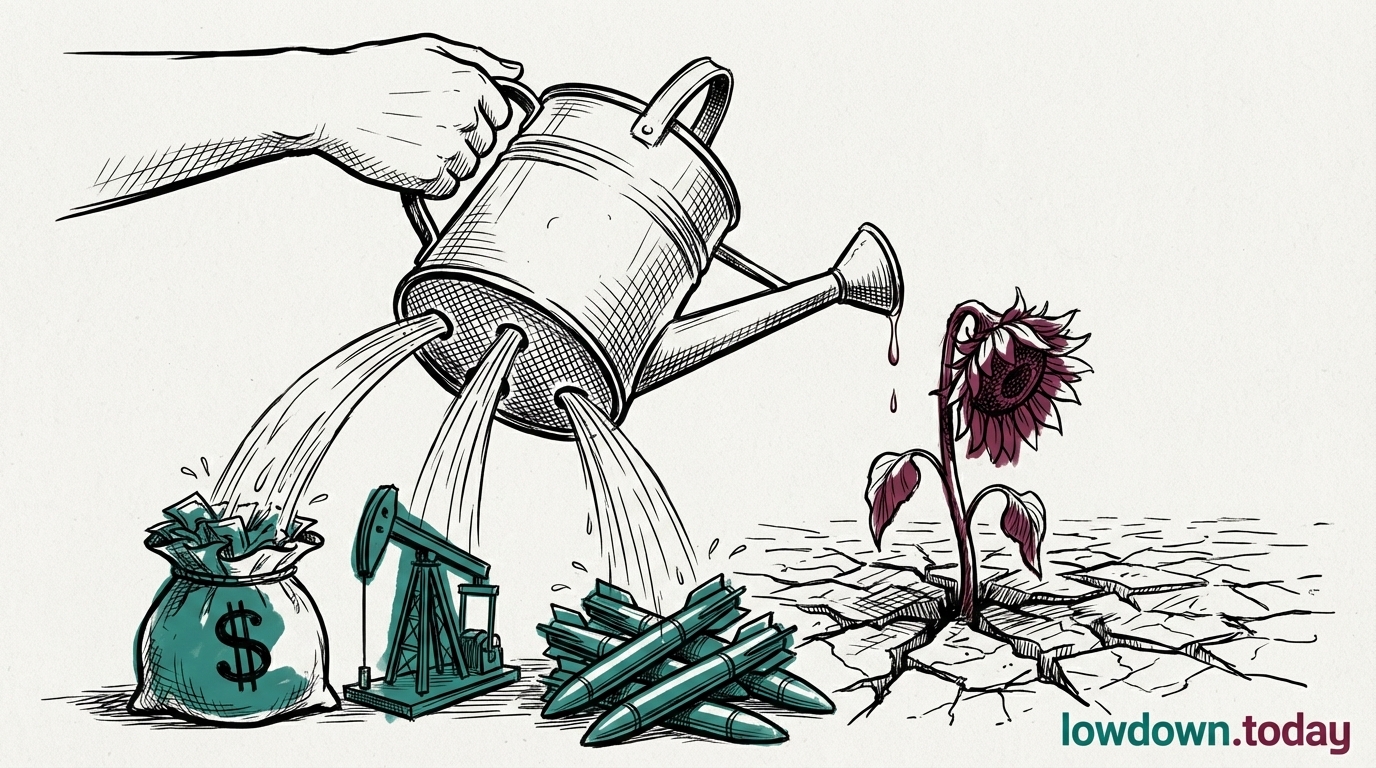
David Axe at CEPA, citing RUSI research, assessed Ukraine's 130 oil strikes in 2025 produced $863 million of damage against roughly $189 billion in annual Russian oil revenue.

ConflictDeveloping
Key takeaway

Ukraine's oil strike campaign delivers footage; the revenue figures sit on the wrong side of the scale.

David Axe at CEPA (Center for European Policy Analysis), citing RUSI research published this month, assessed that Ukraine's 130 refinery and port strikes in 2025 delivered only a 6% export reduction against 2024 1. Cumulative damage came to $863 million against roughly $189 billion in annual Russian oil revenue, or 0.46% of the base.

That is roughly the cost of three weeks of Patriot operations in the Middle East, set against a rounding error in Moscow's books. At that tempo, Ukraine would need over two centuries of strike operations to match a single year of Russian oil revenue. Ukrainian targeteers pick lightly-defended terminals for visible damage, leaving hardened core infrastructure intact. Footage does most of the work the revenue figures do not.

Two separate considerations compound the scale problem. Fire Point, the Ukrainian consortium manufacturing the Flamingo cruise missile , is reportedly under investigation by NABU (Ukraine's National Anti-Corruption Bureau). Only nine Flamingos have been fired in six months, against the hundreds that any serious strike campaign against hardened infrastructure would require. And the Iran war separated price from volume in a way the infrastructure campaign cannot control: Urals rode the Hormuz premium while Baltic throughput was recovering. When Kyiv asks for Patriots for ballistic defence while launching its own drones at pipelines Chevron part-owns, the two trade-offs sit on the same ledger.


Deep Analysis

In plain English

Ukraine has been hitting Russian oil refineries and export terminals in a campaign aimed at cutting the revenue that funds Russia's military. A new report from the Center for European Policy Analysis and RUSI found that 130 such strikes across 2025 reduced Russia's oil exports by only 6% and caused $863 million in total damage. Russia earns roughly $189 billion per year from oil. So the entire year of strikes damaged the equivalent of 0.46% of annual revenue. To put that in context, Russia earns back that amount in about 42 hours. The Iran war's oil price spike likely generated more revenue for Russia in a single week than Ukraine's entire 2025 strike campaign cost Russia in a year.

What could happen next?
  • Meaning

    The CEPA finding reframes the Baltic and Black Sea oil campaigns as primarily having operational-denial value, not economic attrition value; Ukraine's justification for the campaign must shift accordingly.

    Immediate · 0.78
  • Risk

    If the Fire Point/NABU investigation reveals systematic corruption in Ukraine's precision strike procurement, it will complicate Western partner willingness to fund further anti-infrastructure weapons deliveries.

    Short term · 0.62
  • Opportunity

    The 6% export-volume reduction, while small in revenue terms, represents real capacity constraints on specific refinery outputs (aviation fuel, diesel) that have strategic value beyond headline revenue figures.

    Medium term · 0.55
First Reported In

Update #12 · Three narrowings of US support for Kyiv

Center for European Policy Analysis· 11 Apr 2026
Read original
Causes and effects
This Event
CEPA scale check: 0.46% of Russian oil
Load-bearing counter-evidence against the narrative that Ukraine's strike campaign is constraining Russian oil revenue.
Different Perspectives
Rafael Grossi, IAEA Director General
Grossi's Update 349 of 7 May recorded a drone strike on ZNPP's radiation monitoring laboratory on 3 May. Rosatom's 17 May public attack on the Secretariat's neutrality degrades the diplomatic ground Grossi needs for the sixth repair ceasefire at day 60 on the single backup line.
Indian Government / Embassy Moscow
The Indian Embassy in Moscow confirmed on 18 May that an Indian national was killed and three hospitalised at a refinery construction site in the 17 May barrage. India is among the largest buyers of discounted Russian crude; the fatality forces a diplomatic protest without changing the purchasing posture.
Recep Tayyip Erdogan, Turkish President
Erdogan met Zelenskyy in Ankara for nearly three hours on 15 May before the Istanbul session, recovering Turkey's 2022 mediator role and reducing Trump's leverage by hosting bilateral talks without Washington in the room. Turkey hosts the NATO Ankara summit on 7-8 July; the Istanbul format gives Erdogan standing at both tables simultaneously.
Viktor Orban / Hungarian Government
Budapest's new cabinet, formed 12 May, holds the institutional veto point on the EU tranche disbursement ahead of the first-half June window. Hungary has previously leveraged EU loan tranches to extract bilateral concessions; the combination of a fresh cabinet and a tight disbursement timeline makes Budapest the single highest-leverage actor in the EU track this fortnight.
European Council / Commission
The Commission is preparing a three-document disbursement package for the 9.1-billion euro first tranche of the EU loan to Ukraine, targeting first-half June, but delivery depends on the Magyar cabinet, which formed on 12 May, not blocking the mechanism. The 20th sanctions package remains in force against Russia.
Donald Trump / US Treasury
Treasury issued GL 134C with a 48-hour gap after GL 134B expired, confirming the waiver series functions as permanent monthly management rather than a wind-down instrument. Washington was absent from the Istanbul room; Treasury Secretary Bessent framed the Cuba carve-out as protecting 'most vulnerable nations', maintaining the fiction that the 30-day bridge has a humanitarian rationale.



