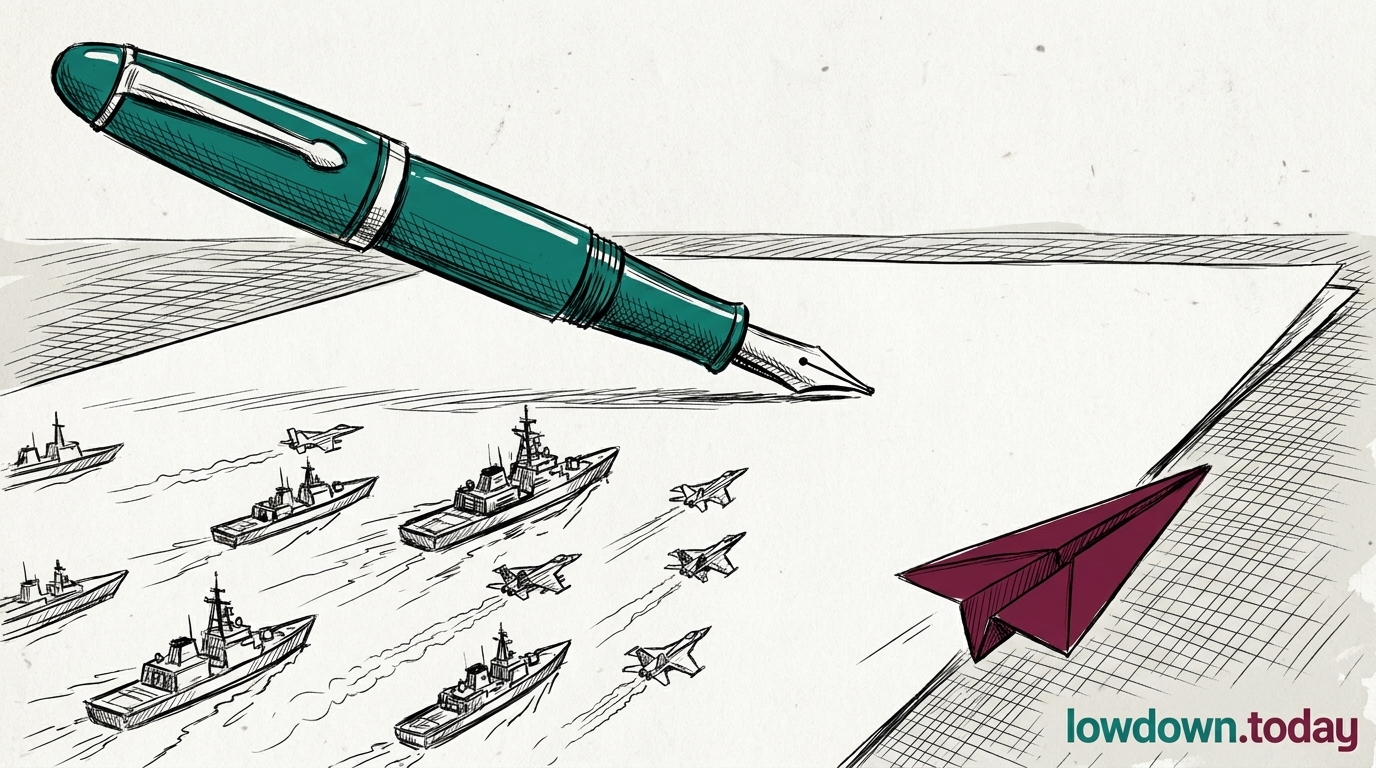
Abbas Araghchi, Iran's Foreign Minister, told Sultan Haitham in Muscat on Sunday 26 April and Vladimir Putin in St Petersburg on Monday 27 April that Iran will reopen the Strait of Hormuz before any nuclear settlement, decoupling two tracks Tehran's prior position had bound together. The State Department rejected the framing the same day, with officials telling the Associated Press the Hormuz proposal 'doesn't address the core issue' of nuclear weapons1. Pakistan now holds a written three-phase Iranian text that sequences Hormuz reopening and the lift of the US blockade first; nuclear talks come 'later'.
The Strait of Hormuz carries roughly a fifth of seaborne crude and a third of LNG; the blockade Tehran has run since the IRGC closure on Day 1 is what Brent has been pricing for sixty days. Tehran's prior position, held since the Islamabad round collapsed, bound the strait to nuclear so that any de-escalation produced both at once. The text now in Pakistan's hands separates them. Iran is offering to lift the blockade without first locking in the nuclear settlement Trump has named as his only public condition for ending the war.
The sequencing mirrors the Joint Plan of Action Iran and the P5+1 signed in November 2013, which front-loaded reversible enrichment caps so that an instrument could be signed without resolving final-status weapons questions; that architecture later ratified the 2015 deal. The 2026 offer has the same shape. The Trump administration has not staffed a final-status negotiating team, has signed no Iran executive instrument across sixty days and has produced no counterpart text. The War Powers Resolution clock corrected on 22 April runs out at 12:01 EDT on Friday 1 May; three days from close on Tuesday.
A counter-reading is worth flagging: the IRGC controls the strait, so the offer's operational delivery is uncertain and may be theatrical, designed to put rejection on Washington's record while protecting the nuclear file. The structural shift survives that critique. Iran's prior text linked the two files; the text now in Pakistan's hands separates them. Whether Tehran would deliver is one question; whether Tehran has rewritten the deal on offer is a separate one, and on the second question the answer is yes.


