
Skip to content
Briefings are running a touch slower this week while we rebuild the foundations.See roadmap
Iran Conflict 2026
4MAY

Day 66: 15,000 troops unsigned; Pakistan carries first reply

4 min read
10:21UTC

Trump deployed roughly 15,000 personnel to the Strait of Hormuz on 3 May with nothing signed behind them, and on the same Sunday the United States transmitted its first written reply to an Iranian ceasefire text via Pakistan. Brent fell $21 in four sessions. The IRGC set a 30-day blockade clock.

Key takeaway

Project Freedom and the Pakistan reply are both unsigned; the bigger the action, the further it travels from a signature.

This briefing mapped
Loading map…
Military
Diplomatic
Economic
Humanitarian
Legal
Regulatory

Trump announced Project Freedom on 3 May, deploying roughly 15,000 personnel and 100-plus aircraft into the Strait of Hormuz from 4 May, with no signed presidential instrument behind the order.

Sources profile:This story draws on mixed-leaning sources from United States
United States

Trump announced on 3 May that 15,000 US personnel, destroyers, and more than 100 aircraft would escort stranded shipping through the strait of Hormuz starting 4 May. The White House presidential-actions index shows no signed instrument authorising the mission.

Two days earlier Trump declared the war over . Deploying the largest US force of the conflict the same week as a hostilities-terminated letter is a legal contradiction Congress now has to decide whether to resolve. 

Briefing analysis

Primary parallel: Operation Earnest Will reflagged 11 Kuwaiti tankers under the US flag in July 1987, putting US Navy escorts in the same Strait of Hormuz channel against the same IRGC small-boat threat. Reagan operated under explicit executive authority, a public reflagging instrument and a stated rule of engagement; Project Freedom has none of these. The geometry is identical, the legal architecture is not.

Counter-parallel: Operation Praying Mantis on 18 April 1988 was the largest US surface action since 1945 and was triggered when an Earnest Will frigate, USS Samuel B. Roberts, struck an Iranian mine. A Project Freedom escort taking similar damage in week one would face a presidential decision under a verbal rule of engagement and a WPR letter that says hostilities are terminated.

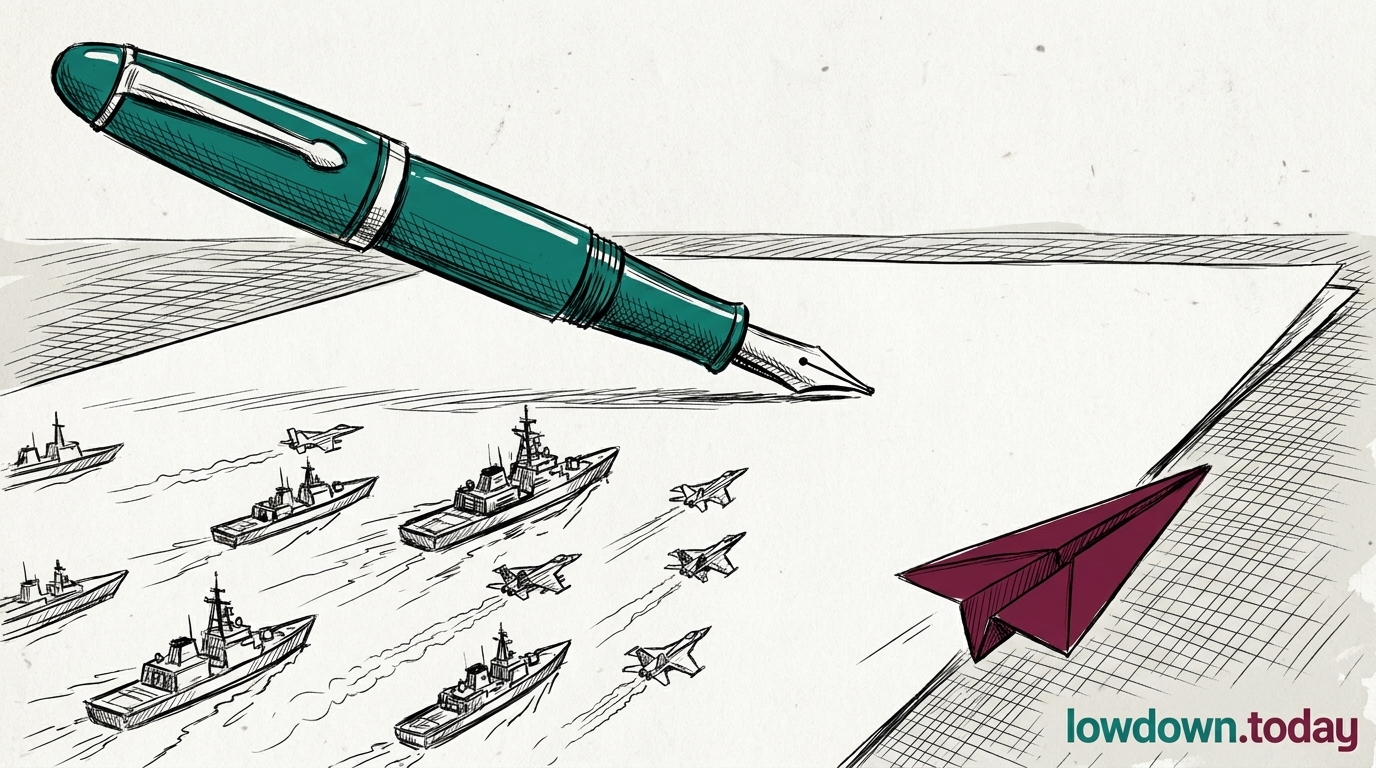
Guided-missile destroyers, more than 100 aircraft, and 15,000 service members entered the Strait of Hormuz on 4 May with no published rules of engagement and no presidential signature behind the launch.

Sources profile:This story draws on mixed-leaning sources from United States
United States

Project Freedom became operational on 4 May with destroyers, more than 100 aircraft, and 15,000 personnel entering the strait of Hormuz. US Central Command (CENTCOM) published no executive order, coalition agreement, or rules of engagement to govern the mission.

The same command is simultaneously blocking ships from Iranian ports and escorting others through the same 33-kilometre strait. No US combatant command has run both missions in the same waterway at once in the post-1945 record. 

Iran's Foreign Ministry confirmed on 3 May that Washington had transmitted a written reply to Tehran's 14-point ceasefire text via Pakistan, the first US paper into the back-channel after four rounds of Iranian written offers.

Sources profile:This story draws on centre-left-leaning sources from United States
United States

Iran confirmed on 3 May that Washington sent a written reply to its 14-point ceasefire proposal via Pakistan. Across four rounds of Iranian written offers, this was the first time the US put its response on paper.

Trump publicly called Iran's terms unacceptable the same day. Written reply through Pakistan; rejection on Truth Social. Both moves happened simultaneously, which has been the pattern of this conflict from the start. 

Sources:CNBC

Brent crude consolidated a four-session decline from $123 on 30 April to $101.70 on 4 May, with each leg attached to a discrete diplomatic trigger rather than a single Trump post.

Sources profile:This story draws on neutral-leaning sources

Brent Crude fell from $123 to $101.70 across four sessions between 30 April and 4 May, the war's largest sustained price drop. Each leg tracked one diplomatic trigger: the United Arab Emirates leaving OPEC, Trump rejecting Iran's proposals, Project Freedom's announcement, Pakistan's first US written reply.

Oil remains $34 above its pre-war level of $67.41. Markets priced a ceasefire becoming more likely, not a supply problem being solved. 

Mehdi Rasouli and Mohammadreza Miri were hanged in Mashhad in the early hours of 4 May; Iranian state media described both as Mossad elements linked to a January coup attempt.

Sources profile:This story draws on mixed-leaning sources from United Kingdom
United Kingdom

Mehdi Rasouli and Mohammadreza Miri were executed in Mashhad on 4 May, labelled by Iranian state media as Mossad agents involved in a January 2026 coup attempt. Iran Human Rights confirmed both deaths and put the wartime political execution total at 25-plus since February.

No independent evidence connecting either man to Israeli intelligence has been published. The Mossad-elements label has been applied to at least four executions in three days. 

Ebrahim Dolatabadi, a Tabarsi-area protest leader, was secretly executed in Mashhad on 4 May, six days after sentencing on a moharebeh charge, the shortest sentencing-to-execution gap of the wartime register.

Sources profile:This story draws on mixed-leaning sources from United Kingdom
United Kingdom

Ebrahim Dolatabadi, a protest leader from the Tabarsi region, was executed in Mashhad on 4 May, just six days after sentencing. Iranian moharebeh cases normally take three to six months from sentencing to execution through mandatory Supreme Court and clemency reviews.

Iran Human Rights confirmed Dolatabadi's six days as the shortest gap of the wartime register. Three executions were confirmed in Mashhad on the same morning; Mehrab Abdollahzadeh at Urmia was confirmed the day before. 

An IRGC general issued a 30-day ultimatum on 3 May for the United States to end its port blockade of Iran, and the Majlis national security commission ruled that Project Freedom would be considered a violation of the ceasefire.

Sources profile:This story draws on centre-right-leaning sources from United Arab Emirates
United Arab Emirates

Iran's Revolutionary Guard set a 30-day deadline on 3 May, running to around 2 June, demanding the US end its naval blockade. Iran's parliament simultaneously declared Project Freedom a ceasefire violation, providing a legal rationale for a response.

The 2 June deadline converges with the US War Powers Resolution operative cliff. Both governments' domestic legal frameworks expire in the same two-week window. 

Sources:Gulf News

CENTCOM reported 48 vessel redirections by 3 May, four more than the 44 logged on 30 April, in the same three-day window the command was staging the Project Freedom escort fleet.

Sources profile:This story draws on centre-leaning sources from United States
United States
LeftRight

US Central Command (CENTCOM) reported 48 vessel redirections by 3 May, adding four in the same three days it was marshalling Project Freedom's escort fleet. Both operations run from the same command with no public reconciliation of how they coexist.

The 48-vessel blockade count is the metric Iran's Revolutionary Guard (IRGC) 30-day ultimatum responds to. Each vessel added narrows the window for diplomacy before the deadline expires around 2 June. 

Senator Todd Young of Indiana joined Susan Collins, John Curtis, and Thom Tillis as the fourth Republican co-sponsor of Lisa Murkowski's draft Iran AUMF; Murkowski confirmed an 11 May filing target on the Senate floor.

Sources profile:This story draws on neutral-leaning sources

Todd Young of Indiana became the fourth Republican co-sponsor of Murkowski's Iran war authorisation bill, formally an Authorisation for the Use of Military Force (AUMF). Murkowski confirmed an 11 May filing date, one week after Project Freedom's 15,000 personnel were already operational.

No bill text has been published. Filing a war authorisation after troops are deployed sets a precedent that presidential military action can precede congressional sign-off indefinitely. 

China's Ministry of Commerce identified the five refineries shielded from OFAC compliance under its 2 May Blocking Rules order: Hengli Petrochemical (Dalian), Shandong Shouguang Luqing, Shandong Jincheng, Hebei Xinhai Chemical, and Shandong Shengxing.

Sources profile:This story draws on neutral-leaning sources

China named the five refineries its Blocking Rules shield from US Treasury sanctions: Hengli Petrochemical (Dalian), three Shandong facilities, and Hebei Xinhai Chemical. Together they process around 600,000 barrels of Iranian crude per day.

Chinese law now directly contradicts US sanctions law on the same companies. Article 9 of the 2021 rules lets any Chinese firm sue a counterparty that obeyed US designations. China's Commerce Ministry can add more refineries without passing new legislation. 

A cargo ship near the Strait of Hormuz was attacked by multiple small boats on 3 May with no claim of responsibility, on the same day Trump announced Project Freedom; the IRGC was suspected.

Sources profile:This story draws on centre-leaning sources from United States
United States
LeftRight

A cargo ship near the strait of Hormuz was attacked by multiple small boats on 3 May, the same day Trump announced Project Freedom. Iran's Revolutionary Guard (IRGC) is suspected; no group claimed responsibility.

The IRGC routinely probes new US postures within hours of announcement to test response thresholds. With 15,000 US personnel now in the strait, the next small-boat incident involving an escorted vessel would be the first US-Iran military contact since 7 April. 

Sources:Fortune
Closing comments

Direction is bidirectional. A 15,000-personnel forward deployment widens the kinetic surface; the first US written reply through Pakistan since 28 February opens the first procedural path toward settlement. The IRGC's 30-day blockade-end ultimatum, expiring approximately 2 June 2026, is the named calendar trigger for a second-stage response if no further written engagement arrives. The Majlis security commission's formal finding that Project Freedom constitutes a ceasefire violation (3 May) gives the corps legal cover within Iranian institutional architecture. A cargo-ship small-boat attack reported by Fortune on 3 May near Hormuz, with no claim of responsibility, is the sharpest single-incident escalation vector of the week.

Different Perspectives
Trump / White House
Trump / White House
Trump announced Project Freedom on 3 May via Truth Social, framing 15,000 personnel and destroyers as a humanitarian gesture for Iran and stranded shipping, then simultaneously called Iran's written ceasefire terms unacceptable while describing talks as very positive. Neither the escort operation nor the written Pakistan reply carries a presidential signature.
Iran (Pezeshkian / Araghchi)
Foreign Ministry spokesman Esmaeil Baghaei confirmed on 3 May that Tehran is reviewing a written US reply delivered via Pakistan to its 14-point ceasefire text, marking the first paper exchange of the war. President Pezeshkian's civilian government has now submitted five written ceasefire proposals since 27 April with no substantive written counter-proposal from Washington.
IRGC (military)
IRGC (military)
The IRGC issued a 30-day ultimatum on 3 May demanding the US end its port blockade, while its aligned Majlis security commission found Project Freedom constitutes a ceasefire violation. With 60 per cent of its small attack-boat fleet operational across 31 Mosaic Defence units, the corps retains the capacity and institutional mandate to escalate independently of the civilian track.
Pakistan
Pakistan
Islamabad carried the first US written reply of the war on 3 May, translating a procedural step neither government would take directly into a channel Pakistan has sustained since Army Chief Asim Munir's 16 April Tehran visit. Pakistan now mediates between two governments running opposite verbal and written tracks through the same diplomats.
Russia
Russia
Moscow has not publicly responded to Project Freedom, but Russian Il-76 transports have continued delivering radar and electronics to Iran at high tempo since Araghchi's 27 April Kremlin meeting with Putin and GRU chief Kostyukov. Russia's interest is to extend the Gulf distraction while advancing in Ukraine; a negotiated Hormuz settlement shortens that window.
China (MOFCOM)
China (MOFCOM)
MOFCOM named five protected refineries on 4 May under its 2021 Blocking Rules, shielding Hengli Petrochemical (Dalian) and four Shandong and Hebei independents from OFAC Iran compliance obligations. The designation formalises a legal counter to US secondary sanctions architecture in writing for the first time, covering approximately 400,000 barrels per day of Chinese refining capacity.
