Skip to content
Briefings are running a touch slower this week while we rebuild the foundations.See roadmap
Iran Conflict 2026
11APR

Seven Ships Cross Hormuz, No Oil Tankers

3 min read
11:03UTC

IRGC / Lloyd's List Intelligence

ConflictDeveloping
Key takeaway

Seven ships in 24 hours is a checkpoint, not a reopening.

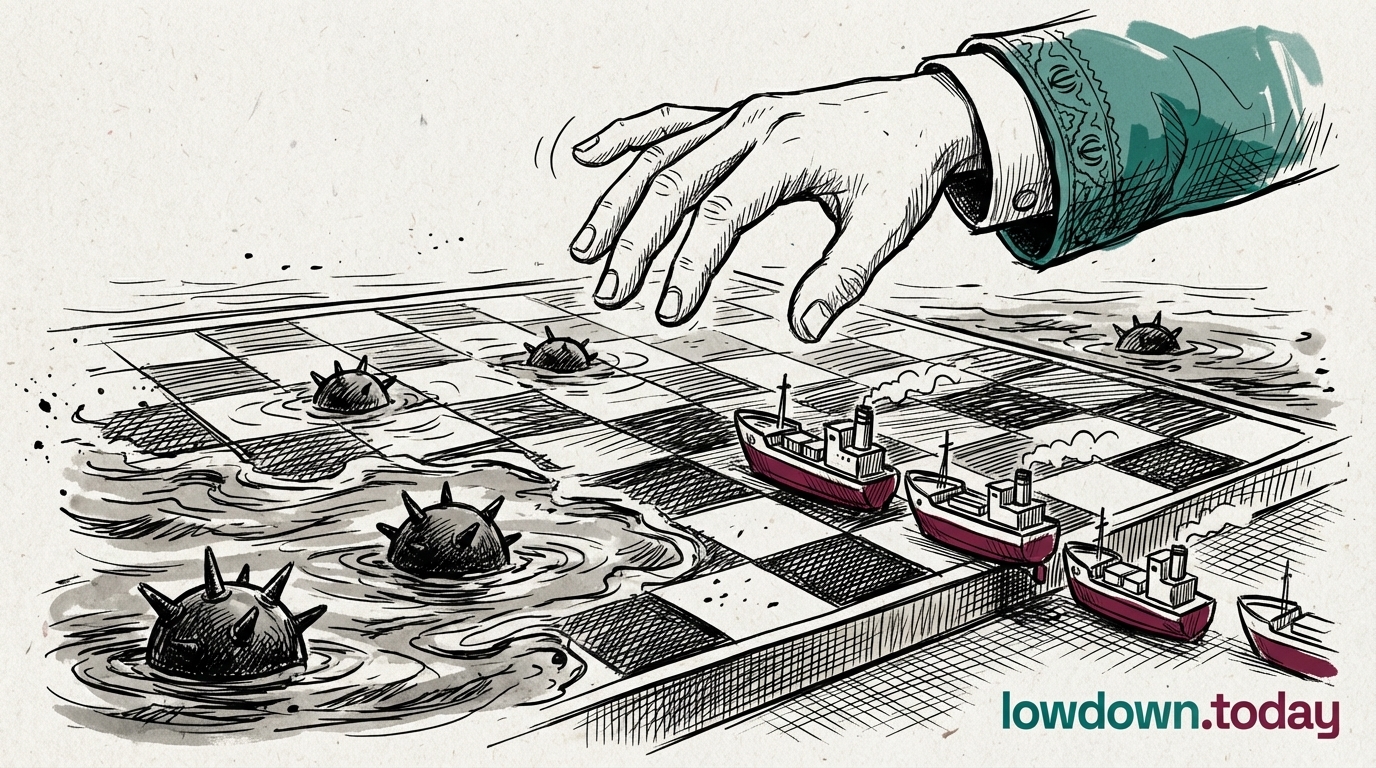
Seven ships transited the Strait of Hormuz on ceasefire Day 3. None were oil tankers. 325 oil tankers and more than 600 vessels remain stranded inside the Persian Gulf. Iran's toll system had reached 20 transits per day before the ceasefire ; seven is a regression, not a recovery. The pre-war baseline of 135 per day illustrates the distance to normalisation.

Iran's inspection and ban regime transforms the strait from an international waterway into a customs border. Ships linked to Israel are excluded; tolls are reportedly payable in cryptocurrency. The IRGC (Islamic Revolutionary Guard Corps) mine charts published on 9 April direct all traffic through corridors near Larak Island under IRGC naval control. Oman formally refused the toll regime, citing international maritime treaty obligations, but Omani vessels still face the same inspection process.

ADNOC CEO Sultan Al Jaber put it plainly: "Passage is subject to permission, conditions and political leverage." Goldman Sachs issued revised scenarios: $82 per barrel base if Hormuz resumes this weekend, $100+ if closed another month, $120 severe. Every day without mine clearance normalises the toll regime that preceded the ceasefire .

Deep Analysis

In plain English

Before the war, about 135 ships passed through the Strait of Hormuz every day, carrying 20% of the world's oil. On Day 3 of the ceasefire that was supposed to reopen it, only seven ships passed and none were oil tankers. 325 tankers are sitting stuck inside the Gulf waiting. Iran is charging fees, banning some ships, and controlling who gets through. The UN tried to force the strait open; Russia and China blocked it.

Deep Analysis
Root Causes

Iran's closure of Hormuz reflects a shift from opportunistic disruption to structural leverage doctrine. The toll system represents a permanent claim to sovereign authority over an internationally recognised strait — the same claim it made unsuccessfully in the 1980s. The ceasefire has preserved the toll regime rather than ending it, which is Iran's primary economic gain from the war regardless of nuclear outcome.

China and Russia's UNSC veto removes multilateral enforcement. Without that mechanism, Hormuz reopening requires either a bilateral US-Iran deal that explicitly addresses the toll regime, or unilateral US naval action. The Trump administration has so far declined both .

What could happen next?
  • Consequence

    Every day without mine clearance normalises Iranian toll authority over an internationally recognised strait, making restoration of UNCLOS freedom of navigation progressively harder to claim without confrontation.

    Short term · Assessed
  • Risk

    GL-U expiry on 19 April would recriminalise 325 stranded tankers' cargo before the ceasefire even ends, forcing operators to choose between legal jeopardy and abandoning cargo.

    Immediate · Assessed
  • Consequence

    China's tankers already transit under the toll regime; its UNSC veto locks in a competitive advantage over Japanese, South Korean, and European shippers for as long as the regime persists.

    Medium term · Assessed
First Reported In

Update #64 · Islamabad talks open already cracked

Iran International· 10 Apr 2026
Read original
Different Perspectives
Qatar
Qatar
Qatar holds approximately $12 billion in frozen Iranian assets that Tehran named as the precondition for any Hormuz reopening sequence; with Oman sidelined and no agreed HEU custodian, the asset-routing architecture that any deal requires has no operational channel and no neutral financial intermediary to run it through.
Hengaw and Iranian civilian population
Iranians face an internet capped at 40 per cent by hardware their president cannot dismantle, field killings that leave no court record, and judicial executions running in parallel; Hengaw, based in Norway, is the primary remaining monitor of a repression system the IRGC is deliberately moving beyond auditable records. The real toll is higher than any single monitor's count.
China
China
China supplied deep-packet-inspection hardware that caps Iran's internet at 40 per cent and enables an instant on-demand blackout, and was barred by Trump as a potential HEU custodian on 27 May. Beijing gains from Iran's continued non-alignment with the West while the DPI sale extends Chinese surveillance-technology exports as a geopolitical instrument.
Pakistan
Pakistan
Foreign Minister Ishaq Dar met Rubio in Washington on 29 May, formally inheriting the role of sole active mediator after Oman's forced withdrawal. Pakistan lacks Oman's banking infrastructure for frozen-asset routing and carries its own regional stakes, making it a less structurally neutral broker for the Qatar-held $12 billion sequencing.
Kuwait
Kuwait
Kuwait invoked Article 51 of the UN Charter after absorbing an Iranian ballistic-missile strike on Ali Al Salem Air Base on 28 May, becoming the first Gulf state to make a formal individual self-defence claim in the war. The invocation creates a legal record enabling a future bilateral defence-pact activation without yet triggering it.
Oman
Oman
Oman denied any Hormuz toll plan within hours of Bessent's 28 May threat, absorbing a sanctions warning from the country it has brokered for since 1981. The rapid capitulation preserved the channel formally, but Tehran now knows Washington will threaten its own mediator, which changes Muscat's calculus on how far it can lean into any joint-management architecture.