
Skip to content
Briefings are running a touch slower this week while we rebuild the foundations.See roadmap
Iran Conflict 2026
8MAR

Day 9: New leader kept secret; Bahrain water hit

10 min read
13:29UTC

Iran's Assembly of Experts confirmed consensus on a new Supreme Leader but withheld the name after Israel threatened to assassinate any successor, while Iranian drones struck a Bahraini desalination plant and Kuwait International Airport, prompting Kuwait to declare force majeure on all oil exports. Lebanon's toll reached 394 dead, including 83 children killed in six days of Israeli strikes.

Key takeaway

Iran is fighting a war that no living person in its government has the constitutional authority to halt, and the one mechanism that could restore that authority — installing a new Supreme Leader — has been made physically dangerous by Israel's assassination threat.

This briefing mapped
Loading map…
Domestic
Military
Economic
Humanitarian
Diplomatic

Three Assembly of Experts members confirmed a successor has been chosen, but announcing his identity under sustained bombardment would make him Israel's next target — leaving Iran without the one authority the IRGC is constitutionally obligated to obey.

Sources profile:This story draws on mixed-leaning sources from Qatar, United States and 2 more
QatarUnited StatesUnited Arab EmiratesUnited Kingdom

Three Assembly of Experts members — Ayatollah Mirbagheri, Ahmad Alamolhoda, and Mohsen Heidari Alekasir — confirmed publicly that a 'majority consensus' has been reached on Khamenei's successor, selected based on the late Supreme Leader's counsel that his successor should be 'hated by the enemy.' The Assembly has not published a name. Iran's consulate in Mumbai denied Israeli media reports naming Mojtaba Khamenei. Members disagree on whether investiture requires an in-person session — constitutionally untested during sustained bombardment of the capital. Khamenei's funeral remains postponed indefinitely; under Shia tradition, a successor is not formally announced until the predecessor is interred.

Iran's constitutional architecture requires a Supreme Leader to function — the IRGC answers to no other authority. The Assembly has reached consensus but cannot safely disclose the name, install the successor, or hold the predecessor's funeral. The command vacuum that prevents a binding ceasefire or coherent military strategy is locked in place by the conditions the war itself creates. 

Sources:Al Jazeera·Al Monitor·The National·Iran International
Briefing analysis

Iran's sole previous Supreme Leader transition occurred on 4 June 1989 when Ayatollah Khomeini died. The Assembly of Experts selected Ali Khamenei within hours, in a peaceful session with no external threat to participants. That transition was constitutionally smooth because it happened in peacetime — the Iran-Iraq war had ended eleven months earlier.

The current succession occurs under sustained aerial bombardment of Tehran, with Israel explicitly threatening to kill both the successor and Assembly members involved in the appointment. The 1989 precedent offers no guidance for installing a Supreme Leader when the act of investiture itself has been made a military target.

Hours after the Assembly announced consensus, Defence Minister Katz declared the successor 'a certain target for assassination' — turning the act of constitutional succession into a trigger for lethal force.

Sources profile:This story draws on mixed-leaning sources from United Arab Emirates and Israel
United Arab EmiratesIsrael

The IDF posted in Farsi that it would 'pursue every person who seeks to appoint a successor' and the successor himself. Defence Minister Katz stated whoever is selected will be 'a certain target for assassination, no matter his name or where he hides.' The statements came within hours of the Assembly of Experts' consensus announcement.

Israel has extended its targeting doctrine from military infrastructure and commanders to the constitutional mechanism for transferring supreme authority. By threatening to kill both the successor and anyone involved in appointing him, Israel ensures the command vacuum persists — the same vacuum that prevents any binding ceasefire or coherent Iranian military restraint. 

President Pezeshkian apologised to Gulf neighbours, was overridden by the IRGC within hours, then promised to escalate attacks on US targets — exposing an elected president who commands nothing.

Sources profile:This story draws on centre-left-leaning sources from United States and Qatar
United StatesQatar
LeftRight

President Pezeshkian vowed Sunday morning to step up attacks on US targets, stating 'The more pressure they impose on us, the stronger our response will naturally be' — reversing his Saturday apology and halt order to Gulf neighbours. The president issued three mutually exclusive policy positions in 24 hours: apology, de-escalation, and escalation. The IRGC ignored his Saturday halt order within hours; Parliament Speaker Ghalibaf publicly attributed continued Gulf strikes to the late Supreme Leader's directives; hardliners labelled any ceasefire 'treason.'

The Iranian president's three mutually exclusive positions in 24 hours demonstrate that nothing he says constitutes Iranian policy. The IRGC ignored his halt order, Parliament's speaker invoked a dead Supreme Leader's authority over the living president, and hardliners labelled ceasefire 'treason.' For any external party seeking to negotiate, there is no Iranian interlocutor with the authority to deliver on commitments. 

Four dead and ten wounded after an IDF strike hit a commercial hotel sheltering displaced families alongside alleged IRGC commanders — the first strike inside Beirut's city centre since the war resumed.

Sources profile:This story draws on centre-left-leaning sources from Qatar, France and 1 more
QatarFranceIsrael

Israel struck a room in the Ramada hotel in central Beirut early Sunday, killing four and wounding ten. The IDF claimed it targeted 'key commanders' of the IRGC Quds Force Lebanon Corps who were 'advancing terror attacks against Israel.' No names were provided. The hotel was also housing displaced civilians who had fled fighting in southern Lebanon and Beirut's southern suburbs. This is the first Israeli strike within Beirut's city centre since hostilities with Hezbollah resumed on 2 March.

Israel's air campaign expanded from Beirut's southern suburbs into the commercial city centre for the first time, striking a hotel known to house displaced civilians alongside alleged IRGC commanders, raising unresolved proportionality questions under International humanitarian law

An Iranian drone damaged a desalination plant in Bahrain — an island nation with virtually no natural freshwater, entirely dependent on desalination to sustain its population.

Sources profile:This story draws on centre-left-leaning sources from Qatar, United States and 1 more
QatarUnited StatesSaudi Arabia
LeftRight

An Iranian drone damaged a water desalination plant in Bahrain, injuring three — the first strike on water infrastructure in an Arab state during this conflict. Bahrain's electricity and water authority stated the attack had 'no impact on water supplies or water network capacity.' Bahrain has virtually no natural freshwater; the population depends almost entirely on desalination.

Iran struck water infrastructure for the first time in this conflict, targeting a desalination plant in a country where the civilian population depends almost entirely on desalination for drinking water. The attack extends a nine-day escalation pattern on Bahrain from military installations through energy infrastructure to the systems sustaining civilian life. 

A missile hit a university in northern Bahrain, wounding three — the latest in a widening pattern of Iranian strikes on civilian infrastructure across the island.

Sources profile:This story draws on centre-left-leaning sources from Qatar and United States
QatarUnited States

A separate Iranian missile damaged a university building in northern Bahrain, wounding three people.

The strike on educational infrastructure, alongside the same-day desalination plant attack, confirms Iranian targeting on Bahrain has expanded well beyond military and energy facilities to civilian institutions with no stated military justification. 

Sources:Al Jazeera·CNBC

Iran's foreign minister accused Washington of bombing a desalination plant on Qeshm Island — an unverified claim that arrived hours after Iranian drones hit Bahrain's own water infrastructure.

Sources profile:This story draws on centre-left-leaning sources from Qatar and United States
QatarUnited States

Iran's Foreign Minister Araghchi claimed the US struck first, stating 'The US committed a blatant and desperate crime by attacking a freshwater desalination plant on Qeshm Island.' The US strike on Qeshm has not been independently confirmed.

The unverified counter-claim, arriving on the same day Iran struck Bahrain's water supply, creates competing narratives about who first targeted civilian water infrastructure — a category specifically protected under international humanitarian law. 

Sources:Al Jazeera·CNBC

Strikes on Kuwait's main airport and a civilian government building drew the Gulf's smallest oil state deeper into a conflict it has no means to control.

Sources profile:This story draws on mixed-leaning sources from France and Türkiye
FranceTürkiye
LeftRight

Iranian drones struck fuel tanks at Kuwait International Airport and the headquarters of the Public Institution for Social Insurance in Kuwait City. Fires at both sites were brought under control.

The targeting of Kuwait International Airport and a government pension administration building extends Iran's Gulf campaign into civilian transport and public services — infrastructure with no military function — while the IRGC's stated rationale of punishing US base hosts does not match the targets actually struck. 

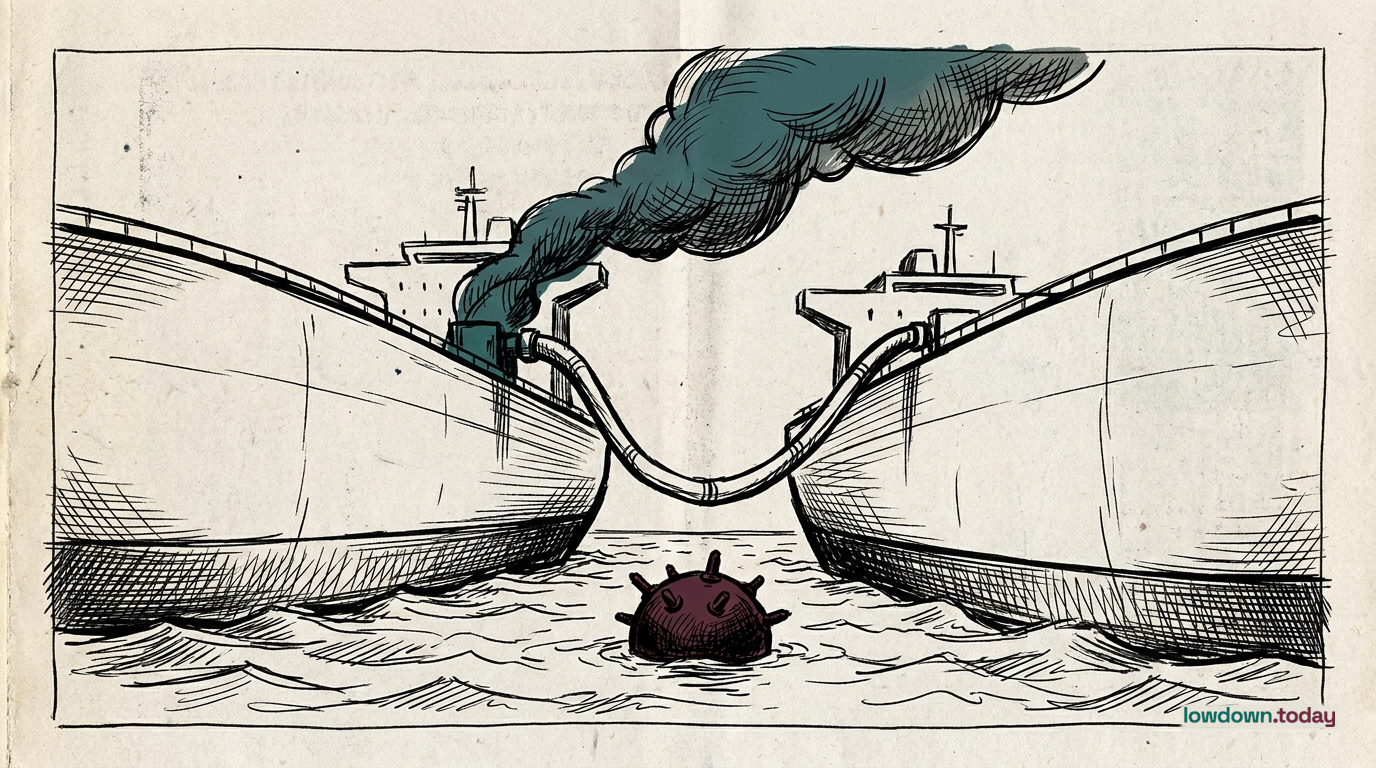
Kuwait became the second OPEC producer in a week to declare force majeure on oil exports — not because its wells are damaged, but because the war has sealed every route to market.

Sources profile:This story draws on mixed-leaning sources from France and Türkiye
FranceTürkiye
LeftRight

Kuwait Petroleum Corporation declared Force majeure on all oil and refined-product exports. Production cuts began Saturday at approximately 100,000 barrels per day and were expected to nearly triple on Sunday. Kuwait is the second OPEC producer to invoke Force majeure in a single week. Combined with Iraq's cuts of approximately 1.5 million barrels per day, roughly 3.5 million barrels per day of Gulf production capacity is being shut in or unable to reach market.

The Force majeure declaration removes approximately 3.5 million barrels per day of Gulf oil from global markets when combined with Iraq's cuts — a supply disruption exceeding the 1990 Iraqi invasion of Kuwait by 75 per cent, driven entirely by the destruction of export logistics rather than production capacity. 

Lebanon's first demographic breakdown of casualties reveals child deaths outpacing the 2006 war. The toll rose 34% in eighteen hours.

Sources profile:This story draws on mixed-leaning sources from Lebanon and United States
LebanonUnited States
LeftRight

Lebanon's health minister Rakan Nasreddine reported 394 killed since Israeli strikes began on 2 March, including 83 children, 42 women, and 9 rescue workers, with 1,130 wounded — a 34% increase from Saturday's 294 count, representing 100 additional deaths in roughly 18 hours. The child casualty rate of approximately 14 per day exceeds the 2006 war rate of approximately 12 per day (UNICEF documented ~400 child deaths over 34 days). Nasreddine condemned attacks on medical teams and ambulances.

The child casualty rate in Lebanon — 14 per day — now exceeds the 2006 war's rate. The overall daily death toll of approximately 66 is nearly double 2006's average. Nine dead rescue workers signal that the medical evacuation chain is itself under attack. 

Sources:Naharnet·UNICEF

China's foreign minister responded within hours to Netanyahu's regime change declaration — while negotiating exclusive passage through the Strait of Hormuz.

Sources profile:This story draws on mixed-leaning sources from China and Ireland (includes China state media)
ChinaIreland

Chinese Foreign Minister Wang Yi stated at his annual NPC press conference that 'plotting colour revolution or seeking Regime change will find no popular support' and called for an 'immediate stop to military operations,' saying the sovereignty of Iran and all countries must be respected. The statement arrived within 12 hours of Netanyahu's Saturday Regime change declaration — fast for Chinese diplomacy. Wang's statement fell ahead of an anticipated Trump-Xi summit tentatively scheduled for late March.

China is building dual leverage as Iran's potential commercial lifeline through exclusive Hormuz transit and its diplomatic shield against Regime change — a position that gives Beijing bargaining weight at the anticipated late-March Trump-Xi summit. 

The 2023 rapprochement is dead. Every Gulf state that rebuilt ties with Tehran now calls Iran's conduct treacherous.

Sources profile:This story draws on mixed-leaning sources from Qatar and India
QatarIndia
LeftRight

Arab League Secretary-General Ahmed Aboul Gheit convened an emergency virtual meeting of Arab foreign ministers, calling Iran's attacks 'treacherous' (غادرة) and a 'massive strategic mistake,' stating 'Iran's attacks cannot be justified under any pretext or excuse.' The term 'treacherous' in Arabic diplomatic register implies betrayal of trust — specifically the diplomatic goodwill extended through the 2023 Saudi-China brokered rapprochement. Every state that spent 2023–2025 rebuilding ties with Tehran now describes Iran's conduct as treacherous.

The unanimous Arab condemnation using the language of personal betrayal signals the destruction of the 2023 China-brokered Saudi-Iran rapprochement — Iran's primary diplomatic gain of the past three years. Gulf States that rebuilt ties with Tehran now treat Iranian diplomatic commitments as structurally unreliable. 

Iran says it downed another $32 million American surveillance drone over western Iran. The Pentagon refuses to confirm any of the four claimed losses, while Russia's TASS broadcasts the kill claim.

Sources profile:This story draws predominantly on Russia state media, with sources from Russia
Russia

TASS reported Iran's army air defences claim to have shot down a fourth US MQ-9 Reaper drone over Lorestan province. An MQ-9 costs approximately $32 million. CBS had previously confirmed three MQ-9 losses, though one was attributed to friendly fire from Qatari forces. Iran has separately claimed 80 drones shot down total, including 74 Israeli and three 'giant, highly advanced' American MQ-9s — arithmetic inconsistent with the fourth claim, suggesting different counting periods or double-counting. The Pentagon has not acknowledged any losses.

Cumulative MQ-9 losses — if confirmed — would represent $128 million in destroyed aircraft and, more consequentially, degraded US persistent surveillance over western Iran at a time when precision targeting depends on real-time ISR feeds. The Pentagon's blanket refusal to acknowledge any drone losses leaves the actual state of American intelligence coverage unknown to the public. The TASS sourcing connects the claim to Russia's expanding dual support role: satellite targeting data for Iran's military, state media amplification for its information operations. 

Sources:TASS
Closing comments

Iranian targeting in Gulf states has moved through a recognisable ladder: military installations (week 1) → diplomatic facilities → energy infrastructure (BAPCO, Shaybah) → civilian buildings (Crowne Plaza, Fontana Towers) → water supply (desalination) and transport hubs (Kuwait airport). Each step targets infrastructure whose destruction produces wider civilian harm. With no one in Tehran authorised to halt operations, and the IRGC operating on standing directives that Ghalibaf has publicly endorsed, the targeting trajectory has no internal brake. Separately, Israel's expansion of strikes into Beirut's city centre — distinct from the southern suburbs — opens a second geographic escalation axis in Lebanon.

Emerging patterns

  • Constitutional crisis of installing supreme leader during active aerial bombardment — Assembly may have chosen a leader it cannot safely reveal or install while Israel threatens assassination
  • Assassination diplomacy — using targeted killing threats to deter or shape Iranian political succession
  • Elected president with no military authority matching rhetoric to whoever spoke last — nothing Pezeshkian says constitutes Iranian policy; only IRGC actions do, and the IRGC is not talking to anyone
  • Geographic expansion of Israeli strikes in Lebanon from southern suburbs to Beirut city centre; strikes on mixed military-civilian locations housing refugees alongside alleged military targets
  • Iranian targeting in Bahrain widening in nine days from military installations through BAPCO refinery, civilian residential buildings, to water supply — sustained campaign against desalination on an island without freshwater sources would produce humanitarian crisis within days
  • Continued widening of Iranian target set in Bahrain to civilian educational institutions
  • Tit-for-tat infrastructure targeting claims — both sides accusing the other of striking water desalination plants
  • Iranian drone strikes on Kuwait widening from military targets to civilian aviation and institutional infrastructure
  • Gulf oil producers curtailing production not from well damage but because the war has eliminated export routes — Strait of Hormuz commercially sealed, storage filling, oil has nowhere to go
  • Accelerating civilian casualty rate in Lebanon with child deaths exceeding 2006 war rate; first responders being killed while operating
Different Perspectives
Chinese Foreign Minister Wang Yi
Delivered Beijing's most direct intervention in the conflict at his annual NPC press conference, explicitly opposing regime change in Iran and calling for immediate cessation of military operations — a 12-hour turnaround from Netanyahu's regime-change declaration, unusually rapid for Chinese diplomatic messaging on active conflicts.
President Pezeshkian
Reversed from Saturday's apology and de-escalation halt order to vowing to 'step up attacks on US targets' on Sunday morning — the third mutually exclusive policy position in 24 hours, following the IRGC's defiance of his halt order and Parliament Speaker Ghalibaf's public repudiation of his authority.
Kuwait Petroleum Corporation
Declared force majeure on all oil and refined-product exports following drone strikes on Kuwait International Airport fuel tanks — the second OPEC producer to invoke force majeure in one week, after Iraq's earlier production cuts.
IDF
IDF
Posted a Farsi-language statement threatening to pursue Assembly of Experts members and assassinate the chosen successor — extending Israel's targeting doctrine from military and nuclear infrastructure to Iran's constitutional succession process itself.
