Can the US sustain MQ-9 losses without losing ISR coverage over Iran?
Timeline for MQ-9 Reaper
Mentioned in: IRGC claims a radar kill at Ali al-Salem
Iran Conflict 2026Mentioned in: CENTCOM hits 80 sites; Iran claims Gulf
Iran Conflict 2026Iran hits US bases in three countries
Iran Conflict 2026Mentioned in: CENTCOM hits Goruk and Qeshm Island
Iran Conflict 2026Mentioned in: Kuwait invokes Article 51 after strike
Iran Conflict 2026Background
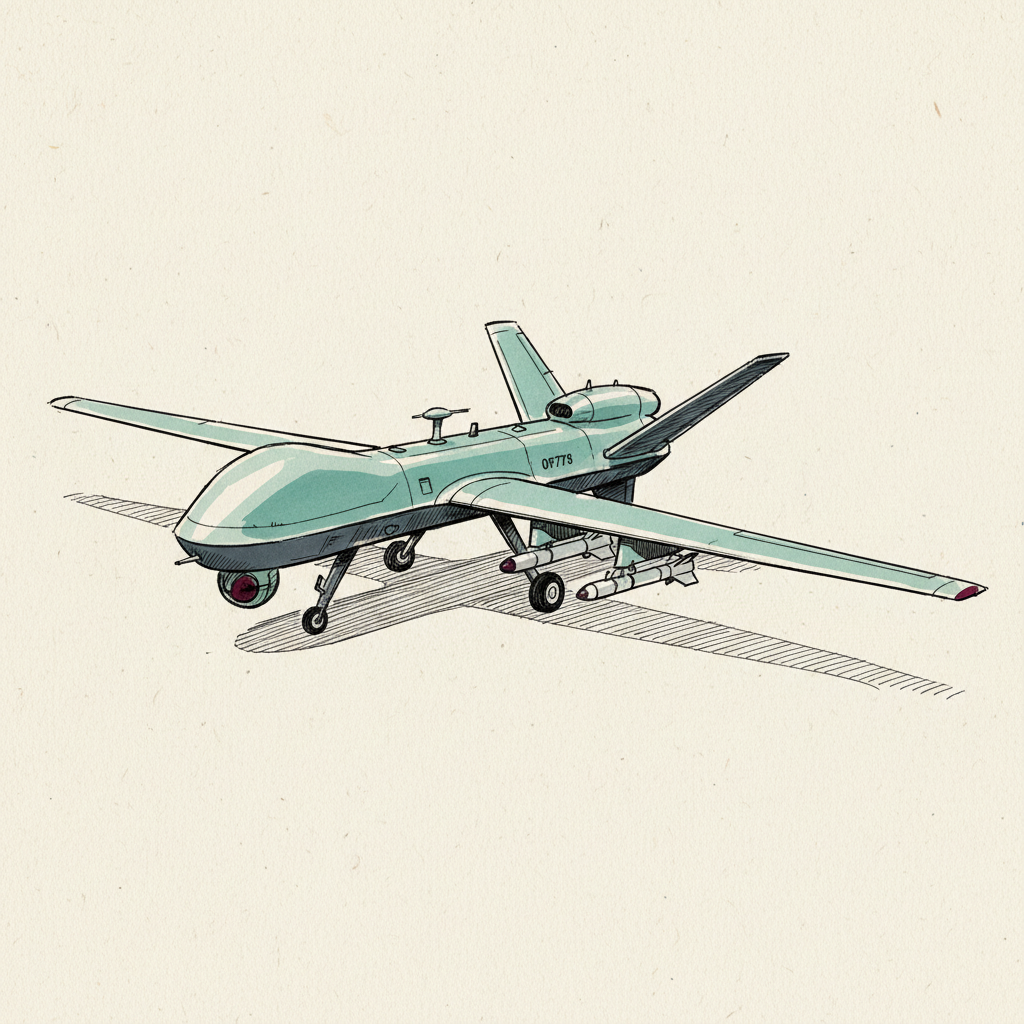
The MQ-9 Reaper is a remotely piloted hunter-killer aircraft built by General Atomics Aeronautical Systems. It is the armed successor to the MQ-1 Predator, combining persistent intelligence, surveillance, and reconnaissance (ISR) with precision strike capability via Hellfire missiles and GBU-12 Paveway II bombs. Cruising at roughly 370 km/h at medium altitude with an endurance of up to 27 hours, it is optimised for semi-permissive airspace where it can loiter over a target area FAR longer than any manned platform.
The Reaper entered US Air Force service in 2007 and has become the backbone of American persistent surveillance operations across the Middle East, Africa, and the Pacific. Unit cost is approximately $32 million. The platform is not stealthy: its radar cross-section is large by modern standards, and Iran's integrated air defence network, including the domestically developed Bavar-373, was specifically engineered to engage medium-altitude platforms in this performance envelope.
In the 2026 Iran conflict the MQ-9 has become the most-lost US airframe of the campaign. The Congressional Research Service logged 24 Reapers among 42 total US aircraft lost or damaged through 20 May 2026. On 7 March 2026, Iranian Army air defences claimed a fourth Reaper downed over Lorestan province, with Iran separately asserting 80 total drones destroyed; the arithmetic was inconsistent, suggesting overlapping counting periods. On 26 May 2026, the IRGC claimed it shot down a further MQ-9 over The Persian Gulf in declared retaliation for US strikes on the Bandar Abbas naval base the previous day; CENTCOM issued no statement confirming or denying the loss.
On 20 July 2026 the IRGC claimed a 22nd-wave drone strike on Ali al-Salem Air Base in Kuwait, saying it destroyed an early-warning radar and an MQ-9 drone shelter and set several drones alight. The claim came from Press TV alone; Kuwait has confirmed none of it.
Each confirmed loss represents degraded persistent surveillance over western Iran at a moment when precision targeting depends on real-time ISR. The attrition has forced operational questions about the continued viability of non-stealthy ISR platforms in contested Gulf airspace, and has placed MQ-9 procurement costs, replacement timelines, and potential successor platforms (including the MQ-9B SkyGuardian) on the congressional agenda.
How many MQ-9 Reapers has the US lost in the Iran war?
What does an MQ-9 Reaper cost and what does it do?
Why did Iran claim to shoot down an MQ-9 on 26 May 2026?
Can Iran's air defences actually shoot down a US MQ-9 Reaper?
What replaces the MQ-9 Reaper in contested airspace?
Did the IRGC destroy an MQ-9 drone shelter at Ali al-Salem?

