
Skip to content
Briefings are running a touch slower this week while we rebuild the foundations.See roadmap
Iran Conflict 2026
8MAR

Day 9: Iran and Israel swap refinery strikes

6 min read
05:11UTC

Israel struck Tehran's oil refineries overnight and the IRGC retaliated against Haifa's refinery within hours — the war's first mutual energy infrastructure exchange. Parliament Speaker Ghalibaf publicly overrode President Pezeshkian's halt order, the IRGC struck two named commercial tankers, and Lebanon's displacement reached 454,000 in six days.

Key takeaway

The conflict crossed from military attrition to mutual economic destruction on Day 9, while the political structures on both sides needed to negotiate any outcome fractured simultaneously.

This briefing mapped
Loading map…
Military
Diplomatic
Domestic
Economic
Humanitarian

Israeli bombs hit the Shahran oil refinery and storage sites across Tehran overnight — the first strikes on either combatant's energy infrastructure, breaking a tacit restraint observed in Middle East conflicts for decades.

Sources profile:This story draws on mixed-leaning sources from Qatar, Türkiye and 2 more (includes China state media)
QatarTürkiyeChinaUnited States
LeftRight

Israeli forces struck the Shahran oil refinery and oil storage sites across Tehran and Alborz provinces overnight — the first Israeli strikes on Iranian Energy infrastructure in the conflict. Video showed fires across the Tehran skyline. The escalation crossed from military and diplomatic targets through the Shaybah oilfield on the Arabian side to the combatants' own refining capacity.

The targeting of Iranian refining capacity shifts the conflict from degrading military capability to destroying economic infrastructure that takes years to rebuild and cannot be substituted. Iran's remaining refineries produce the fuel its 88 million people depend on. Every prior Israeli strike had hit military targets; this crosses into mutual economic destruction. 

Briefing analysis

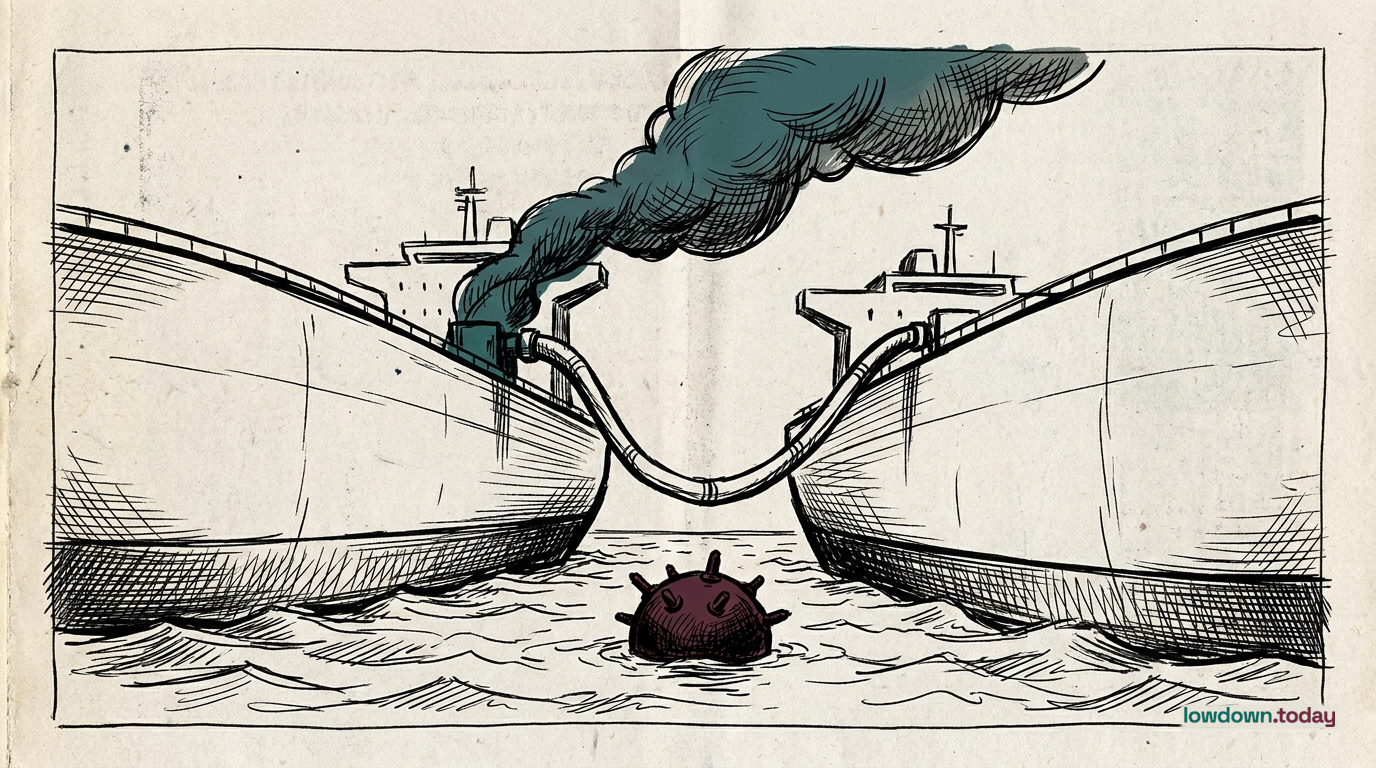
The IRGC's claimed attacks on named civilian tankers echo the Tanker War phase of the Iran-Iraq conflict, when both sides systematically attacked commercial shipping to destroy the other's oil revenue. Between 1984 and 1988, more than 400 vessels were struck, killing at least 200 merchant sailors. That campaign prompted US Navy Operation Earnest Will — the escorted convoy system Trump has promised but not yet delivered.

The mutual refinery strikes parallel the Iran-Iraq 'War of the Cities' (1985-1988), when both sides attacked each other's civilian and economic infrastructure. Iran's Abadan refinery, destroyed in that war, did not return to full capacity until 1997 — a 17-year reconstruction timeline that illustrates the consequences of targeting refining infrastructure.

The IRGC fired Kheibarshekan missiles at Israel's largest refinery within hours of the Tehran strikes — framing the attack as reciprocal. No damage assessment exists from either side.

Sources profile:This story draws on mixed-leaning sources from Qatar and India
QatarIndia
LeftRight

The IRGC launched Kheibarshekan missiles at Israel's Haifa refinery — the country's largest, processing approximately 197,000 barrels per day — within hours of the Israeli strikes on Tehran oil infrastructure. Iran's statement framed the strike as reciprocal: 'oil for oil.' No damage assessment available from either side.

The reciprocal strike on Haifa — processing approximately 197,000 barrels per day — establishes a new escalation ladder based on mutual economic destruction. Once both sides target each other's refining capacity, every remaining refinery, storage depot, and pipeline becomes a potential target. The economic damage operates on a longer timeline than the military campaign itself. 

The Israeli prime minister stated Israel has 'an organised plan' to destabilise Iran's government — the first explicit political objective beyond military destruction, and a public break with Washington.

Sources profile:This story draws on centre-left-leaning sources from Israel and United States
IsraelUnited States
LeftRight

PM Netanyahu declared Regime change as an explicit Israeli war aim on Saturday evening, stating Israel has 'an organised plan with many surprises to destabilise the regime, to enable change' and addressing Iranians directly. This is the first time Netanyahu has stated a specific Israeli political objective beyond destroying military capability, creating a public divergence from Washington where Defence Secretary Hegseth explicitly stated dismantling Iran's security apparatus was 'not Regime change.'

Netanyahu's statement transforms Israel's stated war aims from military degradation to political transformation of Iran — a goal no air campaign has ever achieved. It creates a public divergence from Washington, where Defence Secretary Hegseth explicitly rejected the label, and sets an objective with no historical precedent of success through air power alone. 

Parliament Speaker Ghalibaf publicly contradicts Pezeshkian's ceasefire order, invoking the late Khamenei's directives — splitting the body meant to exercise supreme authority on whether Iran keeps fighting its neighbours.

Sources profile:This story draws on centre-left-leaning sources from Qatar, United States and 1 more
QatarUnited StatesSaudi Arabia

Parliament Speaker Mohammad Bagher GhalibafIran's third-ranking political figure and member of the Interim Leadership Council — publicly contradicted President Pezeshkian's halt order on Saturday evening. Ghalibaf stated The Gulf strikes were not 'miscommunication within the ranks' but followed directives from the late Supreme Leader Khamenei himself, and wrote that as long as Gulf nations host US bases, 'the countries will not enjoy peace.' The body meant to exercise supreme authority is now publicly split on whether to continue attacking Iran's neighbours.

The public fracture between Pezeshkian and Ghalibaf means the interim body that inherited The Supreme Leader's military authority cannot issue coherent orders. Any ceasefire negotiation requires a counterpart who controls the forces with launch authority — and that counterpart does not exist. 

The Revolutionary Guards struck the Marshall Islands-flagged oil tanker Louise P by name with a kamikaze drone in the central Persian Gulf — the first deliberate, publicly claimed attack on an identified civilian vessel in this conflict.

Sources profile:This story draws on mixed-leaning sources from Qatar and Türkiye
QatarTürkiye
LeftRight

The IRGC struck the Marshall Islands-flagged oil tanker Louise P with a kamikaze drone in the central Persian Gulf, stating the strike was made 'on the grounds that it belongs to the US.' This is one of the first deliberate, publicly claimed attacks on an identified civilian vessel — the IRGC named the vessel, claimed responsibility, and stated its rationale.

The IRGC has moved from deniable, misattributed strikes on commercial shipping to named, claimed attacks with stated rationale. The justification — perceived US ownership, not military function — has no standing under international maritime law and extends the targeting threat to any vessel in open Gulf waters, not only in the strait of Hormuz

The oil tanker Prima was struck in the Strait of Hormuz after ignoring IRGC Navy warnings — the first enforcement action against a vessel that defied Iran's declared transit ban.

Sources profile:This story draws on centre-left-leaning sources from Qatar and United Kingdom
QatarUnited Kingdom

The IRGC struck oil tanker Prima with a drone in the strait of Hormuz after the vessel ignored repeated IRGC Navy warnings about the transit ban. Like the Louise P, the IRGC identified the vessel by name and claimed responsibility publicly. Under UNCLOS, attacking civilian merchant vessels is prohibited unless directly assisting military operations — no such claim was made.

The Prima strike, combined with the Louise P attack, establishes that the IRGC is operating two complementary targeting doctrines: nationality-based strikes in open Gulf waters, and enforcement of its unilateral transit ban in the strait of Hormuz. the strait's transit passage rights under international law are now enforced against by kamikaze drone. 

A tugboat sent to help an already-stricken tanker took two missiles. The eight dead are the first confirmed merchant crew killed in the IRGC's campaign against Gulf shipping.

Sources profile:This story draws on mixed-leaning sources from Qatar and Türkiye
QatarTürkiye
LeftRight

A tugboat dispatched to assist the tanker Safeen Prestige was struck by two missiles on 6 March. Eight crew members were reported killed — the first confirmed crew fatalities from IRGC attacks on commercial shipping in this conflict.

First confirmed merchant crew fatalities from IRGC attacks on commercial shipping — and the vessel was performing a rescue operation, not a commercial transit, raising distinct questions under maritime law. 

More than 120 drones and 16 ballistic missiles into the war, the UAE president visited the wounded, chose his words carefully, and committed to nothing beyond endurance.

Sources profile:This story draws on mixed-leaning sources from Saudi Arabia and Qatar
Saudi ArabiaQatar

UAE President Sheikh Mohamed bin Zayed made his first public appearance since the war began, visiting wounded patients at an Abu Dhabi hospital on Saturday. His statement was calibrated as defiant but restrained, avoiding commitment to offensive operations against Iran.

The UAE has absorbed sustained Iranian missile and drone attacks for nine days without military retaliation — MBZ's statement signals deliberate strategy aimed at preserving the Emirates' economic model and diplomatic options, not indecision. 

The first consolidated government accounting shows a nine-day bombardment dominated by one devastating Friday — and a defence system consuming interceptors faster than any factory can replace them.

Sources profile:This story draws on centre-left-leaning sources from Qatar
Qatar

The UAE Ministry of Defence disclosed cumulative attack figures: 16 ballistic missiles and more than 120 drones launched at the UAE since 28 February. This is the first consolidated UAE government tally of attacks received.

First consolidated UAE government tally of attacks received, establishing a documented record of sustained Iranian bombardment against a country Iran is not formally at war with. 

Sources:Al Jazeera

After absorbing 16 ballistic missiles and more than 120 drones in nine days, the UAE is considering financial retaliation rather than military strikes — a choice that reveals how Abu Dhabi calculates its interests in a war it did not start.

Sources profile:This story draws on centre-left-leaning sources from United States
United States

The Wall Street Journal reported the UAE is considering freezing Iranian assets — an economic rather than military response to sustained Iranian attacks.

The UAE's preference for economic over military retaliation — despite having the air power to strike back — signals Abu Dhabi's determination to avoid co-belligerent status. Given Dubai's role as Iran's largest commercial gateway, an asset freeze could impose greater long-term economic damage than airstrikes while keeping the UAE outside the military escalation cycle. 

Sources:CNBC

Lebanon is losing 75,000 people a day to displacement — 2.5 times the rate of the 2006 war — and nine in ten of its shelters are already full.

Sources profile:This story draws on centre-left-leaning sources from Israel and United Kingdom
IsraelUnited Kingdom

Lebanon's social affairs minister Haneen Sayed reported 454,000 people registered as displaced since Israeli strikes began Monday 2 March — nearly five times Saturday morning's 95,000 figure. 399 shelters opened nationwide; 357 are already full. The displacement rate of approximately 75,000 per day is more than 2.5 times the rate of the 2006 Israel-Lebanon war. Lebanon alone has now surpassed the UN's 330,000 region-wide figure from Friday .

The displacement rate far exceeds the 2006 Israel-Lebanon war and is overwhelming a country whose economy contracted by over 60% since 2019. With 89% of shelters at capacity in six days and 1.5 million Syrian refugees already present, Lebanon faces a humanitarian emergency compounding atop structural collapse. 

The president's third reformulation of victory conditions in a week defines no measurable threshold, names no counterpart to deliver it, and is contradicted by the IRGC's record single-day launch volume two days prior.

Sources profile:This story draws on right-leaning sources from United States
United States
LeftRight

Trump stated the war ends only when Tehran's leaders 'cry uncle' or their military is 'no longer functional,' and claimed the US and Israel have 'wiped out' Iran's navy, air force, and missile capability in one week, calling Iran's military 'almost non-existent.' The demand trajectory has moved from nuclear disarmament to unconditional surrender to 'cry uncle' — a colloquial term for psychological capitulation with no legal instrument or named counterpart to deliver it. The IRGC's continued strikes — 109 drones and 9 ballistic missiles at the UAE on Friday alone — contradict the claim that Iran's military capability has been eliminated.

Trump's shifting war-end conditions — from nuclear disarmament to unconditional surrender to 'cry uncle' — describe a subjective threshold with no legal mechanism for delivery. The accompanying claim that Iran's military has been 'wiped out' is contradicted by the IRGC's continued offensive operations, and Iran's succession crisis means no unified authority exists to deliver the capitulation demanded. 

Sources:Fox News

Defence systems activated around the US Embassy as Iraq absorbs spillover from a war it cannot influence — caught between the US security partnership it needs and the Iran-aligned militias embedded in its own governing coalition.

Sources profile:This story draws on mixed-leaning sources from Qatar and China (includes China state media)
QatarChina

The US Embassy compound in Baghdad was targeted by rockets. Defence systems were activated. No casualties reported.

Iraq cannot prevent Iran-aligned militias from attacking US forces on its territory without fracturing the governing Coalition, nor tolerate the attacks without risking the security partnership that suppresses remaining Islamic State cells — a dilemma with no resolution outside a broader ceasefire. 

Iraq's airspace closure — now stretching toward a second week — compounds the Gulf shipping collapse to squeeze the country's oil export lifeline from two directions simultaneously.

Sources profile:This story draws on centre-left-leaning sources from Qatar
Qatar

Iraq's Civil Aviation Authority extended national airspace closure by 72 hours, through approximately Tuesday 10 March.

Extended airspace closure compounds the maritime shipping collapse to cut Iraq's oil export infrastructure off from both sea and air — tankers cannot reach Basra affordably, and airports servicing the export terminals cannot fly in the technical personnel and equipment those terminals require to operate. 

Sources:Al Jazeera

The smallest Gulf state discloses its first consolidated attack tally — 86 missiles and 148 drones since 28 February — while the interceptor stocks defending it deplete faster than they can be manufactured.

Sources profile:This story draws on centre-left-leaning sources from Qatar
Qatar

Bahrain disclosed its first consolidated intercept tally: 86 missiles and 148 drones intercepted since 28 February — the first comprehensive Bahraini government accounting of Iranian attacks received.

Bahrain's 234-projectile tally represents the highest known attack density per unit area in this conflict, and the interceptor consumption required to sustain this defence rate is drawing down a global stockpile that Lockheed Martin's single production line would need years to replenish. 

Sources:Al Jazeera
Closing comments

The refinery exchange creates a category of damage that outlasts any ceasefire. Refineries require 3-5 year construction cycles — they are not military assets replaceable from inventory. Iran's remaining refineries produce the petrol its 88 million people depend on; Haifa processes Israel's primary industrial fuel. This economic mutualisation of harm removes the asymmetry that characterised the first eight days, when damage flowed primarily from US/Israeli strikes on Iranian military infrastructure and Iranian strikes on Gulf neighbours rather than directly between the combatants' home economies. Combined with Trump's 'cry uncle' demand — a psychological condition no institutional actor can deliver during a succession crisis — and Netanyahu's regime change declaration — which forecloses negotiation with any current Iranian leadership — the conflict now lacks a defined endpoint, a counterpart empowered to negotiate one, and a formula either side has offered that the other could accept.

Emerging patterns

  • Escalation from military targets to diplomatic sites to third-party energy infrastructure to combatants' own refineries — tacit mutual restraint on energy infrastructure now broken
  • Reciprocal energy infrastructure targeting between combatants — each side now striking the other's refining capacity
  • Israeli war aims escalation from military degradation to explicit regime change — diverging from stated US position
  • Deepening civil-military authority split in Iran — Pezeshkian's de-escalation overridden by hardliner with competing claim to supreme authority
  • IRGC shifting from deniable or misattributed attacks on shipping to deliberate, publicly claimed strikes on named civilian vessels
  • IRGC enforcing declared transit ban through deliberate strikes on named commercial vessels — systematic targeting of civilian shipping
  • IRGC attacks on civilian maritime targets now producing crew fatalities — escalation beyond vessel damage to loss of life
  • UAE maintaining defensive-only posture despite sustained Iranian attacks — economic response preferred over military escalation
  • Gulf states beginning to disclose consolidated attack tallies — suggesting sustained bombardment at scale
  • UAE preferring economic retaliation over military response — leveraging financial instruments rather than offensive strikes
Different Perspectives
Sheikh Mohamed bin Zayed
Broke nine days of public silence with a hospital visit and Arabic proverb, while the Wall Street Journal reported the UAE is considering freezing Iranian assets — an economic rather than military response to sustained attack.
Benjamin Netanyahu
Benjamin Netanyahu
Declared regime change an explicit war aim and claimed 'an organised plan' to achieve it — the first stated Israeli political objective beyond destroying military capability, and a public divergence from Washington's stated position.
IRGC
IRGC
Named and publicly claimed attacks on two specific civilian tankers — Louise P and Prima — departing from the earlier Sonangol Namibe strike where the IRGC falsely claimed the target was a 'US oil tanker.' The transition from deniable to claimed civilian vessel attacks is a new operational posture with direct legal consequences under UNCLOS.
Mohammad Bagher Ghalibaf
Publicly stated Gulf strikes followed directives from the late Supreme Leader Khamenei, overriding President Pezeshkian's halt order from the previous day. As a member of the interim leadership council, his statement splits the body meant to exercise supreme authority on the war's most consequential operational question.